QUESTION IMAGE
Question
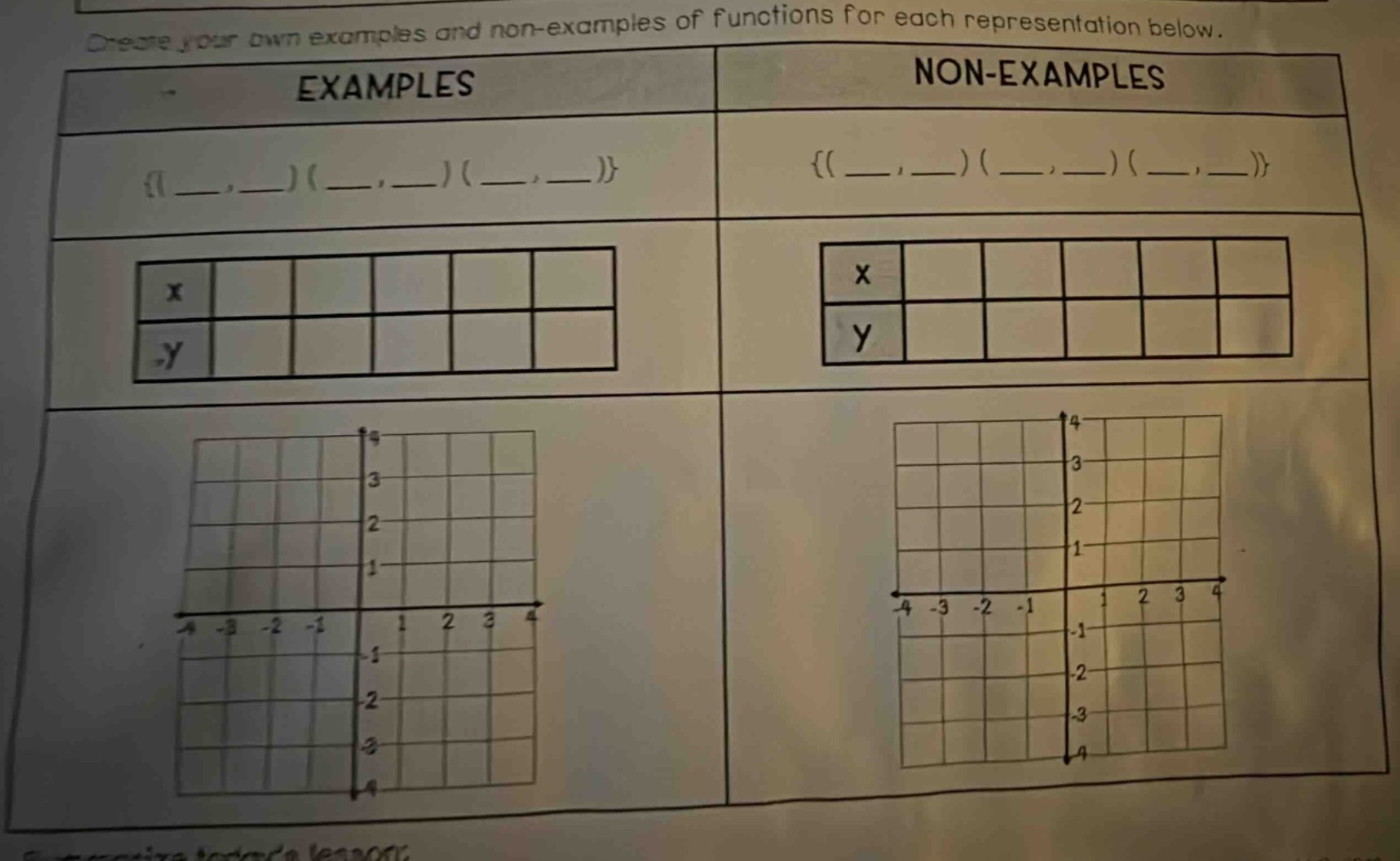
create your own examples and non - examples of functions for each representation below.
examples\tnon - examples
{(,)(,)(,)}\t{(,)(,)(,)}
|x|
| y | \t | x |
|y|
coordinate grid for examples\tcoordinate grid for non - examples
1. Set of Ordered Pairs (Examples and Non - Examples)
Examples (Function)
A function is a relation where each input (first element of the ordered pair) has exactly one output (second element of the ordered pair).
Let's take the set \(\{(1, 2),(2, 3),(3, 4)\}\). Here, the \(x\) - values (1, 2, 3) are all unique, and each has only one corresponding \(y\) - value.
Non - Examples (Not a Function)
A relation that is not a function has at least one input with more than one output. Consider the set \(\{(1, 2),(1, 3),(2, 4)\}\). Here, the input \(x = 1\) is associated with two different output values (\(y=2\) and \(y = 3\)).
2. Table (Examples and Non - Examples)
Examples (Function)
| \(x\) | 1 | 2 | 3 | 4 | 5 |
|---|
In this table, each \(x\) - value (1, 2, 3, 4, 5) has a unique \(y\) - value, so it represents a function.
Non - Examples (Not a Function)
| \(x\) | 1 | 1 | 2 | 3 | 4 |
|---|
Here, the \(x\) - value 1 is associated with two different \(y\) - values (2 and 3), so it does not represent a function.
3. Graph (Examples and Non - Examples)
Examples (Function)
We can draw a graph of the function \(y=x + 1\). For this function, for every \(x\) - value, there is exactly one \(y\) - value. If we use the vertical line test (a vertical line drawn on the graph of a relation will intersect the graph at most once if it is a function), the graph of \(y=x + 1\) will pass the vertical line test. For example, when \(x = 0\), \(y=1\); when \(x = 1\), \(y = 2\), etc. We can plot the points \((0,1)\), \((1,2)\), \((2,3)\) and draw a line through them.
Non - Examples (Not a Function)
A graph of a circle (e.g., \(x^{2}+y^{2}=4\)) is not a function. If we apply the vertical line test, a vertical line (e.g., \(x = 0\)) will intersect the circle at two points \((0, 2)\) and \((0,- 2)\). This means that for the input \(x = 0\), there are two output values (\(y = 2\) and \(y=-2\)), so it is not a function.
Filling the Table in the Image
Set of Ordered Pairs
- Examples: \(\{(1, 2),(2, 3),(3, 4)\}\)
- Non - Examples: \(\{(1, 2),(1, 3),(2, 4)\}\)
Table
- Examples
| \(x\) | 1 | 2 | 3 | 4 | 5 |
|---|
- Non - Examples
| \(x\) | 1 | 1 | 2 | 3 | 4 |
|---|
Graph
- Examples: Plot the points \((0,1)\), \((1,2)\), \((2,3)\) and draw a straight line (for \(y=x + 1\)).
- Non - Examples: Draw the graph of \(x^{2}+y^{2}=4\) (a circle centered at the origin with radius 2).

Snap & solve any problem in the app
Get step-by-step solutions on Sovi AI
Photo-based solutions with guided steps
Explore more problems and detailed explanations
1. Set of Ordered Pairs (Examples and Non - Examples)
Examples (Function)
A function is a relation where each input (first element of the ordered pair) has exactly one output (second element of the ordered pair).
Let's take the set \(\{(1, 2),(2, 3),(3, 4)\}\). Here, the \(x\) - values (1, 2, 3) are all unique, and each has only one corresponding \(y\) - value.
Non - Examples (Not a Function)
A relation that is not a function has at least one input with more than one output. Consider the set \(\{(1, 2),(1, 3),(2, 4)\}\). Here, the input \(x = 1\) is associated with two different output values (\(y=2\) and \(y = 3\)).
2. Table (Examples and Non - Examples)
Examples (Function)
| \(x\) | 1 | 2 | 3 | 4 | 5 |
|---|
In this table, each \(x\) - value (1, 2, 3, 4, 5) has a unique \(y\) - value, so it represents a function.
Non - Examples (Not a Function)
| \(x\) | 1 | 1 | 2 | 3 | 4 |
|---|
Here, the \(x\) - value 1 is associated with two different \(y\) - values (2 and 3), so it does not represent a function.
3. Graph (Examples and Non - Examples)
Examples (Function)
We can draw a graph of the function \(y=x + 1\). For this function, for every \(x\) - value, there is exactly one \(y\) - value. If we use the vertical line test (a vertical line drawn on the graph of a relation will intersect the graph at most once if it is a function), the graph of \(y=x + 1\) will pass the vertical line test. For example, when \(x = 0\), \(y=1\); when \(x = 1\), \(y = 2\), etc. We can plot the points \((0,1)\), \((1,2)\), \((2,3)\) and draw a line through them.
Non - Examples (Not a Function)
A graph of a circle (e.g., \(x^{2}+y^{2}=4\)) is not a function. If we apply the vertical line test, a vertical line (e.g., \(x = 0\)) will intersect the circle at two points \((0, 2)\) and \((0,- 2)\). This means that for the input \(x = 0\), there are two output values (\(y = 2\) and \(y=-2\)), so it is not a function.
Filling the Table in the Image
Set of Ordered Pairs
- Examples: \(\{(1, 2),(2, 3),(3, 4)\}\)
- Non - Examples: \(\{(1, 2),(1, 3),(2, 4)\}\)
Table
- Examples
| \(x\) | 1 | 2 | 3 | 4 | 5 |
|---|
- Non - Examples
| \(x\) | 1 | 1 | 2 | 3 | 4 |
|---|
Graph
- Examples: Plot the points \((0,1)\), \((1,2)\), \((2,3)\) and draw a straight line (for \(y=x + 1\)).
- Non - Examples: Draw the graph of \(x^{2}+y^{2}=4\) (a circle centered at the origin with radius 2).