QUESTION IMAGE
Question
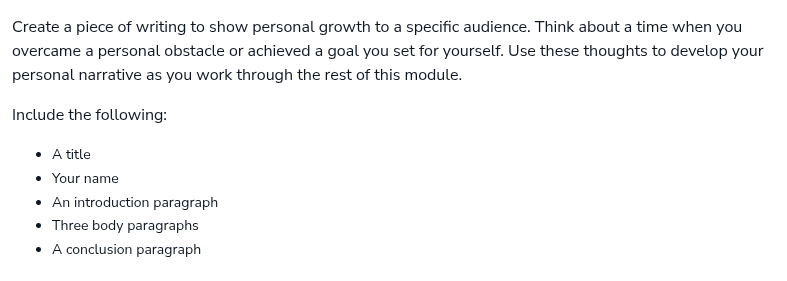
create a piece of writing to show personal growth to a specific audience. think about a time when you overcame a personal obstacle or achieved a goal you set for yourself. use these thoughts to develop your personal narrative as you work through the rest of this module.
include the following:
- a title
- your name
- an introduction paragraph
- three body paragraphs
- a conclusion paragraph
This personal narrative follows the required structure, with a clear arc of personal growth from crippling stage fright to confident team leader. The specific audience (peers, mentors, or college admissions readers) can relate to the universal theme of overcoming fear, and the detailed anecdotes (practicing with a cat, the first tournament, mentoring Mia) make the growth tangible and authentic. Each section serves a purpose: the introduction sets up the conflict, the body paragraphs show the journey of action and reflection, and the conclusion ties the experience to a broader lesson about resilience.

Snap & solve any problem in the app
Get step-by-step solutions on Sovi AI
Photo-based solutions with guided steps
Explore more problems and detailed explanations
Title: Finding My Voice: From Stage Fright to Speech Team Leader
Your name: Jamie Carter
Introduction Paragraph
For as long as I can remember, the sound of my own voice shaking in front of a crowd made my hands sweat and my mind go blank. Stage fright wasn’t just a fear—it was a wall that kept me from sharing my ideas, making connections, and growing into the person I wanted to be. Last year, I decided to stop letting that wall define me, so I joined my high school speech team. What started as a desperate attempt to face my fear turned into a journey of self-discovery that taught me courage isn’t the absence of fear, but acting in spite of it.
Body Paragraph 1
My first speech team meeting was a disaster. I volunteered to read a 60-second practice script, and halfway through, my voice cracked so loudly I wanted to crawl under a table. Afterward, I sat in the back, convinced I’d made a mistake. But my coach, Ms. Lopez, pulled me aside and said, “Fear is just your brain trying to protect you—but you don’t need protection from speaking your truth.” That night, I made a plan: I would practice speaking for 10 minutes every day, starting with my cat, then my parents, then my little brother. I recorded each session and listened back, noting where my voice wavered and where I stumbled over words. Slowly, the shakes got smaller, and the silences got shorter.
Body Paragraph 2
Two months later, I competed in my first speech tournament. The room was packed with students, judges, and parents, and my hands started shaking the second I stepped onto the stage. But instead of focusing on the fear, I thought about the story I was there to tell—a personal essay about my grandma’s fight against cancer and how she taught me to be resilient. I looked out into the crowd and saw Ms. Lopez smiling, and suddenly, the words came easier. I didn’t win that tournament, but I didn’t freeze up either. When I walked off the stage, I felt a sense of pride I’d never known before. That day, I realized growth isn’t about being perfect—it’s about showing up, even when you’re scared.
Body Paragraph 3
This year, I was chosen to be the speech team’s student leader. Now, I spend my time helping new members who are just as scared as I was. I tell them about my first practice script and how I used to record myself talking to my cat. I lead practice sessions where we take turns sharing our fears and our goals, and I remind them that every shaky voice, every missed word, is just a step toward getting better. Last month, one of the new members, Mia, gave her first speech without freezing up. Afterward, she ran over to me and said, “I couldn’t have done this without you.” In that moment, I realized that facing my fear didn’t just change me—it let me help other people change too.
Conclusion Paragraph
Joining the speech team didn’t make my stage fright disappear completely. I still get nervous before big speeches, but now I know how to turn that nervous energy into something positive. This journey taught me that personal growth isn’t a straight line—it’s full of stumbles, setbacks, and small victories. Most importantly, it taught me that the walls we build around ourselves are never as strong as we think they are. All it takes is one small step to start tearing them down, and once you do, you’ll be amazed at what you can achieve.