QUESTION IMAGE
Question
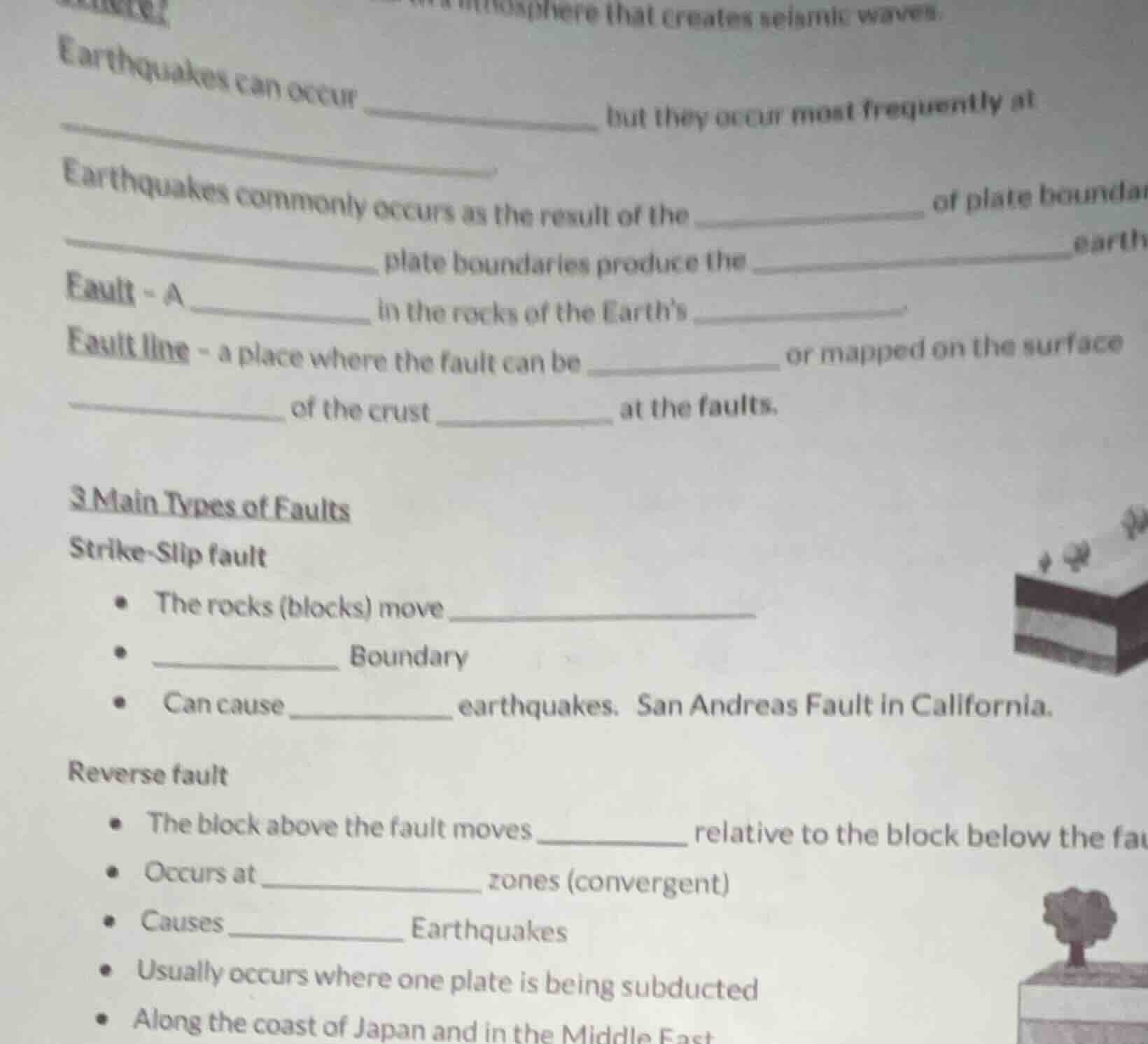
that creates seismic waves. earthquakes can occur ___________ but they occur most frequently at _________. earthquakes commonly occurs as the result of the _______ of plate boundar ___________ plate boundaries produce the ____________earth fault - a ____ in the rocks of the earths ______. fault line - a place where the fault can be _____ or mapped on the surface _____ of the crust ____ at the faults. 3.main types of faults strike - slip fault - the rocks (blocks) move ___________ - _____ boundary - can cause ____ earthquakes. san andreas fault in california. reverse fault - the block above the fault moves ____ relative to the block below the fa - occurs at ______ zones (convergent) - causes ______ earthquakes - usually occurs where one plate is being subducted - along the coast of japan and in the middle east
These fill-in-the-blank questions relate to basic earthquake and fault geology concepts. The answers are based on standard earth science definitions and facts about plate tectonics and fault types.

Snap & solve any problem in the app
Get step-by-step solutions on Sovi AI
Photo-based solutions with guided steps
Explore more problems and detailed explanations
- Earthquakes can occur anywhere on Earth's crust but they occur most frequently at tectonic plate boundaries
- Earthquakes commonly occurs as the result of the movement/activity of plate boundaries. Transform, convergent, and divergent plate boundaries produce the most powerful/damaging earthquakes
- Fault - A fracture/crack in the rocks of the Earth's crust
- Fault line - a place where the fault can be seen/traced or mapped on the surface. Earthquakes occur at the faults.
- Strike-Slip fault
- The rocks (blocks) move horizontally past each other
- Transform Boundary
- Can cause large, shallow-focus earthquakes. San Andreas Fault in California.
- Reverse fault
- The block above the fault moves upward relative to the block below the fault
- Occurs at compression zones (convergent)
- Causes strong, deep-focus Earthquakes