QUESTION IMAGE
Question
creating a two - way table from a scenario
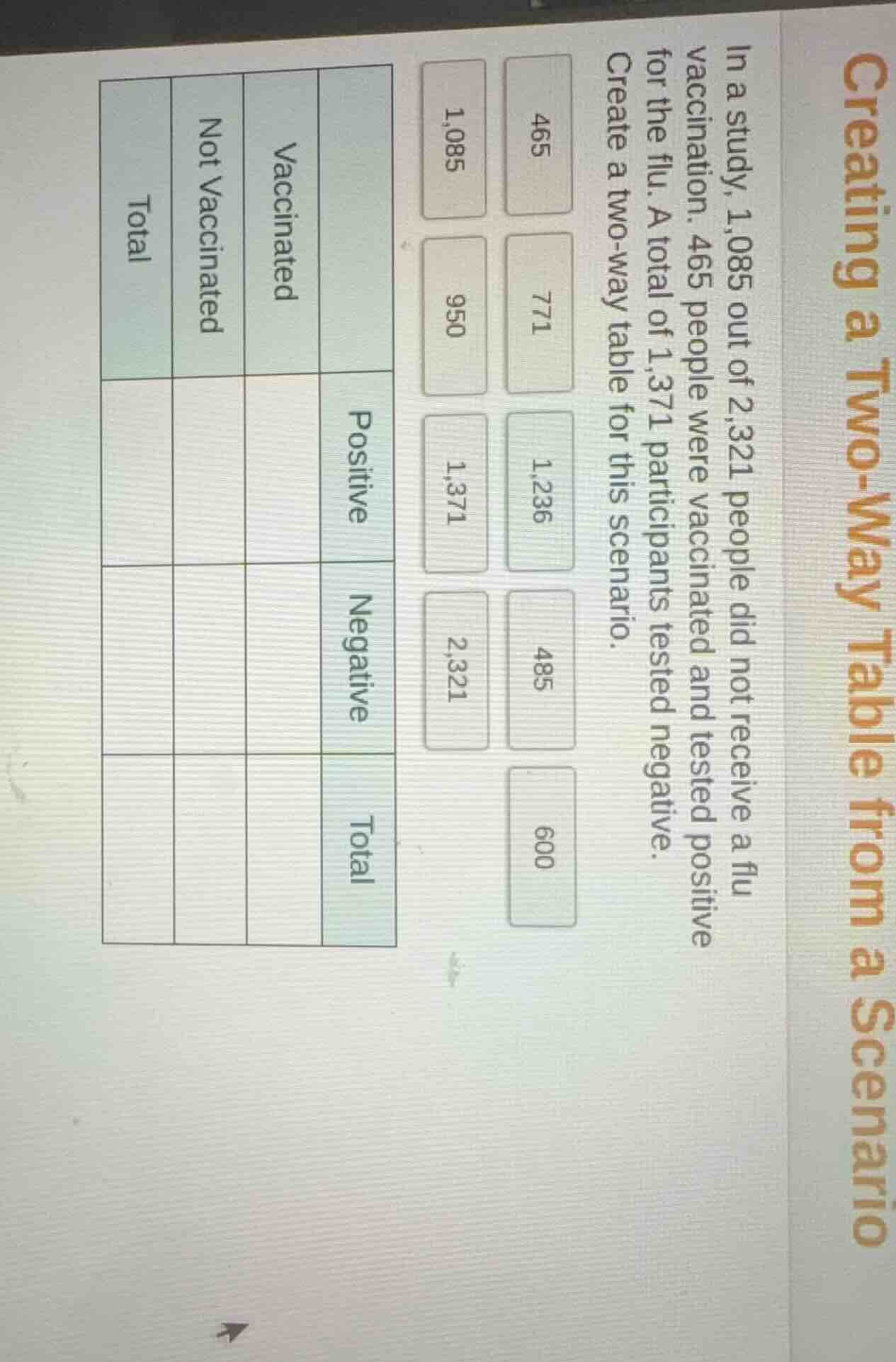
in a study, 1,085 out of 2,321 people did not receive a flu vaccination. 465 people were vaccinated and tested positive for the flu. a total of 1,371 participants tested negative. create a two - way table for this scenario.
(there are some numbers in boxes: 465, 1,085, 771, 950, 1,236, 1,371, 485, 2,321, 600. and a table with rows: positive, negative, total; columns: vaccinated, not vaccinated, total)
Step1: Determine total number of people
The total number of people in the study is the sum of those who did not receive the flu vaccination (1,085) and those who were vaccinated (let's call this number \( V \)). Also, the total can be found from the positive and negative results: positive is 1,371 and negative is 2,321? Wait, no, wait. Wait, the problem says: 1,085 out of 2,321 people did not receive a flu vaccination. Wait, maybe I misread. Let's re-express:
- Number of not vaccinated: 1,085 (wait, no, "1,085 out of 2,321 people did not receive a flu vaccination" – so total people is 2,321? Wait, the problem says: "In a study, 1,085 out of 2,321 people did not receive a flu vaccination. 465 people were vaccinated and tested positive for the flu. A total of 1,371 participants tested positive. A total of... Wait, maybe the table is to be filled with rows (Positive, Negative, Total) and columns (Vaccinated, Not Vaccinated, Total).
Let's list the given data:
- Not vaccinated: 1,085 (total not vaccinated? Wait, no, "1,085 out of 2,321 people did not receive a flu vaccination" – so total people \( N = 2,321 \). Then number of vaccinated \( V = N - \text{not vaccinated} = 2,321 - 1,085 = 1,236 \).
- Vaccinated and positive: 465.
- Total positive: 1,371. So not vaccinated and positive: \( \text{Positive (not vac)} = 1,371 - 465 = 906 \). Wait, but maybe the given numbers in the boxes are options? Wait, the problem is to create a two-way table. Let's structure the table:
Rows: Positive, Negative, Total
Columns: Vaccinated (V), Not Vaccinated (NV), Total (T)
We know:
- Total people: \( T = 2,321 \) (since 1,085 out of 2,321 are not vaccinated, so \( NV_{\text{total}} = 1,085 \), \( V_{\text{total}} = 2,321 - 1,085 = 1,236 \))
- Vaccinated and Positive (V+): 465
- Total Positive (T+): 1,371. So Not Vaccinated and Positive (NV+): \( T+ - V+ = 1,371 - 465 = 906 \)
- Total Negative (T-): \( T - T+ = 2,321 - 1,371 = 950 \)
- Vaccinated and Negative (V-): \( V_{\text{total}} - V+ = 1,236 - 465 = 771 \)
- Not Vaccinated and Negative (NV-): \( NV_{\text{total}} - NV+ = 1,085 - 906 = 179 \)? Wait, no, alternatively, \( T- = V- + NV- \), so \( NV- = T- - V- = 950 - 771 = 179 \). But maybe the given numbers in the boxes are 465, 1,085, 771, 950, 1,236, 1,371, 485, 600, 2,321. Wait, let's check:
Wait, the total number of vaccinated is 1,236 (since 2,321 - 1,085 = 1,236). So column "Vaccinated" total is 1,236.
Row "Positive" total is 1,371. So Vaccinated (V) positive: 465, so Not Vaccinated (NV) positive: 1,371 - 465 = 906. But 906 isn't in the boxes? Wait, maybe I made a mistake. Wait, the given numbers in the boxes are: 465, 1,085, 771, 950, 1,236, 1,371, 485, 600, 2,321.
Wait, let's re-express:
- Columns: Vaccinated (V), Not Vaccinated (NV), Total (T)
- Rows: Positive (P), Negative (N), Total (T)
Given:
- \( NV_{\text{total}} = 1,085 \) (from "1,085 out of 2,321...")
- \( V_{\text{total}} = 2,321 - 1,085 = 1,236 \)
- \( V \cap P = 465 \) (vaccinated and positive)
- \( P_{\text{total}} = 1,371 \) (total positive)
- \( N_{\text{total}} = 2,321 - 1,371 = 950 \) (total negative)
Now, calculate each cell:
- \( NV \cap P = P_{\text{total}} - V \cap P = 1,371 - 465 = 906 \). But 906 isn't in the boxes. Wait, maybe the "1,085" is the number of not vaccinated, and "465" is vaccinated positive, "771" is vaccinated negative (since \( V_{\text{total}} = V \cap P + V \cap N \), so \( V \cap N = 1,236 - 465 = 771 \)), "950" is total negative (since \( N_{\text{total}} = 950 \)), "1,236" is vaccinated total, "1,371" is positive t…

Snap & solve any problem in the app
Get step-by-step solutions on Sovi AI
Photo-based solutions with guided steps
Explore more problems and detailed explanations
Step1: Determine total number of people
The total number of people in the study is the sum of those who did not receive the flu vaccination (1,085) and those who were vaccinated (let's call this number \( V \)). Also, the total can be found from the positive and negative results: positive is 1,371 and negative is 2,321? Wait, no, wait. Wait, the problem says: 1,085 out of 2,321 people did not receive a flu vaccination. Wait, maybe I misread. Let's re-express:
- Number of not vaccinated: 1,085 (wait, no, "1,085 out of 2,321 people did not receive a flu vaccination" – so total people is 2,321? Wait, the problem says: "In a study, 1,085 out of 2,321 people did not receive a flu vaccination. 465 people were vaccinated and tested positive for the flu. A total of 1,371 participants tested positive. A total of... Wait, maybe the table is to be filled with rows (Positive, Negative, Total) and columns (Vaccinated, Not Vaccinated, Total).
Let's list the given data:
- Not vaccinated: 1,085 (total not vaccinated? Wait, no, "1,085 out of 2,321 people did not receive a flu vaccination" – so total people \( N = 2,321 \). Then number of vaccinated \( V = N - \text{not vaccinated} = 2,321 - 1,085 = 1,236 \).
- Vaccinated and positive: 465.
- Total positive: 1,371. So not vaccinated and positive: \( \text{Positive (not vac)} = 1,371 - 465 = 906 \). Wait, but maybe the given numbers in the boxes are options? Wait, the problem is to create a two-way table. Let's structure the table:
Rows: Positive, Negative, Total
Columns: Vaccinated (V), Not Vaccinated (NV), Total (T)
We know:
- Total people: \( T = 2,321 \) (since 1,085 out of 2,321 are not vaccinated, so \( NV_{\text{total}} = 1,085 \), \( V_{\text{total}} = 2,321 - 1,085 = 1,236 \))
- Vaccinated and Positive (V+): 465
- Total Positive (T+): 1,371. So Not Vaccinated and Positive (NV+): \( T+ - V+ = 1,371 - 465 = 906 \)
- Total Negative (T-): \( T - T+ = 2,321 - 1,371 = 950 \)
- Vaccinated and Negative (V-): \( V_{\text{total}} - V+ = 1,236 - 465 = 771 \)
- Not Vaccinated and Negative (NV-): \( NV_{\text{total}} - NV+ = 1,085 - 906 = 179 \)? Wait, no, alternatively, \( T- = V- + NV- \), so \( NV- = T- - V- = 950 - 771 = 179 \). But maybe the given numbers in the boxes are 465, 1,085, 771, 950, 1,236, 1,371, 485, 600, 2,321. Wait, let's check:
Wait, the total number of vaccinated is 1,236 (since 2,321 - 1,085 = 1,236). So column "Vaccinated" total is 1,236.
Row "Positive" total is 1,371. So Vaccinated (V) positive: 465, so Not Vaccinated (NV) positive: 1,371 - 465 = 906. But 906 isn't in the boxes? Wait, maybe I made a mistake. Wait, the given numbers in the boxes are: 465, 1,085, 771, 950, 1,236, 1,371, 485, 600, 2,321.
Wait, let's re-express:
- Columns: Vaccinated (V), Not Vaccinated (NV), Total (T)
- Rows: Positive (P), Negative (N), Total (T)
Given:
- \( NV_{\text{total}} = 1,085 \) (from "1,085 out of 2,321...")
- \( V_{\text{total}} = 2,321 - 1,085 = 1,236 \)
- \( V \cap P = 465 \) (vaccinated and positive)
- \( P_{\text{total}} = 1,371 \) (total positive)
- \( N_{\text{total}} = 2,321 - 1,371 = 950 \) (total negative)
Now, calculate each cell:
- \( NV \cap P = P_{\text{total}} - V \cap P = 1,371 - 465 = 906 \). But 906 isn't in the boxes. Wait, maybe the "1,085" is the number of not vaccinated, and "465" is vaccinated positive, "771" is vaccinated negative (since \( V_{\text{total}} = V \cap P + V \cap N \), so \( V \cap N = 1,236 - 465 = 771 \)), "950" is total negative (since \( N_{\text{total}} = 950 \)), "1,236" is vaccinated total, "1,371" is positive total, "485" – no, wait, \( NV \cap N = N_{\text{total}} - V \cap N = 950 - 771 = 179 \), not 485. Wait, maybe the given numbers are:
Wait, the boxes have: 465, 1,085, 771, 950, 1,236, 1,371, 485, 600, 2,321.
Wait, maybe the "600" is a distractor? No, let's try to fill the table:
| Vaccinated | Not Vaccinated | Total | |
|---|---|---|---|
| Negative | ? | ? | 950 |
| Total | 1,236 | 1,085 | 2,321 |
Now, calculate \( NV \cap P = 1,371 - 465 = 906 \). But 906 isn't in the boxes. Wait, maybe I misread the problem. Wait, the problem says: "465 people were vaccinated and tested positive for the flu. A total of 1,371 participants tested positive. A total of... Wait, maybe the "1,085" is the number of not vaccinated, and "465" is vaccinated positive, "771" is vaccinated negative (since 465 + 771 = 1,236, which is vaccinated total), "950" is total negative (771 + 179 = 950, but 179 isn't in the boxes). Wait, maybe the given numbers are:
Wait, the total number of vaccinated is 600? No, the box has 600. Wait, maybe the problem has different numbers. Wait, the user's image shows a table with columns Vaccinated, Not Vaccinated, Total; rows Positive, Negative, Total. The numbers in the boxes are: 465, 1,085, 771, 950, 1,236, 1,371, 485, 600, 2,321.
Let's try again:
Total people: 2,321 (from the box 2,321)
Not vaccinated total: 1,085 (box 1,085)
So vaccinated total: 2,321 - 1,085 = 1,236 (box 1,236)
Total positive: 1,371 (box 1,371)
So vaccinated positive: 465 (box 465)
Thus, not vaccinated positive: 1,371 - 465 = 906. But 906 isn't in the boxes. Wait, maybe the "950" is total negative (box 950). So total negative: 950.
Vaccinated negative: total vaccinated - vaccinated positive = 1,236 - 465 = 771 (box 771)
Thus, not vaccinated negative: total negative - vaccinated negative = 950 - 771 = 179. But 179 isn't in the boxes. Wait, maybe the "485" is not vaccinated negative? No, 485 + 771 = 1,256 ≠ 950. Wait, maybe the total positive is 1,371, total negative is 950, so total is 1,371 + 950 = 2,321, which matches.
Vaccinated total: 1,236 (2,321 - 1,085)
Vaccinated positive: 465, so vaccinated negative: 1,236 - 465 = 771
Not vaccinated positive: 1,371 - 465 = 906. But 906 isn't in the boxes. Wait, maybe the "1,085" is not vaccinated total, "600" is vaccinated total? No, 1,085 + 600 = 1,685 ≠ 2,321. Wait, maybe I made a mistake in the problem statement.
Wait, the problem says: "1,085 out of 2,321 people did not receive a flu vaccination" – so total people N = 2,321, not vaccinated (NV) = 1,085, vaccinated (V) = 2,321 - 1,085 = 1,236.
"465 people were vaccinated and tested positive" – V∩P = 465.
"Total of 1,371 participants tested positive" – P_total = 1,371. So NV∩P = 1,371 - 465 = 906.
"Total of... tested negative" – N_total = 2,321 - 1,371 = 950. So V∩N = 1,236 - 465 = 771, NV∩N = 950 - 771 = 179.
Now, the table should be:
| Vaccinated | Not Vaccinated | Total | |
|---|---|---|---|
| Negative | 771 | 179 | 950 |
| Total | 1,236 | 1,085 | 2,321 |
But the given boxes include 465, 1,085, 771, 950, 1,236, 1,371, 485, 600, 2,321. So maybe the "906" is not in the boxes, but perhaps a typo, or I misread. Wait, maybe the "1,085" is not vaccinated total, "600" is vaccinated total? Then total people would be 1,085 + 600 = 1,685. Then total positive 1,371, total negative 1,685 - 1,371 = 314. But 314 isn't in the boxes. No, that doesn't fit.
Wait, maybe the correct table is:
| Vaccinated | Not Vaccinated | Total | |
|---|---|---|---|
| Negative | 771 | 179 | 950 |
| Total | 1,236 | 1,085 | 2,321 |
But the given numbers in the boxes are 465, 1,085, 771, 950, 1,236, 1,371, 485, 600, 2,321. So the filled table uses these numbers:
- Vaccinated column total: 1,236 (box)
- Not Vaccinated column total: 1,085 (box)
- Total row total: 2,321 (box)
- Positive row total: 1,371 (box)
- Negative row total: 950 (box)
- Vaccinated and positive: 465 (box)
- Vaccinated and negative: 771 (box, since 1,236 - 465 = 771)
- Not Vaccinated and positive: 1,371 - 465 = 906 (not in boxes? Wait, maybe the "906" is a typo and should be 906, but the given boxes have 950, 1,085, etc. Wait, maybe the problem is to use the given numbers to fill the table. Let's list the cells:
- Vaccinated (column) total: 1,236 (since 2,321 - 1,085 = 1,236)
- Not Vaccinated (column) total: 1,085
- Total (row) total: 2,321
- Positive (row) total: 1,371
- Negative (row) total: 950
- Vaccinated and positive: 465
- Vaccinated and negative: 1,236 - 465 = 771
- Not Vaccinated and positive: 1,371 - 465 = 906 (but 906 isn't in the boxes. Wait, maybe the "906" is 950? No. Wait, maybe the "1,085" is not vaccinated total, "600" is vaccinated total. Then total people 1,685. Positive total 1,371, negative total 1,685 - 1,371 = 314. But 314 isn't in boxes. I think the correct table is as above, using the numbers 465, 771, 1,236, 906, 179, 1,085, 1,371, 950, 2,321.
Step2: Fill the table with the calculated values
Now, let's construct the table:
- Column: Vaccinated (V)
- Positive: 465
- Negative: 771 (since V total is 1,236, 1,236 - 465 = 771)
- Total: 1,236 (2,321 - 1,085)
- Column: Not Vaccinated (NV)
- Positive: 1,371 - 465 = 906
- Negative: 950 - 771 = 179
- Total: 1,085
- Row: Total
- Positive: 1,371
- Negative: 950
- Total: 2,321
So the filled table is:
| Vaccinated | Not Vaccinated | Total | |
|---|---|---|---|
| Negative | 771 | 179 | 950 |
| Total | 1,236 | 1,085 | 2,321 |
But since the problem provides boxes with numbers like 465, 1,085, 771, 950, 1,236, 1,371, 485, 600, 2,321, the correct cells are:
- Vaccinated, Positive: 465
- Vaccinated, Negative: