QUESTION IMAGE
Question
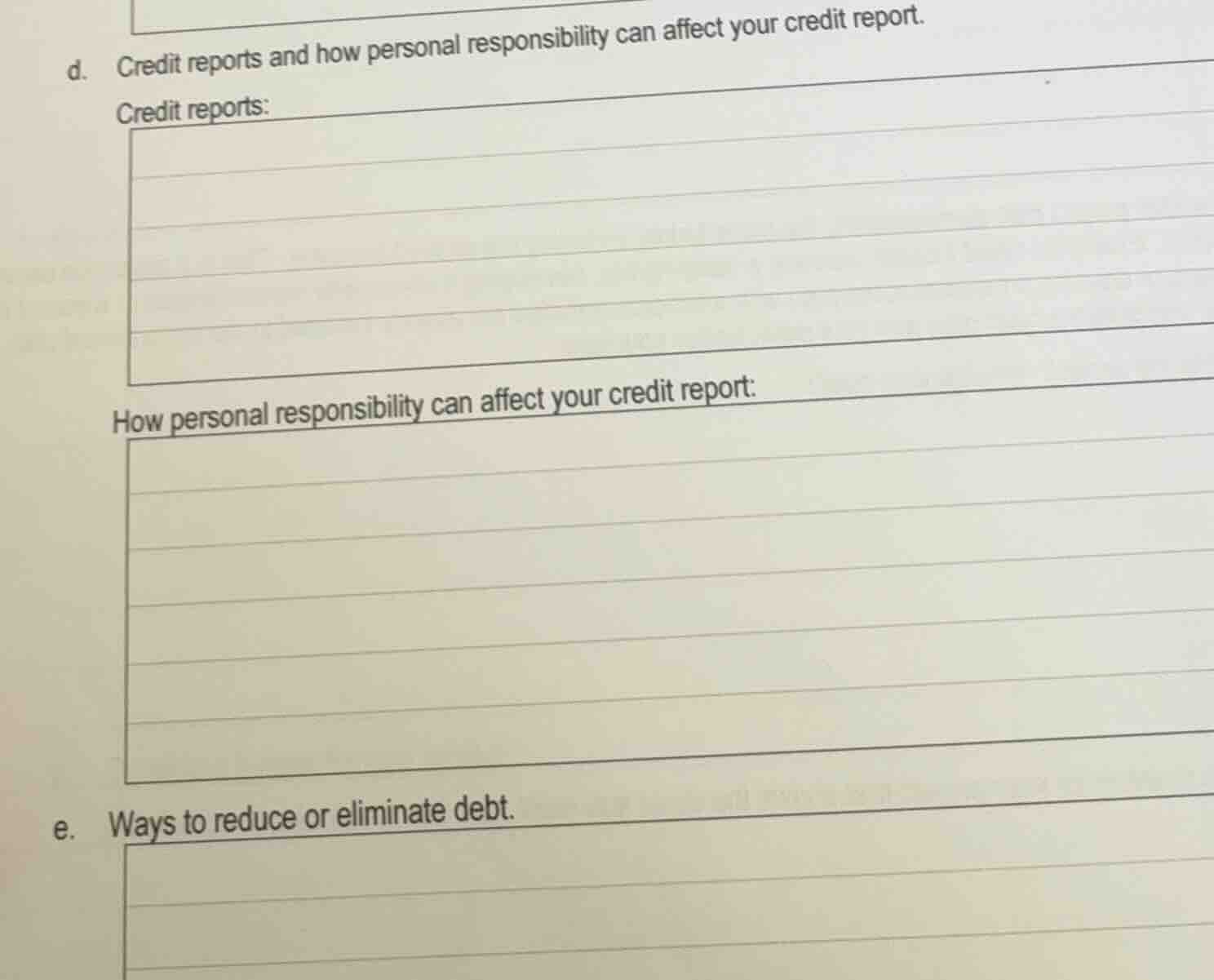
d. credit reports and how personal responsibility can affect your credit report.
credit reports:
how personal responsibility can affect your credit report:
e. ways to reduce or eliminate debt.
Part d - Credit reports and how personal responsibility affects them
Credit reports:
A credit report is a detailed record of an individual’s credit history, compiled by credit bureaus (e.g., Equifax, Experian, TransUnion). It includes:
- Personal information: Name, address, Social Security number, date of birth.
- Credit accounts: Details of loans (mortgages, auto loans), credit cards, payment history (on - time, late, missed payments), account balances, and credit limits.
- Public records: Bankruptcies, tax liens, civil judgments.
- Inquiries: Hard inquiries (when you apply for credit) and soft inquiries (e.g., pre - approved offers, self - checks).
How personal responsibility affects your credit report:
- Payment behavior: Paying bills on time (credit cards, loans, utilities) boosts your credit score and keeps your report positive. Late or missed payments (e.g., 30 + days late) are reported and lower your score.
- Credit utilization: Responsible use of credit (keeping balances below 30% of credit limits) shows good money management. Maxing out cards or high balances harm your report.
- Account management: Closing old accounts (especially without a replacement) can lower your credit age, while keeping old, well - managed accounts open helps. Opening too many new accounts quickly (hard inquiries) signals risk.
- Legal and financial obligations: Fulfilling court - ordered payments (e.g., child support) and avoiding bankruptcies/liens maintains a clean report. Ignoring these leads to negative marks.
Part e - Ways to reduce or eliminate debt
- Budgeting: Create a detailed budget to track income and expenses. Allocate extra funds toward debt repayment. For example, use the 50/30/20 rule (50% needs, 30% wants, 20% debt/savings).
- Debt snowball/avalanche:
- Snowball: Pay off the smallest debt first (for motivation), then roll that payment into the next smallest debt.
- Avalanche: Pay off the debt with the highest interest rate first (saves money on interest long - term), then move to the next highest.
- Negotiation: Contact creditors to negotiate lower interest rates, waived fees, or a revised payment plan (e.g., lower monthly payments for a short period).
- Increasing income: Take on a side job (freelancing, tutoring) or sell unused items to generate extra money for debt repayment.
- Debt consolidation: Combine multiple debts (e.g., credit cards) into a single loan with a lower interest rate (e.g., a personal loan or balance - transfer credit card) to simplify payments and reduce interest costs.
- Avoiding new debt: Stop using credit cards or taking loans while repaying existing debt to prevent the debt from growing.

Snap & solve any problem in the app
Get step-by-step solutions on Sovi AI
Photo-based solutions with guided steps
Explore more problems and detailed explanations
s (Summarized for Clarity)
d. Credit reports:
A record of credit history (accounts, payments, public records, inquiries) from bureaus.
d. How personal responsibility affects:
Payment behavior, credit utilization, account management, and legal obligations directly impact the report.
e. Ways to reduce/eliminate debt:
Budgeting, debt snowball/avalanche, negotiation, increasing income, debt consolidation, and avoiding new debt.