QUESTION IMAGE
Question
creoles felt that they were not treated fairly. this bad feeling boiled over when napoleon overthrew the king of spain and named his own brother as king. creoles in latin america had no loyalty to the new king. they revolted. even after the old king was restored, they did not give up their fight for freedom.
- which class revolted, and why?
the libertadores end spanish rule (page 225)
who were the libertadores?
two leaders pushed much of south america to independence. simón bolívar was a writer, fighter, and political thinker. he survived defeats and exile to help win independence for venezuela in 1821. josé de san martín helped win independence for argentina in 1816 and chile in 1818. bolívar led their combined armies to a great victory in 1824. this victory gained independence for all the spanish colonies.
- which two great leaders led the fights for independence in venezuela, chile, and argentina?
mexico ends spanish rule; brazil’s loyal liberator (pages 227–228)
how did mexico and brazil achieve independence?
in mexico, mestizos and indians led the fight for independence. in 1810, miguel hidalgo, a village priest, called for a revolt against spanish rule. creoles united with the spanish government to put down this revolt by the lower classes.
hidalgo lost, but padre josé maría morelos took over leadership of the rebels. fighting continued until 1815, when the creoles won.
after a revolution in spain put a new government to power, the creoles joined with the other groups fighting for independence. in 1821, mexico’s won its independence. in 1823, the region of central america separated itself from mexico.
in brazil, 8,000 creoles signed a paper asking the son of portugal’s king to rule an independent brazil. he agreed. brazil became free that year through a bloodless revolt.
- how were the drives for independence in mexico and brazil different?
independence brings disunity (page 228)
how did the fight for independence affect latin america?
the rebellions hurt the societies and economies of latin america. turmoil continued in the region. the new countries were split up into smaller units. in 1830, the territory of gran colombia divided into colombia, ecuador, and venezuela. in 1841, the united provinces of central america split into five republics.
- how did territories and countries change as a result of the fight for independence?
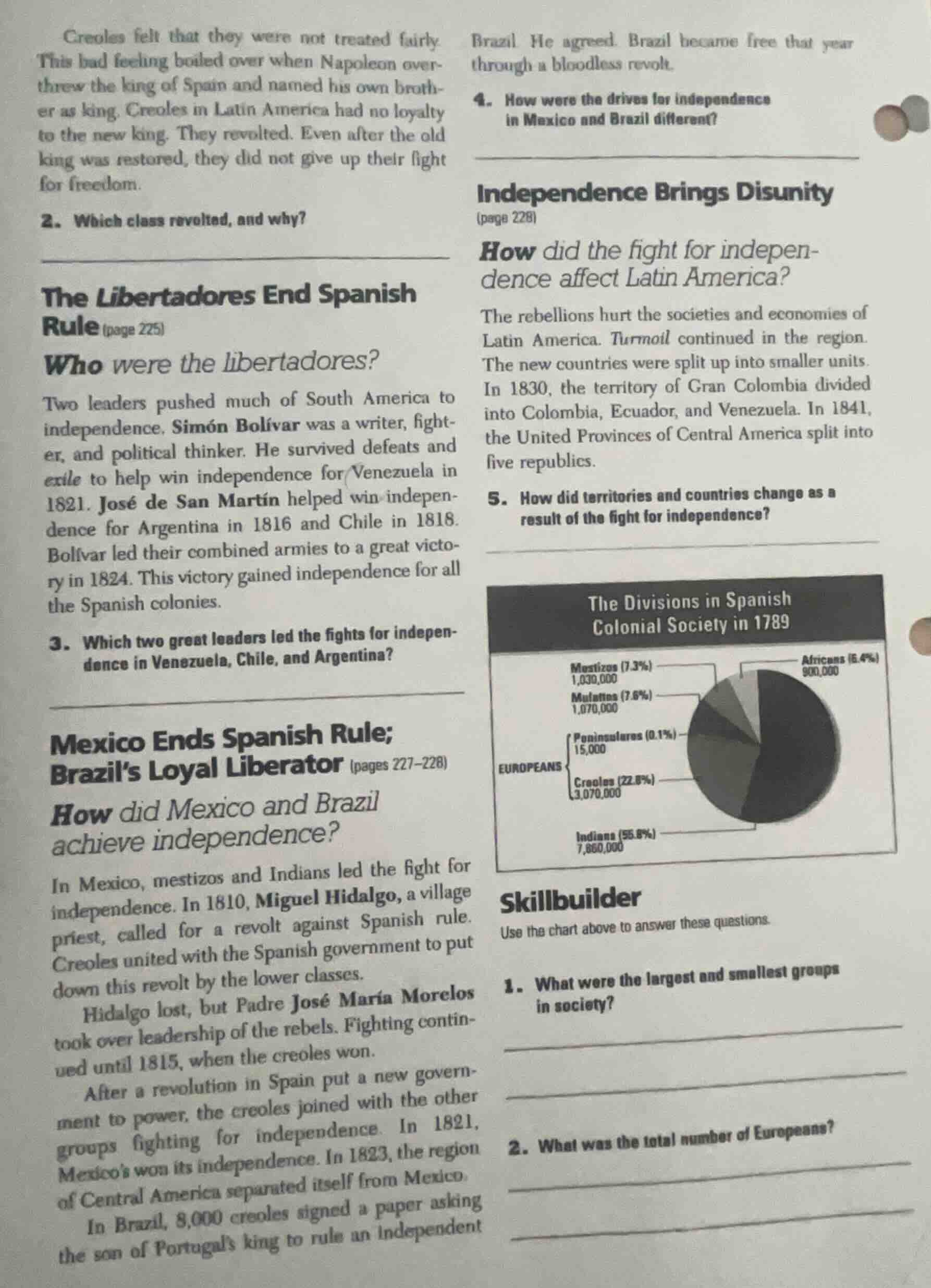
the divisions in spanish colonial society in 1789
chart showing percentages and numbers of different groups: mestizos (7.3%, 1,030,000), mulattos (7.6%, 1,070,000), africans (6.4%, 900,000), peninsulares (0.1%, 15,000), creoles (22.8%, 3,070,000), indians (55.8%, 7,860,000)
skillbuilder
use the chart above to answer these questions.
- what were the largest and smallest groups in society?
- what was the total number of europeans?
Sub - question 1: Which class revolted, and why?
The text says Creoles felt unfairly treated. When Napoleon overthrew the Spanish king and put his brother in power, Creoles in Latin America had no loyalty to the new king, so they revolted. Even after the old king was restored, they continued fighting for freedom.
From the text, Simón Bolívar helped win independence for Venezuela in 1821, and José de San Martín helped win independence for Argentina in 1816 and Chile in 1818. Also, Bolívar led their combined armies to a great victory in 1824 that gained independence for all Spanish colonies.
In Mexico, mestizos and Indians initially led the fight for independence. Miguel Hidalgo, a village priest, called for a revolt in 1810, and later Padre José María Morelos took over. Creoles first united with the Spanish government to put down the lower - class revolt but later joined the fight for independence, and Mexico won independence in 1821. In Brazil, 8,000 creoles signed a paper asking the son of Portugal’s king to rule an independent Brazil, and Brazil became free that year through a bloodless revolt.

Snap & solve any problem in the app
Get step-by-step solutions on Sovi AI
Photo-based solutions with guided steps
Explore more problems and detailed explanations
The Creoles revolted. They felt they were not treated fairly, and when Napoleon overthrew the king of Spain and installed his own brother as king, the Creoles in Latin America had no loyalty to the new king, and they also continued their fight for freedom even after the old king was restored.