QUESTION IMAGE
Question
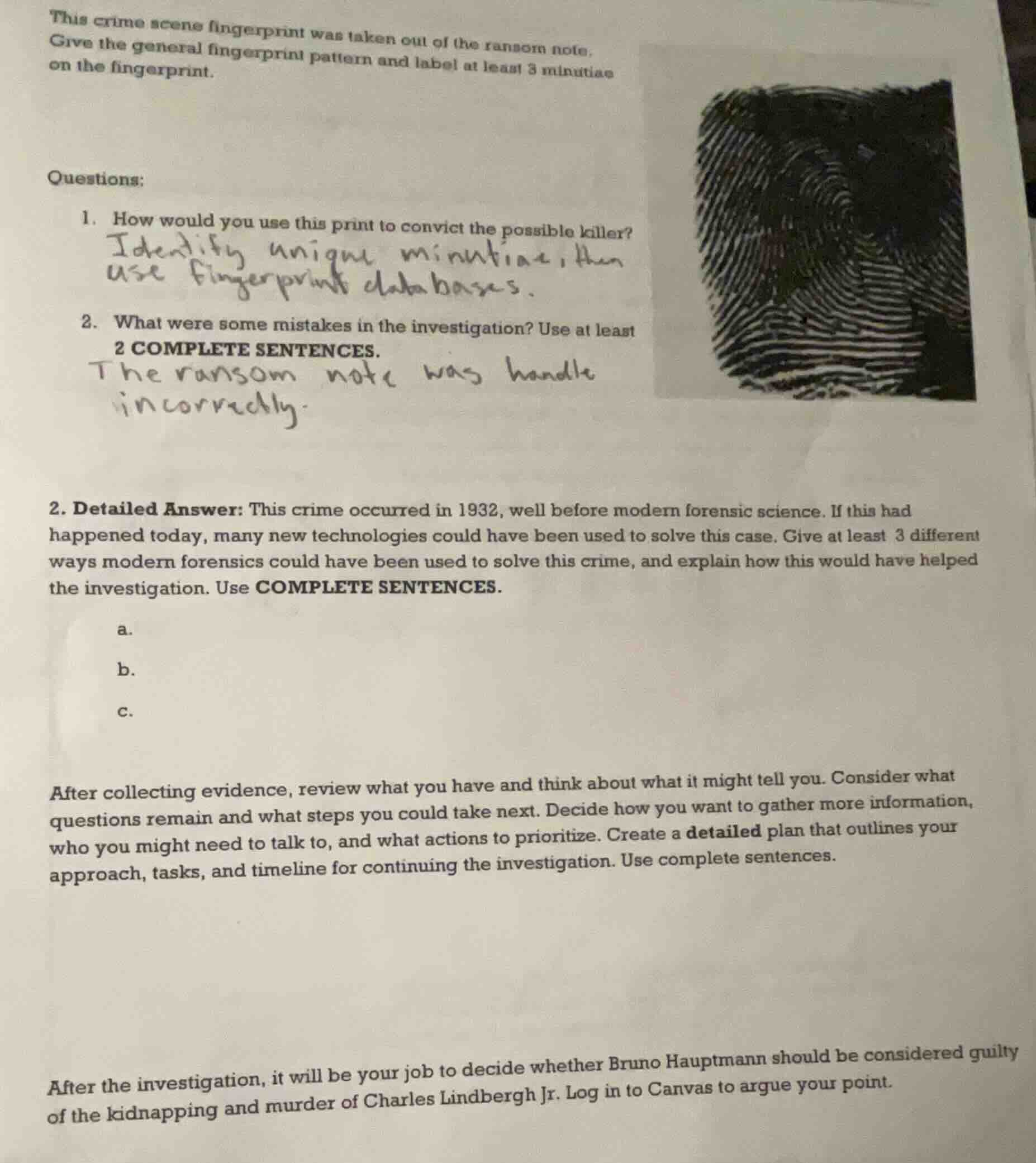
this crime scene fingerprint was taken out of the ransom note. give the general fingerprint pattern and label at least 3 minutiae on the fingerprint. questions: 1. how would you use this print to convict the possible killer? 2. what were some mistakes in the investigation? use at least 2 complete sentences. 2. detailed answer: this crime occurred in 1932, well before modern forensic science. if this had happened today, many new technologies could have been used to solve this case. give at least 3 different ways modern forensics could have been used to solve this crime, and explain how this would have helped the investigation. use complete sentences. a. b. c. after collecting evidence, review what you have and think about what it might tell you. consider what questions remain and what steps you could take next. decide how you want to gather more information, who you might need to talk to, and what actions to prioritize. create a detailed plan that outlines your approach, tasks, and timeline for continuing the investigation. use complete sentences. after the investigation, it will be your job to decide whether bruno hauptmann should be considered guilty of the kidnapping and murder of charles lindbergh jr. log in to canvas to argue your point.
For the modern forensics question (a, b, c):
a. Automated Fingerprint Identification Systems (AFIS) would allow investigators to quickly cross-reference the ransom note fingerprint against a national database of known offenders and persons of interest, drastically cutting down the time needed to identify a match compared to the manual 1932 process, which would immediately narrow down suspects.
b. Forensic document examination using modern spectroscopy and ink analysis could trace the type of ink and paper used in the ransom note to specific manufacturers or retail locations, helping investigators track down where the materials were purchased and identify who bought them.
c. DNA testing could be used on any trace biological evidence (like skin cells, saliva) left on the ransom note or at the crime scene; even tiny amounts of DNA could be amplified via PCR technology to create a profile, which could be cross-referenced with a national DNA database to link a suspect to the scene.
For the investigation plan:
First, within 24 hours, prioritize re-analyzing all existing physical evidence (ransom note, crime scene debris) with modern forensic tools (AFIS, DNA testing, ink analysis) to generate new leads. Next, over 3-5 days, interview individuals connected to the original 1932 investigation, surviving witnesses, and relatives of persons of interest to gather new testimonies or overlooked details. Then, over 1-2 weeks, cross-reference any new forensic matches or witness leads with financial records (modern digital tracking would replace 1932's limited paper trails) to look for suspicious transactions tied to the ransom demand. Finally, over 2-3 weeks, bring in a forensic profiler to create a suspect profile based on combined evidence, and focus surveillance and additional interviews on individuals fitting that profile.

Snap & solve any problem in the app
Get step-by-step solutions on Sovi AI
Photo-based solutions with guided steps
Explore more problems and detailed explanations
Modern Forensics Uses:
a. Automated Fingerprint Identification Systems (AFIS) would cross-reference the ransom note fingerprint with a national database, rapidly identifying potential suspects by matching unique minutiae, which would eliminate weeks of manual comparison work.
b. Modern forensic document analysis with ink spectroscopy would trace the ransom note's ink and paper to specific suppliers, allowing investigators to track where the materials were bought and narrow down who had access to them.
c. PCR-amplified DNA testing would extract and analyze tiny biological traces (skin cells, saliva) from the ransom note or crime scene, creating a DNA profile that could be cross-referenced with national databases to directly link a suspect to the evidence.
Investigation Plan:
- First 24 Hours: Re-test all physical evidence (ransom note, crime scene items) with AFIS, DNA extraction, and ink analysis to generate initial forensic leads.
- Days 3-5: Interview surviving 1932 witnesses, case investigators, and relatives of persons of interest to collect overlooked testimonies or new context.
- Days 6-14: Cross-reference forensic leads with digital financial records (modern equivalent of 1932 paper trails) to identify suspicious transactions linked to the ransom amount.
- Days 15-28: Consult a forensic profiler to build a suspect profile from combined evidence, then target surveillance and follow-up interviews on individuals matching the profile.