QUESTION IMAGE
Question
date:
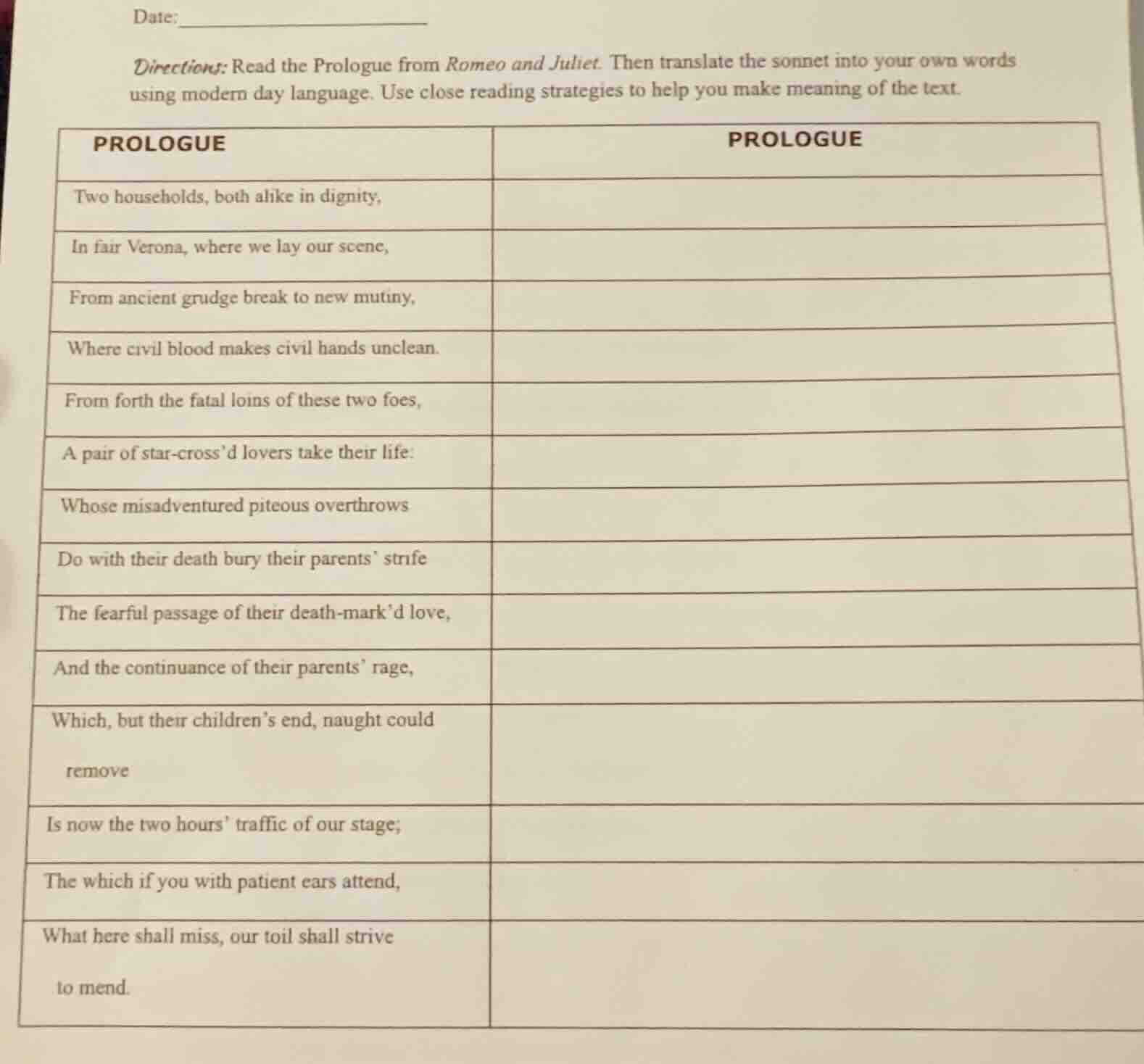
directions: read the prologue from romeo and juliet. then translate the sonnet into your own words using modern day language. use close reading strategies to help you make meaning of the text.
prologue prologue
two households, both alike in dignity,
in fair verona, where we lay our scene,
from ancient grudge break to new mutiny,
where civil blood makes civil hands unclean.
from forth the fatal loins of these two foes,
a pair of star - crossd lovers take their life:
whose misadventured piteous overthrows
do with their death bury their parents strife
the fearful passage of their death - markd love,
and the continuance of their parents rage,
which, but their childrens end, naught could
remove
is now the two hours traffic of our stage;
the which if you with patient ears attend,
what here shall miss, our toil shall strive
to mend.
To solve this, we'll translate each line of the Romeo and Juliet Prologue into modern English by analyzing the meaning of archaic terms and rephrasing for clarity:
Line 1: "Two households, both alike in dignity,"
- "Households" = families. "Alike in dignity" = similar in social status/respectability.
- Modern: Two families, both equal in social standing,
Line 2: "In fair Verona, where we lay our scene,"
- "Fair" = beautiful. "Lay our scene" = set the story.
- Modern: In beautiful Verona, where our story takes place,
Line 3: "From ancient grudge break to new mutiny,"
- "Ancient grudge" = long - standing feud. "Break to new mutiny" = erupt into fresh violence.
- Modern: From an old feud, new violence breaks out,
Line 4: "Where civil blood makes civil hands unclean."
- "Civil blood" = blood of citizens (family members). "Unclean" = stained (with guilt/violence).
- Modern: Where the blood of family members stains their own hands with guilt.
Line 5: "From forth the fatal loins of these two foes,"
- "Fatal loins" = the (destined - to - be - tragic) offspring. "Foes" = enemies (the two families).
- Modern: From the doomed offspring of these two enemies,
Line 6: "A pair of star - cross’d lovers take their life:"
- "Star - cross’d" = ill - fated (by destiny). "Take their life" = commit suicide.
- Modern: A pair of ill - fated lovers kill themselves:
Line 7: "Whose misadventured piteous overthrows"
- "Misadventured" = ill - fated. "Piteous overthrows" = tragic downfalls.
- Modern: Whose tragic and pitiful downfalls
Line 8: "Do with their death bury their parents’ strife"
- "Bury their parents’ strife" = end their parents’ feud.
- Modern: With their deaths, end their parents’ feud.
Line 9: "The fearful passage of their death - mark’d love,"
- "Fearful passage" = dangerous journey. "Death - mark’d" = destined to end in death.
- Modern: The dangerous course of their love, marked for death,
Line 10: "And the continuance of their parents’ rage,"
- "Continuance" = continuation. "Rage" = anger/feud.
- Modern: And the continuation of their parents’ anger,
Line 11: "Which, but their children’s end, naught could remove"
- "Naught" = nothing. "Remove" = end.
- Modern: Which, nothing could end except their children’s deaths.
Line 12: "Is now the two hours’ traffic of our stage;"
- "Traffic" = business/action. "Stage" = the play’s performance.
- Modern: Is now the action of our two - hour play;
Line 13: "The which if you with patient ears attend,"
- "Patient ears attend" = listen patiently.
- Modern: If you listen patiently to this story,
Line 14: "What here shall miss, our toil shall strive to mend."
- "Miss" = be unclear. "Toil" = effort. "Strive to mend" = try to fix.
- Modern: What is unclear here, we will try to make clear.
Final Translated Prologue:
Two families, both equal in social standing,
In beautiful Verona, where our story takes place,
From an old feud, new violence breaks out,
Where the blood of family members stains their own hands with guilt.
From the doomed offspring of these two enemies,
A pair of ill - fated lovers kill themselves:
Whose tragic and pitiful downfalls
With their deaths, end their parents’ feud.
The dangerous course of their love, marked for death,
And the continuation of their parents’ anger,
Which, nothing could end except their children’s deaths.
Is now the action of our two - hour play;
If you listen patiently to this story,
What is unclear here, we will try to make clear.

Snap & solve any problem in the app
Get step-by-step solutions on Sovi AI
Photo-based solutions with guided steps
Explore more problems and detailed explanations
To solve this, we'll translate each line of the Romeo and Juliet Prologue into modern English by analyzing the meaning of archaic terms and rephrasing for clarity:
Line 1: "Two households, both alike in dignity,"
- "Households" = families. "Alike in dignity" = similar in social status/respectability.
- Modern: Two families, both equal in social standing,
Line 2: "In fair Verona, where we lay our scene,"
- "Fair" = beautiful. "Lay our scene" = set the story.
- Modern: In beautiful Verona, where our story takes place,
Line 3: "From ancient grudge break to new mutiny,"
- "Ancient grudge" = long - standing feud. "Break to new mutiny" = erupt into fresh violence.
- Modern: From an old feud, new violence breaks out,
Line 4: "Where civil blood makes civil hands unclean."
- "Civil blood" = blood of citizens (family members). "Unclean" = stained (with guilt/violence).
- Modern: Where the blood of family members stains their own hands with guilt.
Line 5: "From forth the fatal loins of these two foes,"
- "Fatal loins" = the (destined - to - be - tragic) offspring. "Foes" = enemies (the two families).
- Modern: From the doomed offspring of these two enemies,
Line 6: "A pair of star - cross’d lovers take their life:"
- "Star - cross’d" = ill - fated (by destiny). "Take their life" = commit suicide.
- Modern: A pair of ill - fated lovers kill themselves:
Line 7: "Whose misadventured piteous overthrows"
- "Misadventured" = ill - fated. "Piteous overthrows" = tragic downfalls.
- Modern: Whose tragic and pitiful downfalls
Line 8: "Do with their death bury their parents’ strife"
- "Bury their parents’ strife" = end their parents’ feud.
- Modern: With their deaths, end their parents’ feud.
Line 9: "The fearful passage of their death - mark’d love,"
- "Fearful passage" = dangerous journey. "Death - mark’d" = destined to end in death.
- Modern: The dangerous course of their love, marked for death,
Line 10: "And the continuance of their parents’ rage,"
- "Continuance" = continuation. "Rage" = anger/feud.
- Modern: And the continuation of their parents’ anger,
Line 11: "Which, but their children’s end, naught could remove"
- "Naught" = nothing. "Remove" = end.
- Modern: Which, nothing could end except their children’s deaths.
Line 12: "Is now the two hours’ traffic of our stage;"
- "Traffic" = business/action. "Stage" = the play’s performance.
- Modern: Is now the action of our two - hour play;
Line 13: "The which if you with patient ears attend,"
- "Patient ears attend" = listen patiently.
- Modern: If you listen patiently to this story,
Line 14: "What here shall miss, our toil shall strive to mend."
- "Miss" = be unclear. "Toil" = effort. "Strive to mend" = try to fix.
- Modern: What is unclear here, we will try to make clear.
Final Translated Prologue:
Two families, both equal in social standing,
In beautiful Verona, where our story takes place,
From an old feud, new violence breaks out,
Where the blood of family members stains their own hands with guilt.
From the doomed offspring of these two enemies,
A pair of ill - fated lovers kill themselves:
Whose tragic and pitiful downfalls
With their deaths, end their parents’ feud.
The dangerous course of their love, marked for death,
And the continuation of their parents’ anger,
Which, nothing could end except their children’s deaths.
Is now the action of our two - hour play;
If you listen patiently to this story,
What is unclear here, we will try to make clear.