QUESTION IMAGE
Question
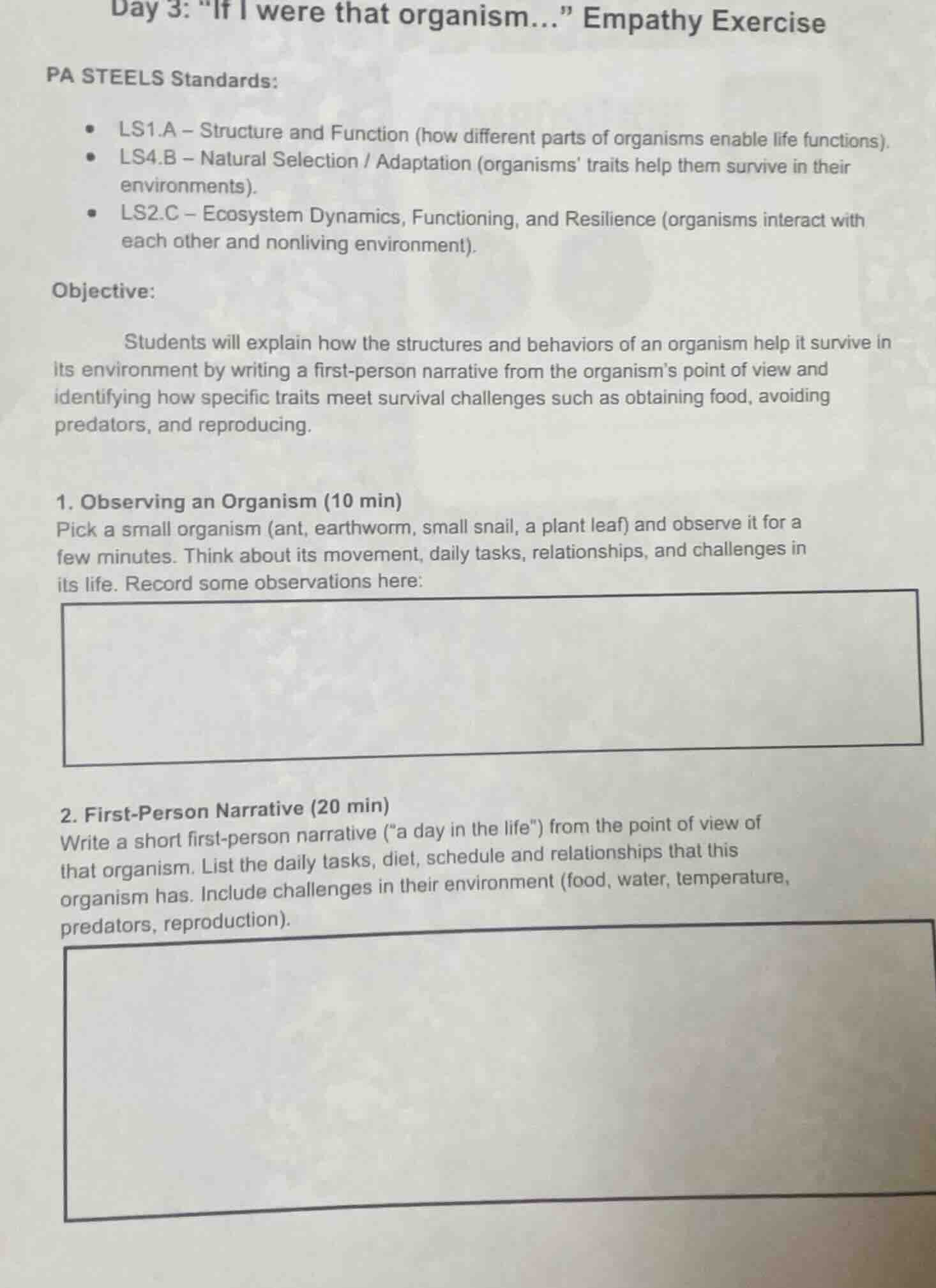
day 3: \if i were that organism...\ empathy exercise
pa steels standards:
- ls1.a – structure and function (how different parts of organisms enable life functions).
- ls4.b – natural selection / adaptation (organisms traits help them survive in their environments).
- ls2.c – ecosystem dynamics, functioning, and resilience (organisms interact with each other and nonliving environment).
objective:
students will explain how the structures and behaviors of an organism help it survive in its environment by writing a first - person narrative from the organisms point of view and identifying how specific traits meet survival challenges such as obtaining food, avoiding predators, and reproducing.
- observing an organism (10 min)
pick a small organism (ant, earthworm, small snail, a plant leaf) and observe it for a few minutes. think about its movement, daily tasks, relationships, and challenges in its life. record some observations here:
text box for observations
- first - person narrative (20 min)
write a short first - person narrative (\a day in the life\) from the point of view of that organism. list the daily tasks, diet, schedule and relationships that this organism has. include challenges in their environment (food, water, temperature, predators, reproduction).
text box for narrative
Part 1: Observing an Organism (Example with a Snail)
To complete the observation, we choose a small snail. We observe its movement (using its muscular foot to glide on a slimy trail), daily tasks (searching for food like decaying leaves or plants, finding shelter), relationships (interacting with its environment, maybe other snails for mating), and challenges (avoiding predators like birds or small mammals, dealing with dry conditions as it needs moisture).
We write a first - person narrative as the snail. We include daily tasks (waking up, finding food, seeking shelter), diet (decaying leaves, plants), schedule (active in moist, cool conditions like early morning or evening), relationships (with other snails, plants, and the environment), and challenges (predators, dryness, reproduction).

Snap & solve any problem in the app
Get step-by-step solutions on Sovi AI
Photo-based solutions with guided steps
Explore more problems and detailed explanations
- Movement: Glides slowly on a slimy trail using its muscular foot.
- Daily Tasks: Searches for food (decaying plant matter), explores the area for shelter (under rocks or leaves).
- Relationships: May interact with other snails during mating season; interacts with plants (eats them, uses them for cover).
- Challenges: Avoiding predators (birds, small mammals), surviving dry weather (needs moisture to stay active), finding enough food.