QUESTION IMAGE
Question
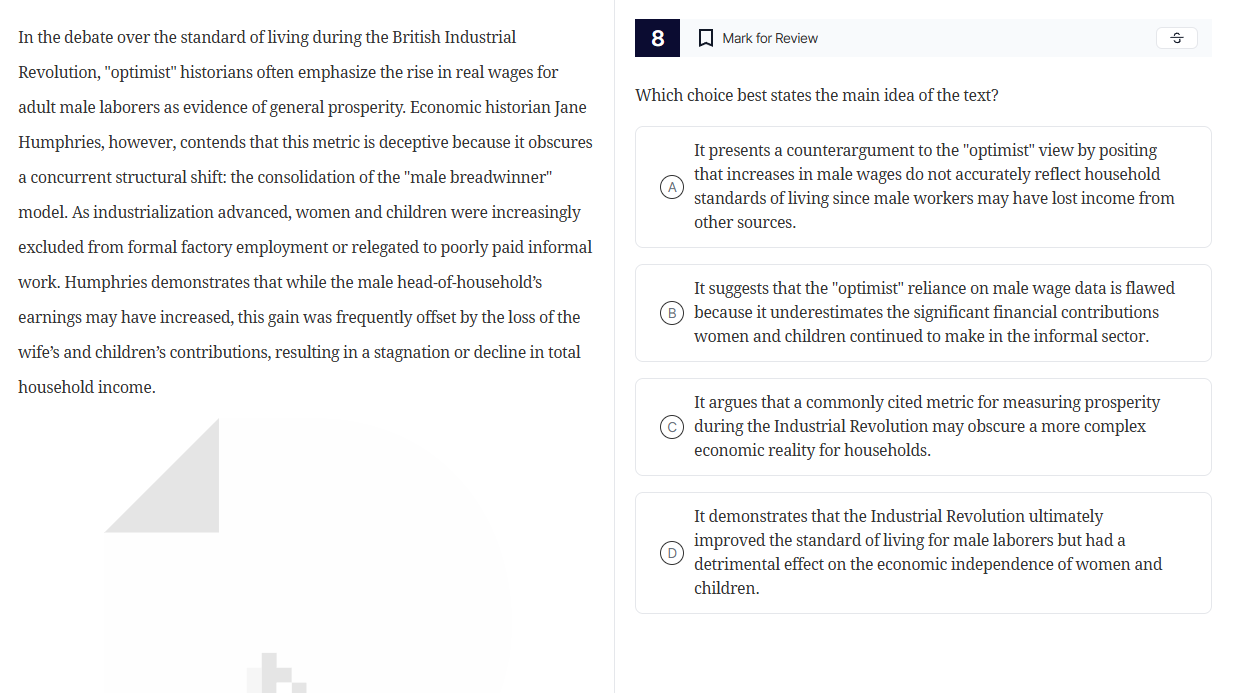
in the debate over the standard of living during the british industrial revolution, \optimist\ historians often emphasize the rise in real wages for adult male laborers as evidence of general prosperity. economic historian jane humphries, however, contends that this metric is deceptive because it obscures a concurrent structural shift: the consolidation of the \male breadwinner\ model. as industrialization advanced, women and children were increasingly excluded from formal factory employment or relegated to poorly paid informal work. humphries demonstrates that while the male head - of - households earnings may have increased, this gain was frequently offset by the loss of the wifes and childrens contributions, resulting in a stagnation or decline in total household income.
8 mark for review
which choice best states the main idea of the text?
a it presents a counterargument to the \optimist\ view by positing that increases in male wages do not accurately reflect household standards of living since male workers may have lost income from other sources.
b it suggests that the \optimist\ reliance on male wage data is flawed because it underestimates the significant financial contributions women and children continued to make in the informal sector.
c it argues that a commonly cited metric for measuring prosperity during the industrial revolution may obscure a more complex economic reality for households.
d it demonstrates that the industrial revolution ultimately improved the standard of living for male laborers but had a detrimental effect on the economic independence of women and children.
- Option A: The text does not mention male workers losing income from other sources, so A is incorrect.
- Option B: The text focuses on the loss of women and children's contributions (not underestimating their informal contributions), so B is incorrect.
- Option C: The text shows that the "optimist" metric (male real wages) obscures the complex reality of household income (due to women and children's lost earnings), so C matches the main idea.
- Option D: The text does not conclude the Industrial Revolution improved male laborers' standard of living (it shows household income might stagnate/decline), so D is incorrect.

Snap & solve any problem in the app
Get step-by-step solutions on Sovi AI
Photo-based solutions with guided steps
Explore more problems and detailed explanations
C. It argues that a commonly cited metric for measuring prosperity during the Industrial Revolution may obscure a more complex economic reality for households.