QUESTION IMAGE
Question
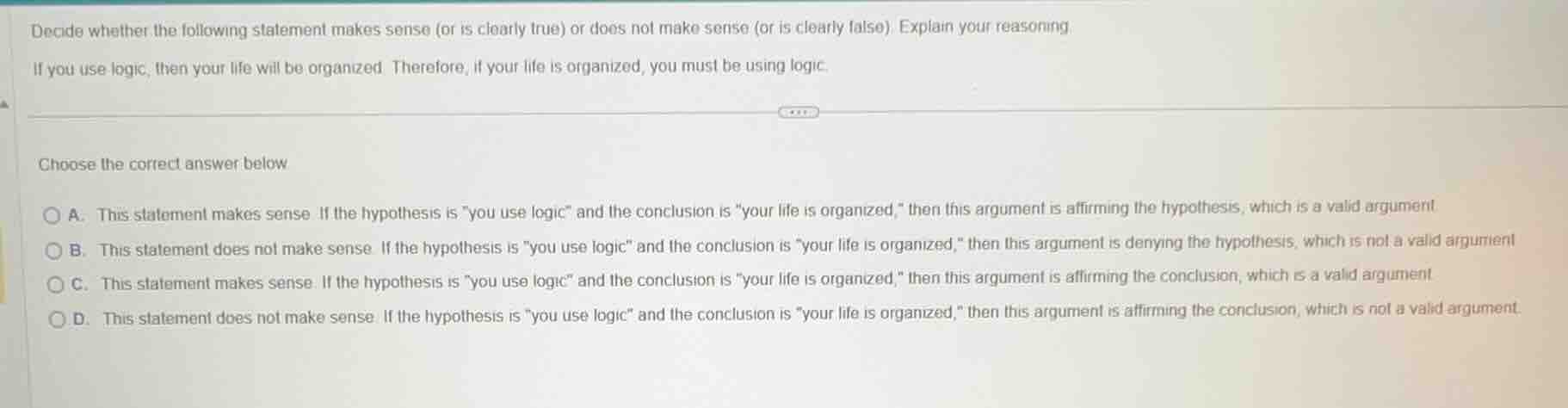
decide whether the following statement makes sense (or is clearly true) or does not make sense (or is clearly false). explain your reasoning.
if you use logic, then your life will be organized. therefore, if your life is organized, you must be using logic.
choose the correct answer below
a. this statement makes sense. if the hypothesis is \you use logic\ and the conclusion is \your life is organized,\ then this argument is affirming the hypothesis, which is a valid argument.
b. this statement does not make sense. if the hypothesis is \you use logic\ and the conclusion is \your life is organized,\ then this argument is denying the hypothesis, which is not a valid argument.
c. this statement makes sense. if the hypothesis is \you use logic\ and the conclusion is \your life is organized,\ then this argument is affirming the conclusion, which is a valid argument.
d. this statement does not make sense. if the hypothesis is \you use logic\ and the conclusion is \your life is organized,\ then this argument is affirming the conclusion, which is not a valid argument.
First, identify the original conditional statement: "If you use logic (hypothesis), then your life will be organized (conclusion)". The second part of the argument is "if your life is organized, you must be using logic", which is affirming the conclusion (the "then" part) and trying to infer the hypothesis (the "if" part). In logic, affirming the conclusion (also called the fallacy of affirming the consequent) is not a valid form of argument. Let's analyze each option:
- Option A: Says it's affirming the hypothesis, but the second statement is using the conclusion to infer the hypothesis, so it's affirming the conclusion, not the hypothesis. Eliminate A.
- Option B: Says it's denying the hypothesis, but the second statement is using the conclusion (life organized) to infer the hypothesis (using logic), not denying the hypothesis. Eliminate B.
- Option C: Claims it's a valid argument, but affirming the conclusion is invalid. Eliminate C.
- Option D: Correctly identifies that the argument is affirming the conclusion and that this is not a valid argument, and also states the statement does not make sense (since the reasoning is invalid).

Snap & solve any problem in the app
Get step-by-step solutions on Sovi AI
Photo-based solutions with guided steps
Explore more problems and detailed explanations
D. This statement does not make sense. If the hypothesis is "you use logic" and the conclusion is "your life is organized," then this argument is affirming the conclusion, which is not a valid argument.