QUESTION IMAGE
Question
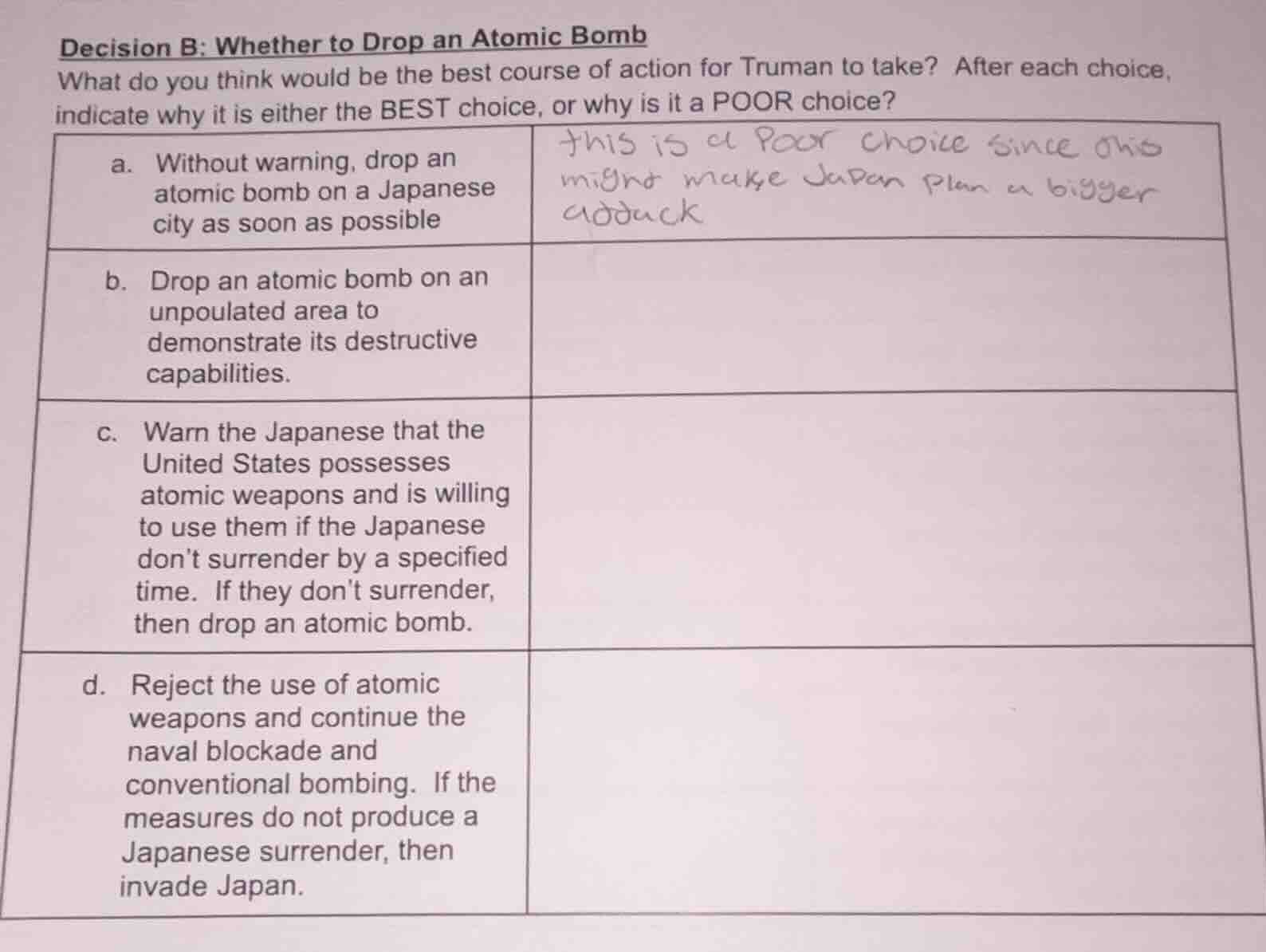
decision b: whether to drop an atomic bomb
what do you think would be the best course of action for truman to take? after each choice,
indicate why it is either the best choice, or why is it a poor choice?
a. without warning, drop an
atomic bomb on a japanese
city as soon as possible
b. drop an atomic bomb on an
unpoulated area to
demonstrate its destructive
capabilities.
c. warn the japanese that the
united states possesses
atomic weapons and is willing
to use them if the japanese
dont surrender by a specified
time. if they dont surrender,
then drop an atomic bomb.
d. reject the use of atomic
weapons and continue the
naval blockade and
conventional bombing. if the
measures do not produce a
japanese surrender, then
invade japan.
Option b
Dropping the atomic bomb on an unpopulated area to demonstrate its power is a better choice compared to option a (which would cause massive civilian casualties immediately without warning) and option d (which could lead to a long - drawn - out war and more casualties from invasion). It gives Japan a chance to see the destructive power without immediately killing many civilians, and it also shows the US's military capability. Option c has the risk that Japan might not believe the warning or might not surrender in time, and then the US would be in a difficult position. So option b is a relatively better choice as it balances showing military strength and minimizing immediate civilian harm.
Warning Japan about the atomic weapons and giving them a chance to surrender is a more ethical choice as it gives Japan an opportunity to avoid the destruction of the atomic bomb. It also shows that the US is willing to give a chance before using such a devastating weapon. However, there is a risk that Japan might not take the warning seriously or might not surrender, but it is a more diplomatic and less immediately destructive option compared to a (which causes immediate civilian deaths) and b (which still uses the atomic bomb, even on an unpopulated area, without giving a surrender chance). Option d could lead to a long war and many more casualties from invasion. So option c is a good choice as it combines a warning with a clear consequence, trying to achieve surrender without immediate mass destruction.
Rejecting atomic weapons and continuing with conventional means first is a more humanitarian choice as it avoids the use of a weapon of mass destruction. The naval blockade and conventional bombing can put pressure on Japan, and invasion is a last resort. However, invasion of Japan would likely cause extremely high casualties on both sides, much more than the atomic bomb in some estimates. But it avoids the moral and humanitarian issues of using atomic weapons on civilians. Compared to a (immediate atomic bomb on a city) and b (using atomic bomb on unpopulated area), it is a more traditional warfare approach, but it has the risk of very high casualties in the long run. Still, it is a choice that values avoiding atomic destruction initially.

Snap & solve any problem in the app
Get step-by-step solutions on Sovi AI
Photo-based solutions with guided steps
Explore more problems and detailed explanations
b. Drop an atomic bomb on an unpopulated area to demonstrate its destructive capabilities.