QUESTION IMAGE
Question
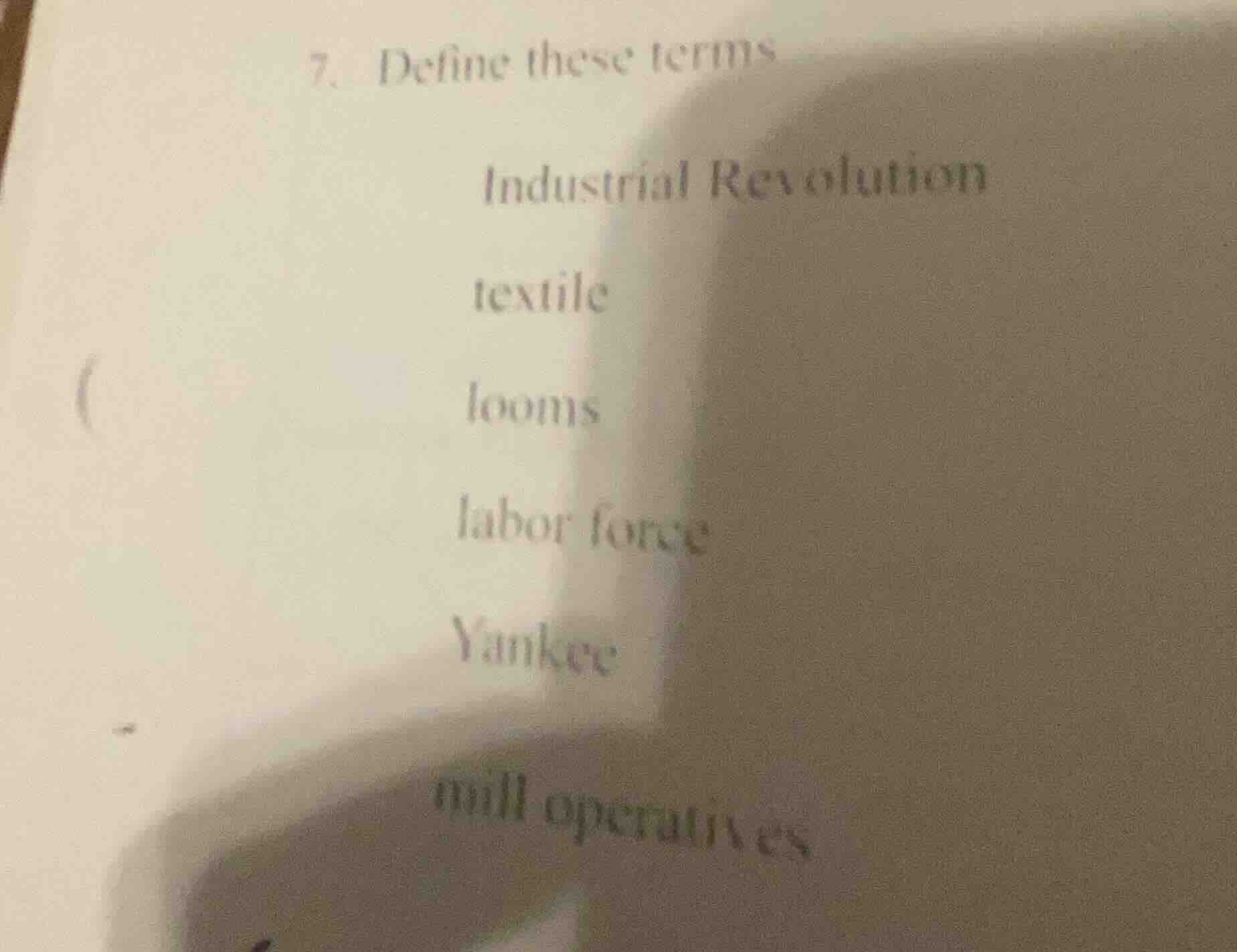
- define these terms
industrial revolution
textile
looms
labor force
yankee
mill operatives
Brief Explanations
- Industrial Revolution: A period of major technological, economic, and social shift starting in late 18th-century Britain, moving from agrarian, handcraft-based economies to machine manufacturing and industrial production.
- textile: A type of woven, knitted, or felted fabric made from natural or synthetic fibers, used for clothing, upholstery, and other goods.
- looms: A mechanical or electronic device used to weave threads or fibers into textiles.
- labor force: The total number of people who are either employed or actively seeking employment in an economy or industry.
- Yankee: In a 19th-century U.S. context, a term for a person from the northern United States; more broadly, a colloquial term for an American.
- mill operatives: Workers employed in a mill (typically a textile mill) who operate machinery or perform tasks related to manufacturing goods like textiles.

Snap & solve any problem in the app
Get step-by-step solutions on Sovi AI
Photo-based solutions with guided steps
Explore more problems and detailed explanations
- Industrial Revolution: A period of 18th/19th-century shift from agrarian to machine-based industrial economies, originating in Britain.
- textile: A fabric made from woven, knitted, or felted natural/synthetic fibers.
- looms: A device used to weave threads into textiles.
- labor force: Employed and job-seeking individuals in an economy/industry.
- Yankee: A term for a northern U.S. resident (19th c.) or broadly, an American.
- mill operatives: Workers employed in a mill (often textile) to operate machinery or perform manufacturing tasks.