QUESTION IMAGE
Question
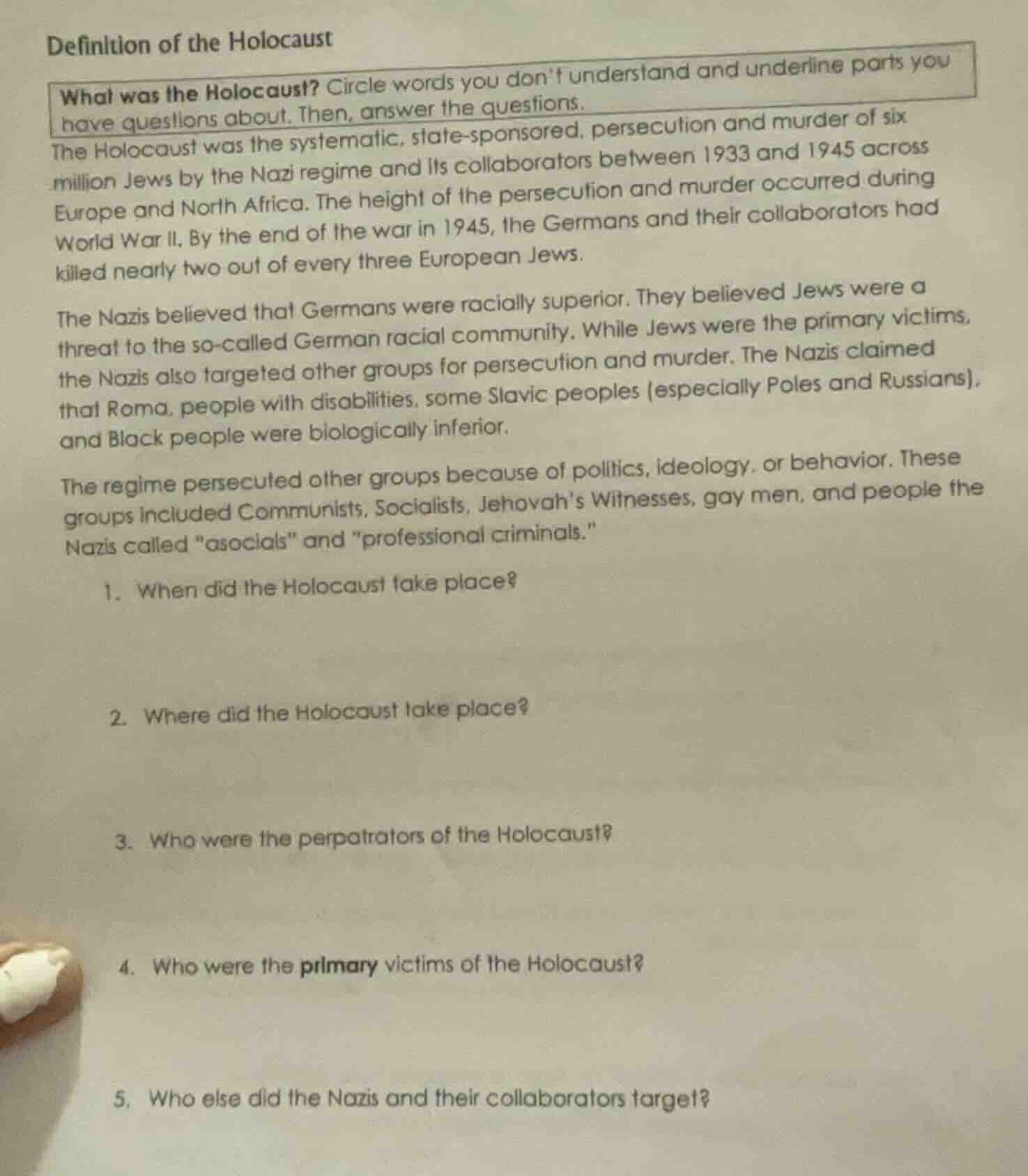
definition of the holocaust
what was the holocaust? circle words you dont understand and underline parts you
have questions about. then, answer the questions.
the holocaust was the systematic, state - sponsored, persecution and murder of six
million jews by the nazi regime and its collaborators between 1933 and 1945 across
europe and north africa. the height of the persecution and murder occurred during
world war ii. by the end of the war in 1945, the germans and their collaborators had
killed nearly two out of every three european jews.
the nazis believed that germans were racially superior. they believed jews were a
threat to the so - called german racial community. while jews were the primary victims,
the nazis also targeted other groups for persecution and murder. the nazis claimed
that roma, people with disabilities, some slavic peoples (especially poles and russians),
and black people were biologically inferior.
the regime persecuted other groups because of politics, ideology, or behavior. these
groups included communists, socialists, jehovahs witnesses, gay men, and people the
nazis called \asocials\ and \professional criminals.\
- when did the holocaust take place?
- where did the holocaust take place?
- who were the perpetrators of the holocaust?
- who were the primary victims of the holocaust?
- who else did the nazis and their collaborators target?
All answers are directly sourced from the provided text about the Holocaust.
- The time period is stated in the first paragraph of the definition.
- The location is specified in the first paragraph.
- The perpetrators are identified in the first paragraph as the organizing forces behind the Holocaust.
- The primary victims are named early in the second paragraph.
- Additional targeted groups are listed in the second and third paragraphs of the text.

Snap & solve any problem in the app
Get step-by-step solutions on Sovi AI
Photo-based solutions with guided steps
Explore more problems and detailed explanations
- Between 1933 and 1945, with the height during World War II.
- Across Europe and North Africa.
- The Nazi regime and its collaborators.
- Jews (nearly two out of every three European Jews were killed by 1945).
- Roma, people with disabilities, some Slavic peoples (especially Poles and Russians), Black people, Communists, Socialists, Jehovah's Witnesses, gay men, and people the Nazis called "asocials" and "professional criminals."