QUESTION IMAGE
Question
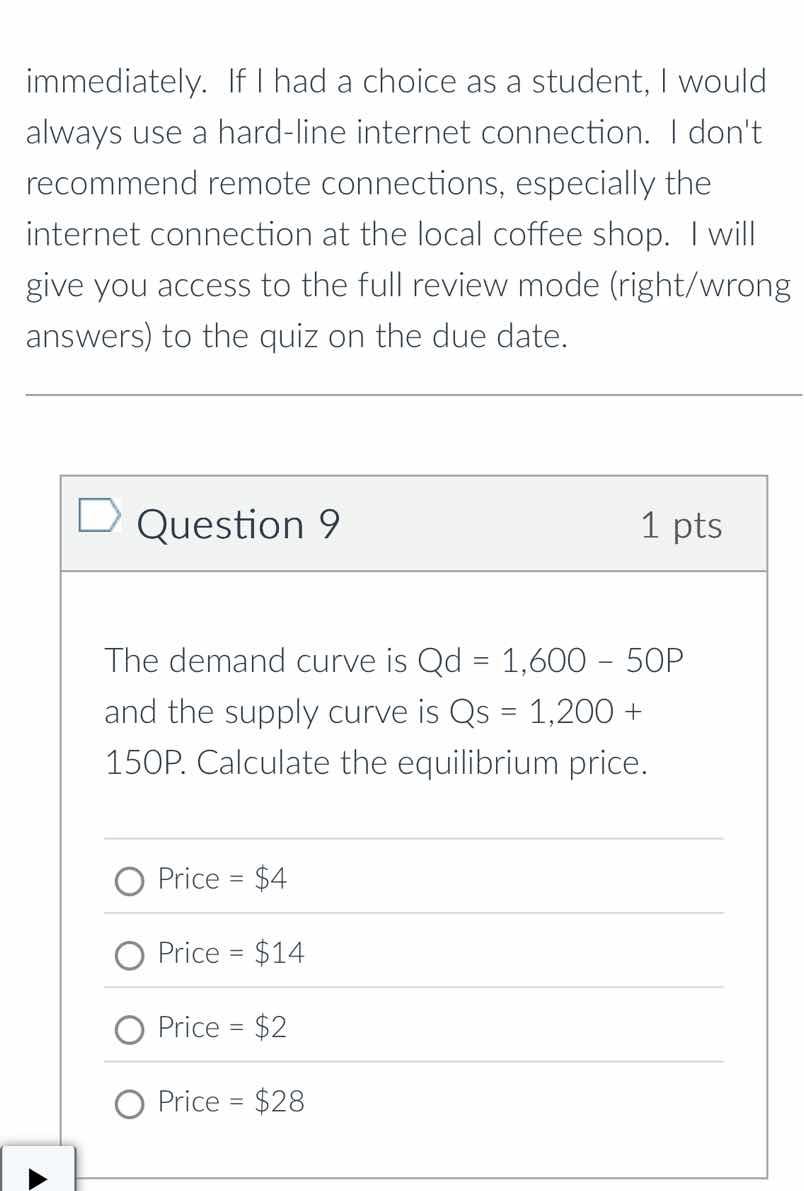
the demand curve is qd = 1,600 - 50p and the supply curve is qs = 1,200 + 150p. calculate the equilibrium price.
price = $4
price = $14
price = $2
price = $28
Step1: Set Qd = Qs (Equilibrium condition)
At equilibrium, quantity demanded (\(Q_d\)) equals quantity supplied (\(Q_s\)). So we set \(1600 - 50P = 1200 + 150P\).
Step2: Solve for P
First, add \(50P\) to both sides:
\(1600 = 1200 + 150P + 50P\)
Simplify the right side:
\(1600 = 1200 + 200P\)
Then, subtract \(1200\) from both sides:
\(1600 - 1200 = 200P\)
\(400 = 200P\)
Finally, divide both sides by \(200\):
\(P = \frac{400}{200} = 2\)? Wait, no—wait, let's check again. Wait, \(1600 - 1200 = 400\), \(150P + 50P = 200P\), so \(400 = 200P\) → \(P = 2\)? But wait, let's re-express the equations. Wait, no, maybe I made a mistake. Wait, \(Q_d = 1600 - 50P\), \(Q_s = 1200 + 150P\). Set equal:
\(1600 - 50P = 1200 + 150P\)
Bring variables to one side and constants to the other:
\(1600 - 1200 = 150P + 50P\)
\(400 = 200P\)
\(P = 400 / 200 = 2\)? But the options include $2. Wait, but let's check with \(P=2\):
\(Q_d = 1600 - 50(2) = 1600 - 100 = 1500\)
\(Q_s = 1200 + 150(2) = 1200 + 300 = 1500\). Yes, that works. Wait, but the options have Price = $2 as an option. Wait, but maybe I miscalculated earlier. Wait, the options are $4, $14, $2, $28. So with \(P=2\), it works. Wait, but let's check again. Wait, the equations:
\(1600 - 50P = 1200 + 150P\)
\(1600 - 1200 = 150P + 50P\)
\(400 = 200P\)
\(P = 2\). So the equilibrium price is $2.

Snap & solve any problem in the app
Get step-by-step solutions on Sovi AI
Photo-based solutions with guided steps
Explore more problems and detailed explanations
Price = $2