QUESTION IMAGE
Question
deriving a formula for volume of a pyramid
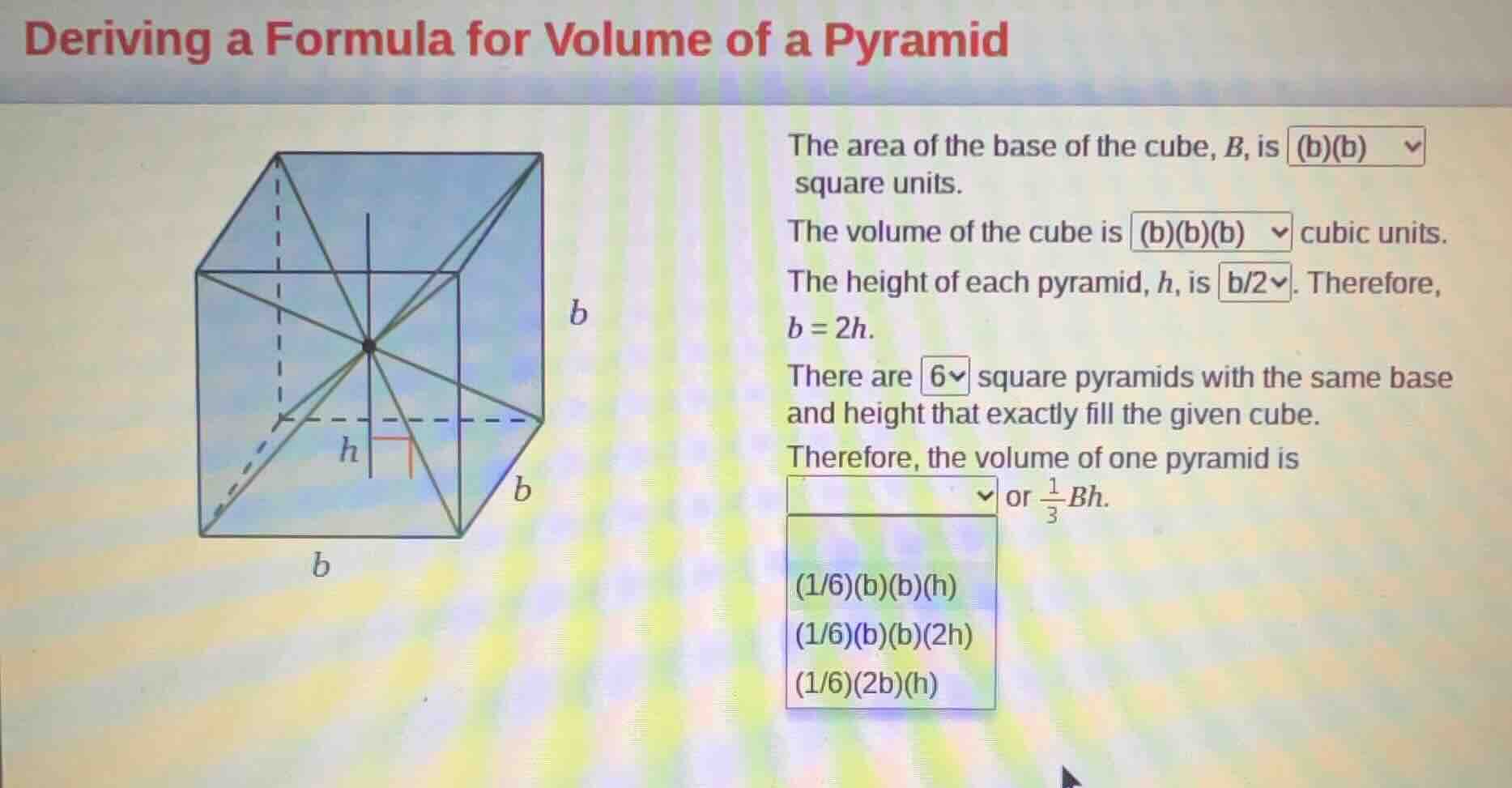
the area of the base of the cube, b, is (b)(b) square units.
the volume of the cube is (b)(b)(b) cubic units.
the height of each pyramid, h, is b/2. therefore, b = 2h.
there are 6 square pyramids with the same base and height that exactly fill the given cube.
therefore, the volume of one pyramid is
(1/6)(b)(b)(h)
(1/6)(b)(b)(2h)
(1/6)(2b)(h)
or \\(\frac{1}{3}bh\\).
Step1: Recall cube and pyramid volume relation
The volume of the cube is \( V_{\text{cube}}=(b)(b)(b) \). There are 6 pyramids filling the cube, so volume of one pyramid \( V_{\text{pyramid}}=\frac{1}{6}V_{\text{cube}} \). But we know \( b = 2h \), so substitute \( b \) with \( 2h \) in the cube volume for pyramid's volume.
Step2: Substitute \( b = 2h \) into the formula
\( V_{\text{pyramid}}=\frac{1}{6}(b)(b)(b) \), replace \( b \) with \( 2h \): \( \frac{1}{6}(b)(b)(2h) \) (since \( b = 2h \), so the third \( b \) is \( 2h \), wait, actually, original cube side is \( b \), height of pyramid \( h=\frac{b}{2} \), so \( b = 2h \). So volume of cube is \( b^3=(2h)^3 \)? Wait no, earlier steps: the cube has side \( b \), volume \( b^3 \). There are 6 pyramids, so each pyramid's volume is \( \frac{1}{6}b^3 \). But since \( b = 2h \), substitute \( b = 2h \) into \( \frac{1}{6}b^3 \): \( \frac{1}{6}(2h)^3 \)? No, wait the options: let's check the options. The options are \( \frac{1}{6}(b)(b)(h) \), \( \frac{1}{6}(b)(b)(2h) \), \( \frac{1}{6}(2b)(h) \). Wait, the height of the pyramid is \( h=\frac{b}{2} \), so \( b = 2h \). The volume of the cube is \( b\times b\times b \). There are 6 pyramids, so each pyramid's volume is \( \frac{1}{6}\times b\times b\times b \). But since \( b = 2h \), we can write \( b\times b\times b = b\times b\times(2h) \) (because \( b = 2h \), so the third dimension is \( b = 2h \)). Wait, no, the cube's volume is \( b^3 \), and each pyramid has volume \( \frac{1}{6}b^3 \). But since \( h=\frac{b}{2} \), then \( b = 2h \), so substitute \( b = 2h \) into \( \frac{1}{6}b^3 \): \( \frac{1}{6}(2h)^3 \) is not an option. Wait, maybe I misread. Wait the problem says "the volume of one pyramid is [option] or \( \frac{1}{3}Bh \)". Let's recall \( B = b\times b \), so \( \frac{1}{3}Bh=\frac{1}{3}(b\times b)h \). Now let's check the options:
Option 1: \( \frac{1}{6}(b)(b)(h) \): \( \frac{1}{6}b^2h \), but \( \frac{1}{3}b^2h \) is the formula, so no.
Option 2: \( \frac{1}{6}(b)(b)(2h) \): \( \frac{1}{6}b^2\times 2h=\frac{1}{3}b^2h \), which matches \( \frac{1}{3}Bh \) (since \( B = b^2 \)).
Option 3: \( \frac{1}{6}(2b)(h) \): \( \frac{1}{3}bh \), not matching.
So the correct substitution: since \( b = 2h \), then in \( \frac{1}{6}b^3 \), \( b^3 = b\times b\times b = b\times b\times 2h \) (because \( b = 2h \), so the third \( b \) is \( 2h \)). So \( \frac{1}{6}\times b\times b\times 2h \), which is \( \frac{1}{6}(b)(b)(2h) \).

Snap & solve any problem in the app
Get step-by-step solutions on Sovi AI
Photo-based solutions with guided steps
Explore more problems and detailed explanations
\(\frac{1}{6}(b)(b)(2h)\) (the second option)