QUESTION IMAGE
Question
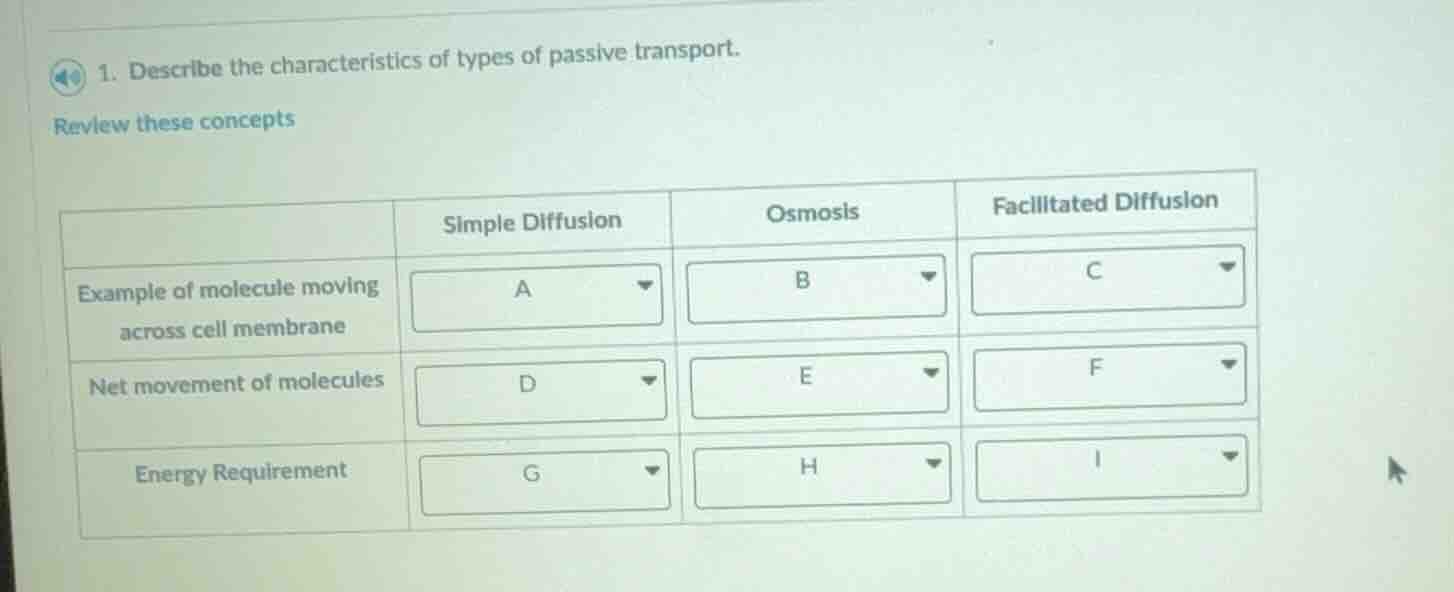
- describe the characteristics of types of passive transport.
review these concepts
| simple diffusion | osmosis | facilitated diffusion | |
|---|---|---|---|
| net movement of molecules | d | e | f |
| energy requirement | g | h | i |
Brief Explanations
Each type of passive transport has distinct defining features:
- Simple Diffusion: Small, nonpolar molecules move directly through the phospholipid bilayer down their concentration gradient, no energy needed.
- Osmosis: A specialized form of passive transport limited to water molecules, moving across a semipermeable membrane to balance solute concentrations, no energy needed.
- Facilitated Diffusion: Larger or polar molecules use integral membrane proteins (channels/carriers) to move down their concentration gradient, no energy needed.

Snap & solve any problem in the app
Get step-by-step solutions on Sovi AI
Photo-based solutions with guided steps
Explore more problems and detailed explanations
| Category | Simple Diffusion | Osmosis | Facilitated Diffusion |
|---|---|---|---|
| Net movement of molecules | D. Down the concentration gradient (high to low) | E. Down the water potential gradient (low solute to high solute concentration) | F. Down the concentration gradient (high to low, via transport proteins) |
| Energy Requirement | G. No cellular energy (ATP) required | H. No cellular energy (ATP) required | I. No cellular energy (ATP) required |