QUESTION IMAGE
Question
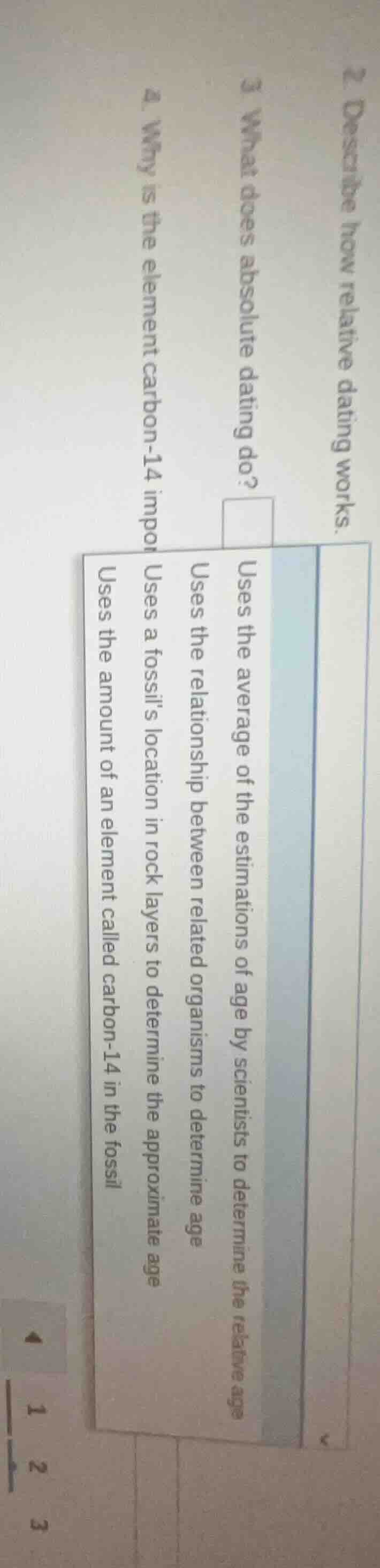
2 describe how relative dating works.
3 what does absolute dating do?
4 why is the element carbon - 14 impor
uses the average of the estimations of age by scientists to determine the relative age
uses the relationship between related organisms to determine age
uses a fossil’s location in rock layers to determine the approximate age
uses the amount of an element called carbon - 14 in the fossil
Brief Explanations
- Relative dating estimates the age of fossils/rock layers by comparing their position to other fossils/rocks (deeper layers are older) and using relationships between related organisms to establish a sequence of ages.
- Absolute dating provides a numerical age estimate for fossils or rocks, often using radioactive isotopes like carbon-14 to measure decay over time.
- Carbon-14 is important because it is a radioactive isotope that can be used in absolute dating to determine the precise age of once-living organic materials by measuring the remaining amount of carbon-14, since it decays at a known constant rate.

Snap & solve any problem in the app
Get step-by-step solutions on Sovi AI
Photo-based solutions with guided steps
Explore more problems and detailed explanations
- Relative dating works by using the relationship between related organisms to determine age, and also uses a fossil's location in rock layers to determine the approximate age (deeper layers indicate older fossils relative to shallower ones).
- Uses the amount of an element called carbon-14 in the fossil (and other radioactive isotopes) to determine a precise numerical age of a fossil or rock sample.
- Carbon-14 is important because it is a radioactive isotope with a known half-life that allows scientists to perform absolute dating on once-living organisms, calculating their exact age by measuring the remaining carbon-14 in the fossil.