QUESTION IMAGE
Question
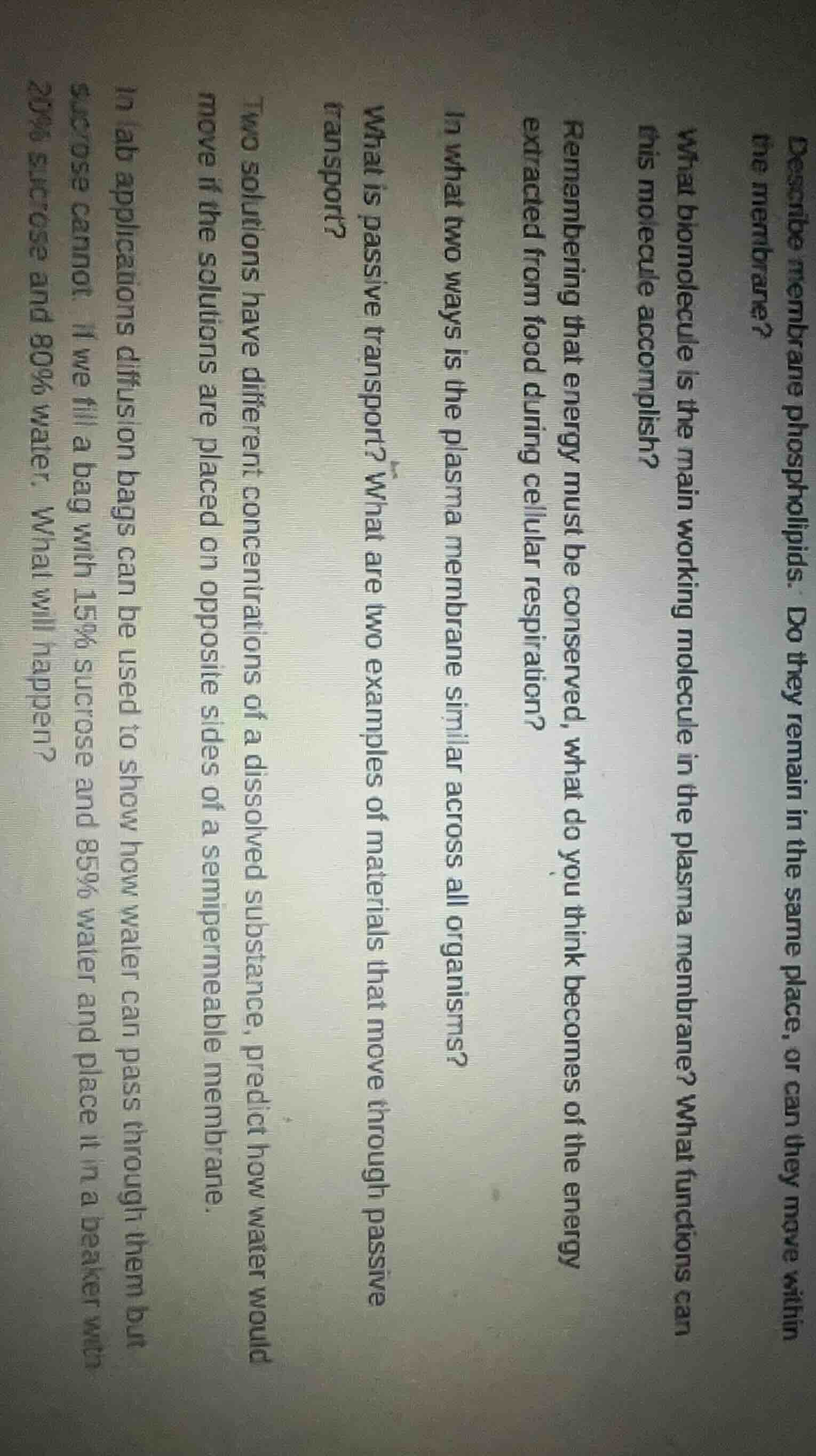
describe membrane phospholipids. do they remain in the same place, or can they move within the membrane?
what biomolecule is the main working molecule in the plasma membrane? what functions can this molecule accomplish?
remembering that energy must be conserved, what do you think becomes of the energy extracted from food during cellular respiration?
in what two ways is the plasma membrane similar across all organisms?
what is passive transport? what are two examples of materials that move through passive transport?
two solutions have different concentrations of a dissolved substance, predict how water would move if the solutions are placed on opposite sides of a semipermeable membrane.
in lab applications diffusion bags can be used to show how water can pass through them but sucrose cannot. if we fill a bag with 15% sucrose and 85% water and place it in a beaker with 20% sucrose and 80% water. what will happen?
1. Describe membrane phospholipids...
Membrane phospholipids have a hydrophilic head (phosphate - glycerol) and hydrophobic tails (fatty acids). They form a bilayer in the membrane. The hydrophobic tails face inward, and hydrophilic heads face outward (toward aqueous environments). They can move within the bilayer (lateral diffusion) but don't flip - flop easily between layers.
The main working molecule in the plasma membrane (for functions like transport, signaling) is the protein. Membrane proteins can be integral (spanning the membrane) or peripheral (attached to the surface). Functions include transport (e.g., channel proteins for passive transport, carrier proteins for active/passive), receptor (for signal transduction), and enzymatic activity.
During cellular respiration, energy from food (like glucose) is conserved in ATP (adenosine triphosphate) and in the proton gradient (in oxidative phosphorylation). The energy from food is extracted by breaking down organic molecules (like glucose in glycolysis, Krebs cycle) and the energy is used to make ATP (via substrate - level phosphorylation and oxidative phosphorylation) and to create a proton gradient (used for ATP synthesis in chemiosmosis).

Snap & solve any problem in the app
Get step-by-step solutions on Sovi AI
Photo-based solutions with guided steps
Explore more problems and detailed explanations
Membrane phospholipids have a hydrophilic head (with phosphate - glycerol) and hydrophobic fatty - acid tails. They form a bilayer (hydrophobic tails inward, hydrophilic heads outward, facing aqueous regions). They can move laterally within the bilayer but rarely flip between layers.