QUESTION IMAGE
Question
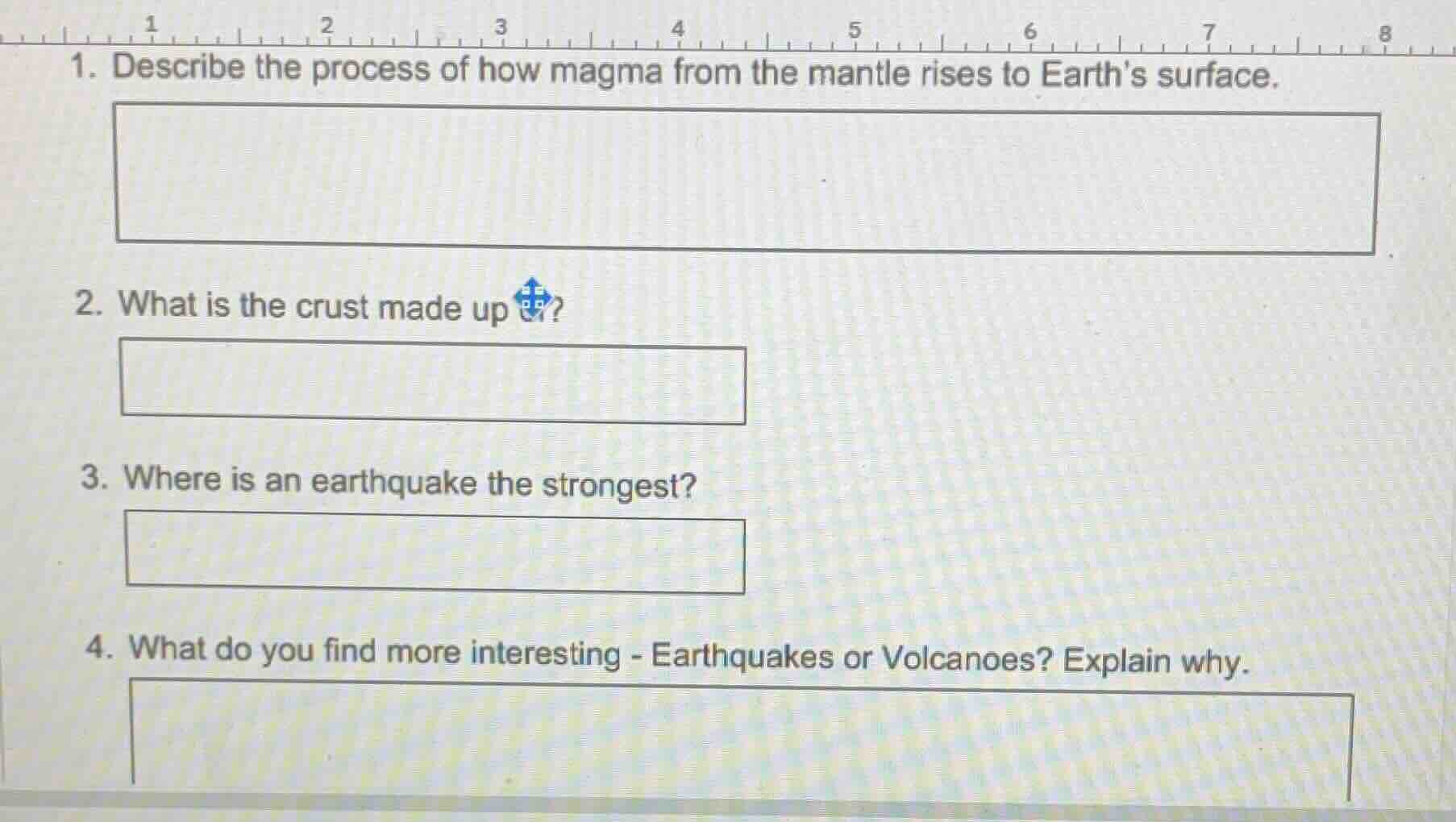
- describe the process of how magma from the mantle rises to earths surface.
- what is the crust made up of?
- where is an earthquake the strongest?
- what do you find more interesting - earthquakes or volcanoes? explain why.
Brief Explanations
- Magma rises due to mantle convection: heat from Earth's core warms mantle rock, making it less dense than surrounding rock. This less dense rock rises toward the crust. As it moves upward, pressure decreases, allowing more rock to melt and expand the magma body. If it reaches a weak point in the crust (like a divergent boundary or hot spot), it pushes through and erupts at the surface as lava.
- The crust is Earth's outermost layer, composed mostly of low-density silicate rocks. Oceanic crust is thin (5-10 km) and made of dark, iron-rich basalt. Continental crust is thicker (30-50 km) and made of lighter, silica-rich rocks like granite and sedimentary rocks.
- An earthquake's strongest point is the hypocenter (focus), the underground location where the fault first slips. The point directly above this on Earth's surface is the epicenter, where surface shaking is typically the most intense.
- (Example answer) Volcanoes are more interesting because they create new land (like Hawaiian islands) and offer visible, dynamic displays of Earth's internal activity. They also support unique ecosystems around their vents, and their eruptions can shape global climate patterns, linking deep Earth processes to surface and atmospheric systems.

Snap & solve any problem in the app
Get step-by-step solutions on Sovi AI
Photo-based solutions with guided steps
Explore more problems and detailed explanations
- Mantle rock is heated by the core, becomes less dense, and rises. As pressure drops, more rock melts to expand the magma body. It pushes through weak crustal points (boundaries, hot spots) and reaches the surface, erupting as lava.
- The crust is made of low-density silicate rocks: thin, iron-rich basalt (oceanic crust) and thicker, silica-rich granite/sedimentary rocks (continental crust).
- An earthquake is strongest at its underground hypocenter (focus), with the most intense surface shaking at the overlying epicenter.
- (Example) Volcanoes are more interesting. They create new land, show dynamic internal Earth activity, support unique ecosystems, and can alter global climate, connecting deep and surface Earth systems.