QUESTION IMAGE
Question
- describe the transformation and the rule that is used to get from the preimage, j, to the image, s?
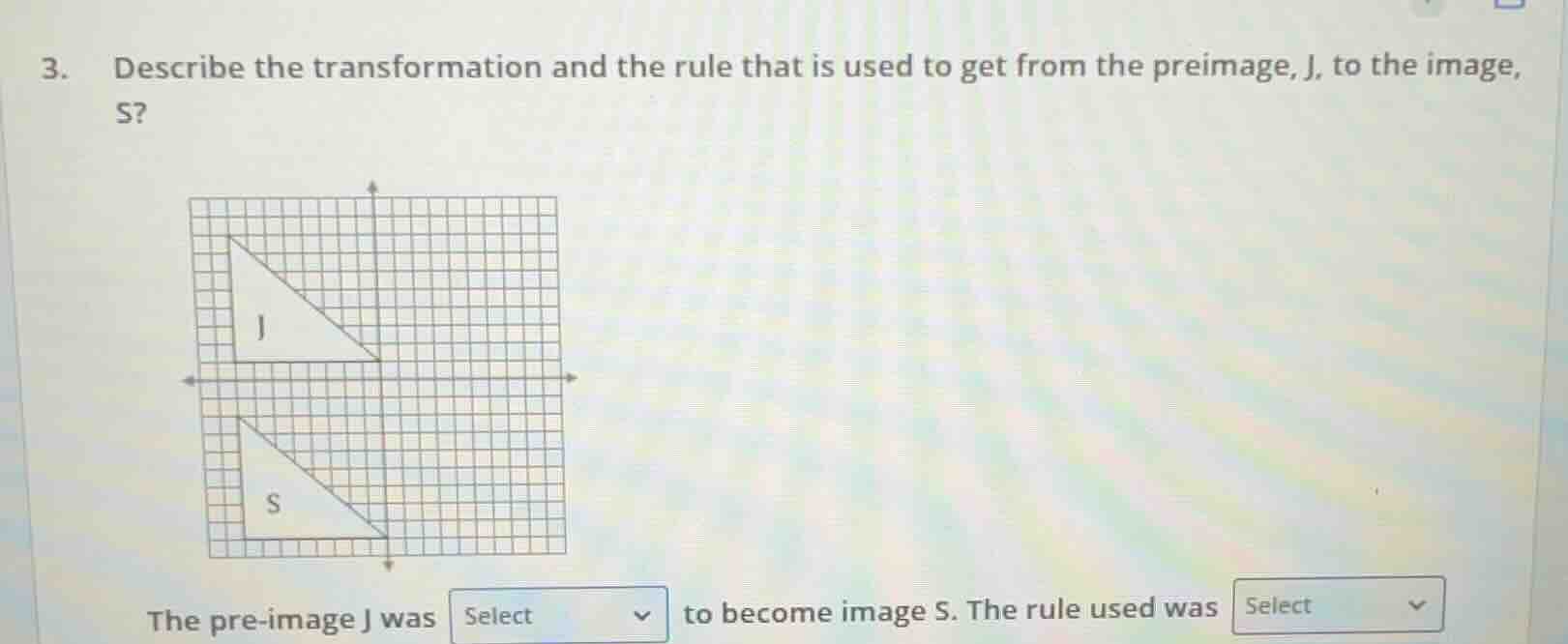
the pre - image j was select to become image s. the rule used was select
Step1: Analyze the vertical shift
Looking at the pre - image \(J\) and the image \(S\), we can see that each point of \(J\) has moved downwards. To find the number of units moved, we can look at the vertical distance between corresponding points. If we take a vertex of \(J\) (for example, the top - most vertex) and the corresponding vertex of \(S\), we can see that the vertical change (change in \(y\) - coordinate) is negative (since it's moving down). By counting the grid squares, we find that the figure has moved down by 5 units (this may vary slightly depending on the grid, but typically in such problems, we count the vertical distance). The transformation is a translation (specifically a vertical translation downwards).
Step2: Determine the rule for translation
The general rule for a vertical translation of a point \((x,y)\) is \((x,y)\to(x,y - k)\) where \(k\) is the number of units moved down. If we assume the vertical shift is 5 units down, the rule for the translation is \((x,y)\to(x,y - 5)\). The transformation is a translation (moved down/translated vertically downwards).

Snap & solve any problem in the app
Get step-by-step solutions on Sovi AI
Photo-based solutions with guided steps
Explore more problems and detailed explanations
The pre - image \(J\) was translated (moved) down to become image \(S\). The rule used was \((x,y)\to(x,y - 5)\) (the number of units down may need to be adjusted based on the exact grid, but the transformation is a vertical translation downwards with a rule of shifting the \(y\) - coordinate down by a certain number of units). If we consider the standard grid - based translation, the transformation is a translation (vertical shift down) and the rule is \((x,y)\to(x,y - n)\) where \(n\) is the number of units moved down (e.g., if \(n = 5\), the rule is \((x,y)\to(x,y - 5)\)).