QUESTION IMAGE
Question
details
no additional details were added for this assignment.
the first and last child will inherit the mutated gene because genes need to be equal, which means one son and one daughter will be affected.
during sexual reproduction, only one chromosome is contributed by each parent. the father could contribute one unaffected gene.
the mother has strong genes, but over time the genes from the father will win out, causing the children to inherit the disease.
the female children will inherit genes only from their unaffected mother, but the male children will inherit the disease.
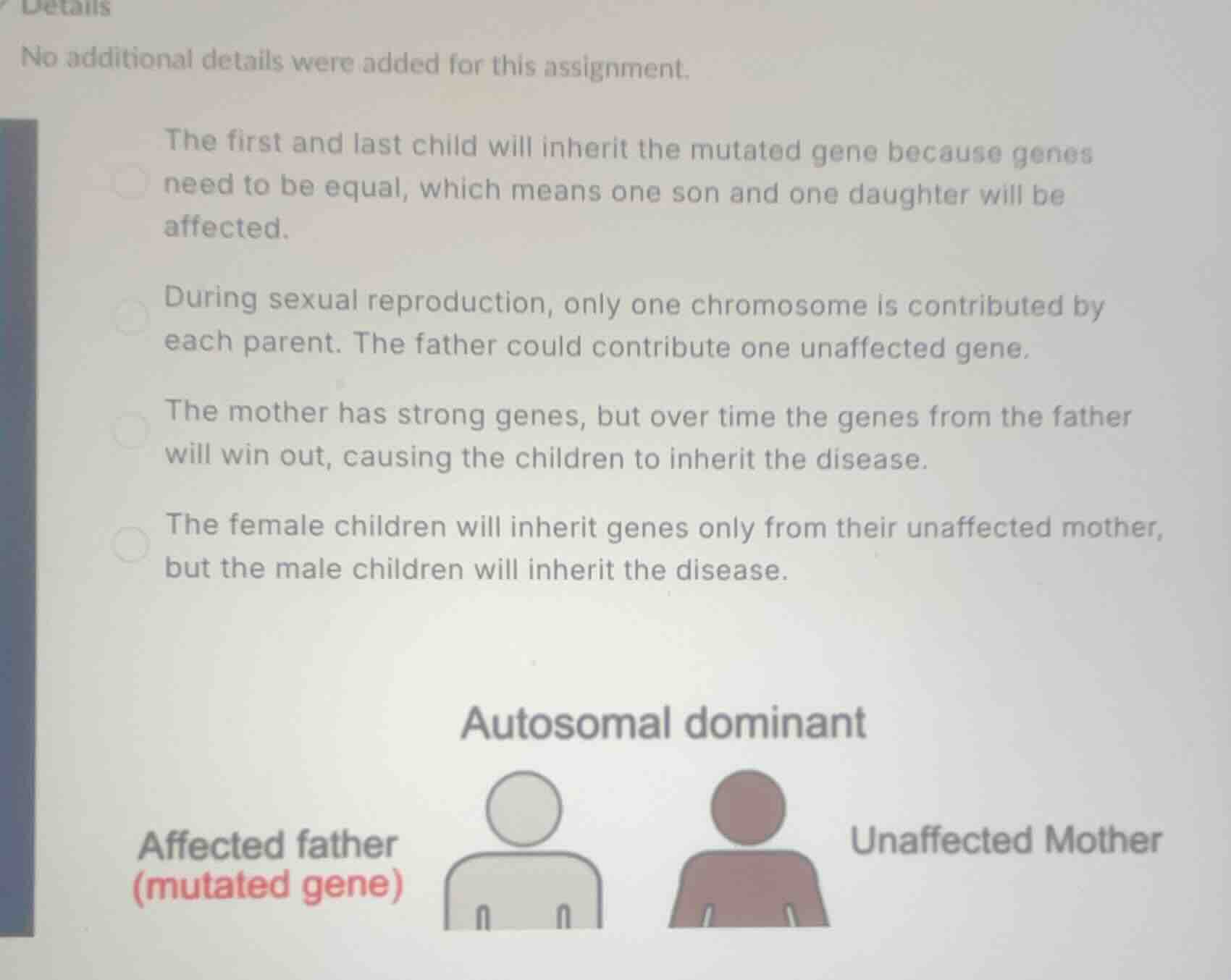
autosomal dominant
affected father
(mutated gene)
unaffected mother
To determine the correct statement, we analyze each option:
- The first option's reasoning about genes needing to be equal and specific children inheriting is incorrect for autosomal dominant inheritance.
- The second option: In autosomal dominant inheritance, during sexual reproduction, each parent contributes one chromosome (allele) for each gene. The affected father has one mutated (dominant) and one normal allele, and the mother has two normal alleles. The father could pass on the normal allele, so this statement is correct.
- The third option's idea of "genes from the father winning out" is not how autosomal dominant inheritance works; it depends on allele dominance, not "strength" over time.
- The fourth option is incorrect as autosomal dominant is not sex - linked, so male and female children have the same inheritance pattern related to this trait, and female children don't only inherit from the mother.

Snap & solve any problem in the app
Get step-by-step solutions on Sovi AI
Photo-based solutions with guided steps
Explore more problems and detailed explanations
During sexual reproduction, only one chromosome is contributed by each parent. The father could contribute one unaffected gene.