QUESTION IMAGE
Question
determine whether the following statements are true and give an explanation or counter example. complete parts a through d below
bc negative, the surface areas of these functions are considered undefined
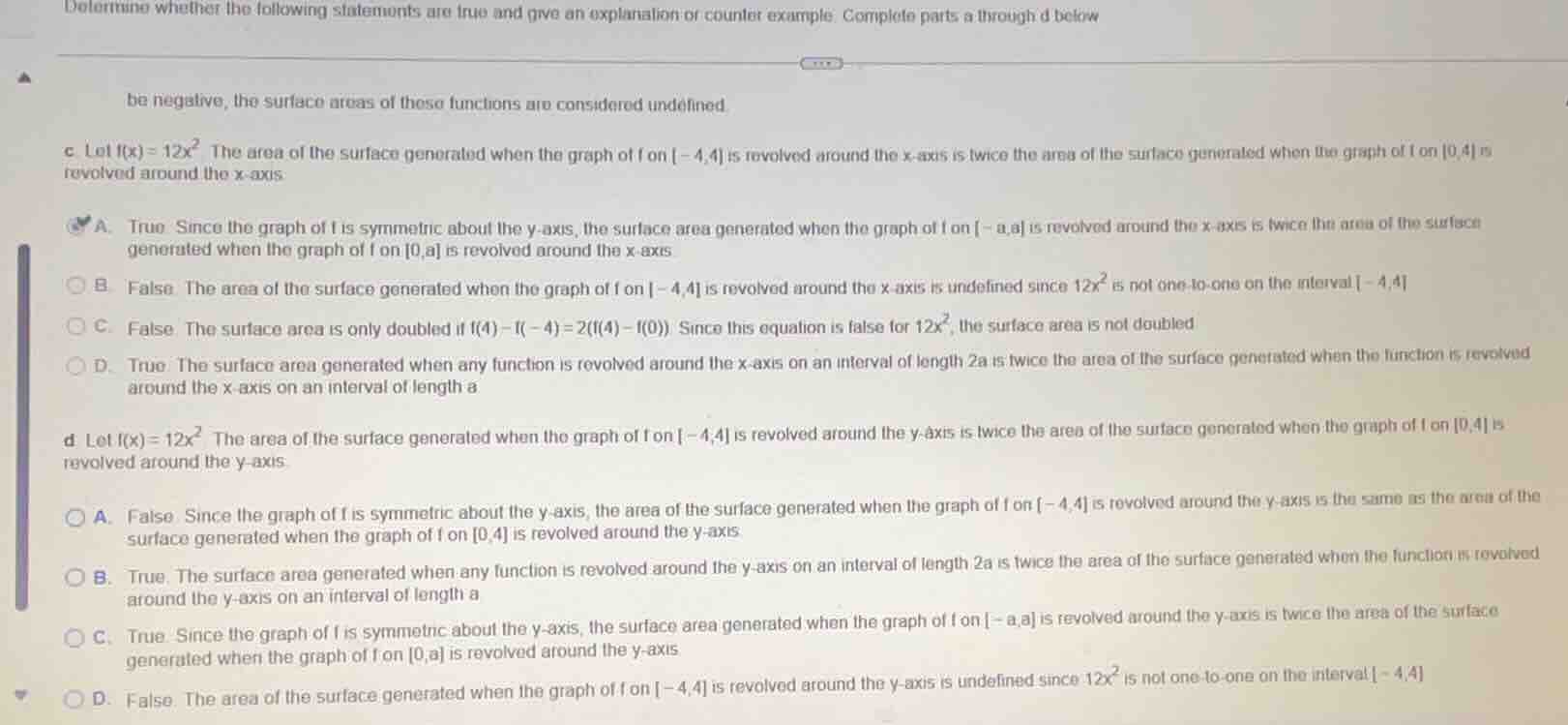
c. let ( f(x) = 12x^2 ). the area of the surface generated when the graph of ( f ) on (-4, 4) is revolved around the ( x )-axis is twice the area of the surface generated when the graph of ( f ) on (0, 4) is revolved around the ( x )-axis.
a. true. since the graph of ( f ) is symmetric about the ( y )-axis, the surface area generated when the graph of ( f ) on (-a, a) is revolved around the ( x )-axis is twice the area of the surface generated when the graph of ( f ) on (0, a) is revolved around the ( x )-axis.
b. false. the area of the surface generated when the graph of ( f ) on (-4, 4) is revolved around the ( x )-axis is undefined since ( 12x^2 ) is not one - to - one on the interval (-4, 4)
c. false. the surface area is only doubled if ( f(4)-f(-4)=2(f(4)-f(0)) ). since this equation is false for ( 12x^2 ), the surface area is not doubled
d. true. the surface area generated when any function is revolved around the ( x )-axis on an interval of length ( 2a ) is twice the area of the surface generated when the function is revolved around the ( x )-axis on an interval of length ( a )
d. let ( f(x)=12x^2 ). the area of the surface generated when the graph of ( f ) on (-4, 4) is revolved around the ( y )-axis is twice the area of the surface generated when the graph of ( f ) on (0, 4) is revolved around the ( y )-axis.
a. false. since the graph of ( f ) is symmetric about the ( y )-axis, the area of the surface generated when the graph of ( f ) on (-4, 4) is revolved around the ( y )-axis is the same as the area of the surface generated when the graph of ( f ) on (0, 4) is revolved around the ( y )-axis.
b. true. the surface area generated when any function is revolved around the ( y )-axis on an interval of length ( 2a ) is twice the area of the surface generated when the function is revolved around the ( y )-axis on an interval of length ( a )
c. true. since the graph of ( f ) is symmetric about the ( y )-axis, the surface area generated when the graph of ( f ) on (-a, a) is revolved around the ( y )-axis is twice the area of the surface generated when the graph of ( f ) on (0, a) is revolved around the ( y )-axis
d. false. the area of the surface generated when the graph of ( f ) on (-4, 4) is revolved around the ( y )-axis is undefined since ( 12x^2 ) is not one - to - one on the interval (-4, 4)
Part c
To determine the validity, we analyze the function \( f(x) = 12x^2 \). This function is even (symmetric about the \( y \)-axis) because \( f(-x)=12(-x)^2 = 12x^2=f(x) \). The formula for the surface area of revolution around the \( x \)-axis is \( S = 2\pi\int_{a}^{b}f(x)\sqrt{1+(f'(x))^2}dx \). For an even function on \([-a,a]\), the integral from \(-a\) to \(a\) is \( 2\int_{0}^{a}f(x)\sqrt{1+(f'(x))^2}dx \), so the surface area on \([-a,a]\) is twice that on \([0,a]\). Here, \( a = 4 \), so the statement holds. Option A correctly uses the symmetry of the even function to justify the surface area relationship. Option B is wrong because surface area of revolution doesn't require the function to be one - to - one. Option C misapplies a non - relevant condition. Option D is wrong as not all functions have this property, only even functions (in this symmetric interval case) do.
The function \( f(x)=12x^2 \) is even (symmetric about the \( y \)-axis). The formula for the surface area of revolution around the \( y \)-axis (using the method for functions \( y = f(x) \), \( a\leq x\leq b \)) is \( S=2\pi\int_{a}^{b}x\sqrt{1+(f'(x))^2}dx \). For the interval \([-4,4]\), the integral \( \int_{-4}^{4}x\sqrt{1+(f'(x))^2}dx \) is zero because the integrand \( x\sqrt{1+(f'(x))^2} \) is an odd function (since \( x \) is odd and \( \sqrt{1+(f'(x))^2} \) is even, odd times even is odd). The integral from \(-4\) to \(4\) of an odd function is zero, and the integral from \(0\) to \(4\) is \( \int_{0}^{4}x\sqrt{1+(f'(x))^2}dx \). So the surface area on \([-4,4]\) is not twice that on \([0,4]\) (in fact, due to the odd - nature of the integrand for \( y \)-axis revolution, the relationship is different). Option A is correct as the integrand for \( y \)-axis revolution makes the area on \([-4,4]\) equal to that on \([0,4]\) (because the negative part cancels out), not twice. Option B is wrong as there's no general rule for all functions. Option C is wrong as the symmetry of the function about the \( y \)-axis doesn't lead to the surface area on \([-a,a]\) being twice that on \([0,a]\) for \( y \)-axis revolution (due to the \( x \) term in the integrand). Option D is wrong as the function doesn't need to be one - to - one for surface area of revolution around the \( y \)-axis.

Snap & solve any problem in the app
Get step-by-step solutions on Sovi AI
Photo-based solutions with guided steps
Explore more problems and detailed explanations
A. True. Since the graph of \( f \) is symmetric about the \( y \)-axis, the surface area generated when the graph of \( f \) on \([-a,a]\) is revolved around the \( x \)-axis is twice the area of the surface generated when the graph of \( f \) on \([0,a]\) is revolved around the \( x \)-axis.