QUESTION IMAGE
Question
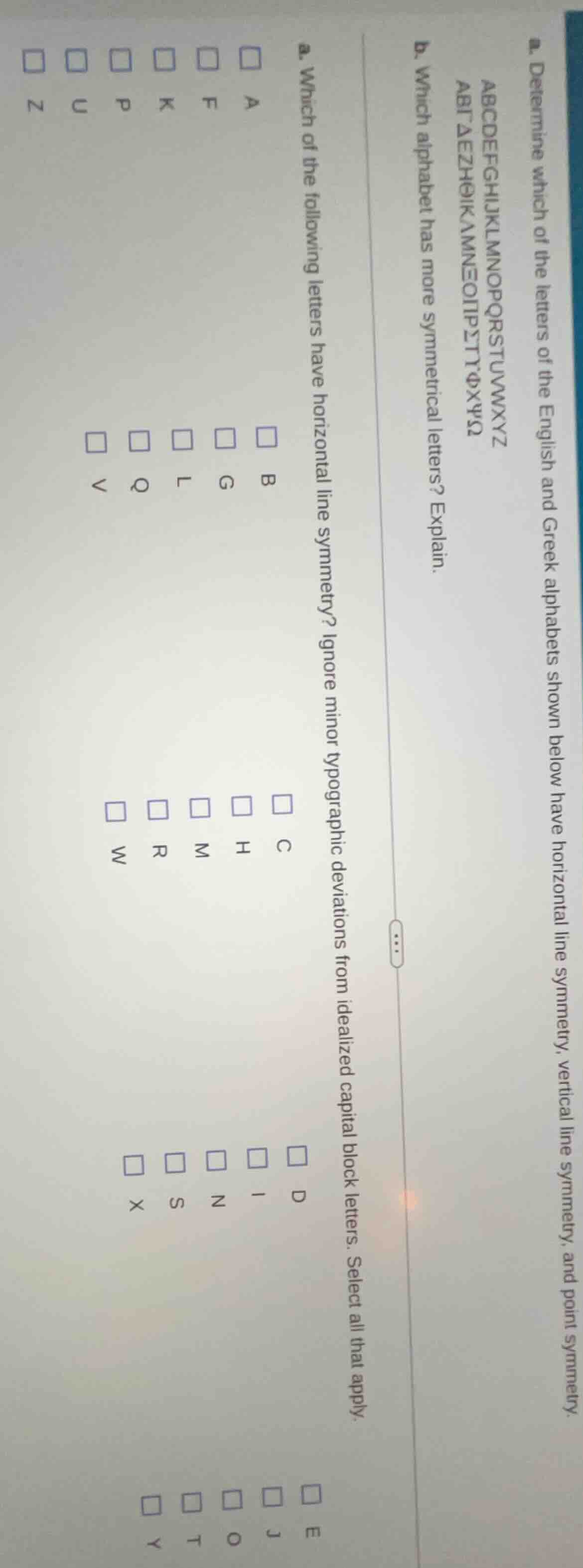
- determine which of the letters of the english and greek alphabets shown below have horizontal line symmetry, vertical line symmetry, and point symmetry.
abcdefghijklmnopqrstuvwxyz
αβγδεζηθικλμνξοπρστυφχψω
b. which alphabet has more symmetrical letters? explain.
a. which of the following letters have horizontal line symmetry? ignore minor typographic deviations from idealized capital block letters. select all that apply.
a f k p u z
b g l q v
c h m r w
d i n s x
e j o t y
Part a: Identifying Letters with Horizontal Line Symmetry
To determine which letters have a horizontal line of symmetry, we check if a horizontal line can be drawn through the middle of the letter such that the top half mirrors the bottom half. Let's analyze each set:
- First Row (A, F, K, P, U, Z):
- A: Vertical symmetry, not horizontal.
- F: No horizontal symmetry (the top and bottom parts don’t match).
- K: No horizontal symmetry.
- P: No horizontal symmetry.
- U: Has horizontal symmetry (top and bottom halves match).
- Z: No horizontal symmetry.
- Second Row (B, G, L, Q, V):
- B: Has horizontal symmetry (top and bottom halves match).
- G: No horizontal symmetry.
- L: No horizontal symmetry.
- Q: No horizontal symmetry.
- V: Vertical symmetry, not horizontal.
- Third Row (C, H, M, R, W):
- C: Has horizontal symmetry (top and bottom halves match).
- H: Has horizontal symmetry (top and bottom halves match).
- M: Vertical symmetry, not horizontal.
- R: No horizontal symmetry.
- W: Vertical symmetry, not horizontal.
- Fourth Row (D, I, N, S, X):
- D: Has horizontal symmetry (top and bottom halves match).
- I: Has horizontal symmetry (top and bottom halves match).
- N: No horizontal symmetry.
- S: Has horizontal symmetry (top and bottom halves match).
- X: Point symmetry (and both horizontal/vertical), so it has horizontal symmetry.
- Fifth Row (E, J, O, T, Y):
- E: Has horizontal symmetry (top and bottom halves match).
- J: No horizontal symmetry.
- O: Has horizontal symmetry (top and bottom halves match).
- T: Has horizontal symmetry (top and bottom halves match).
- Y: Vertical symmetry, not horizontal.
Part b: Comparing Symmetrical Letters in English and Greek Alphabets
English Alphabet (ABCDEFGHIJKLMNOPQRSTUVWXYZ):
- Horizontal Symmetry: B, C, D, E, H, I, O, S, T, U, X (11 letters)
- Vertical Symmetry: A, H, I, M, O, T, U, V, W, X, Y (11 letters)
- Point Symmetry: H, I, N, O, S, X, Z (7 letters)
Greek Alphabet (ΑΒΓΔΕΖΗΘΙΚΛΜΝΞΟΠΡΣΤΥΦΧΨΩ):
- Horizontal Symmetry: Α, Ε, Ζ, Η, Θ, Ι, Ο, Τ, Υ, Ω (10 letters)
- Vertical Symmetry: Α, Β, Γ, Δ, Ε, Η, Ι, Λ, Ο, Τ, Υ (11 letters)
- Point Symmetry: Ζ, Θ, Ι, Ν, Ο, Σ, Χ (7 letters)
- Horizontal Symmetry: English has 11, Greek has 10.
- Vertical Symmetry: Both have 11.
- Point Symmetry: Both have 7.
Overall, the English alphabet has more letters with horizontal line symmetry (11 vs. 10 in Greek). For vertical and point symmetry, they are equal or very close.
Final Answers:
Part a:
Letters with horizontal line symmetry:
- First row: U
- Second row: B
- Third row: C, H
- Fourth row: D, I, S, X
- Fifth row: E, O, T
Part b:
The English alphabet has more letters with horizontal line symmetry. English has 11 horizontally symmetrical letters, while Greek has 10. For vertical and point symmetry, they are comparable (English and Greek have 11 and 11 for vertical, 7 and 7 for point, respectively).

Snap & solve any problem in the app
Get step-by-step solutions on Sovi AI
Photo-based solutions with guided steps
Explore more problems and detailed explanations
- Horizontal Symmetry: English has 11, Greek has 10.
- Vertical Symmetry: Both have 11.
- Point Symmetry: Both have 7.
Overall, the English alphabet has more letters with horizontal line symmetry (11 vs. 10 in Greek). For vertical and point symmetry, they are equal or very close.
Final Answers:
Part a:
Letters with horizontal line symmetry:
- First row: U
- Second row: B
- Third row: C, H
- Fourth row: D, I, S, X
- Fifth row: E, O, T
Part b:
The English alphabet has more letters with horizontal line symmetry. English has 11 horizontally symmetrical letters, while Greek has 10. For vertical and point symmetry, they are comparable (English and Greek have 11 and 11 for vertical, 7 and 7 for point, respectively).