QUESTION IMAGE
Question
deux fonctions dont les règles sont :
y = -0,6(x + 7,9)² + 3,7
y = (9/5)x + 15,52
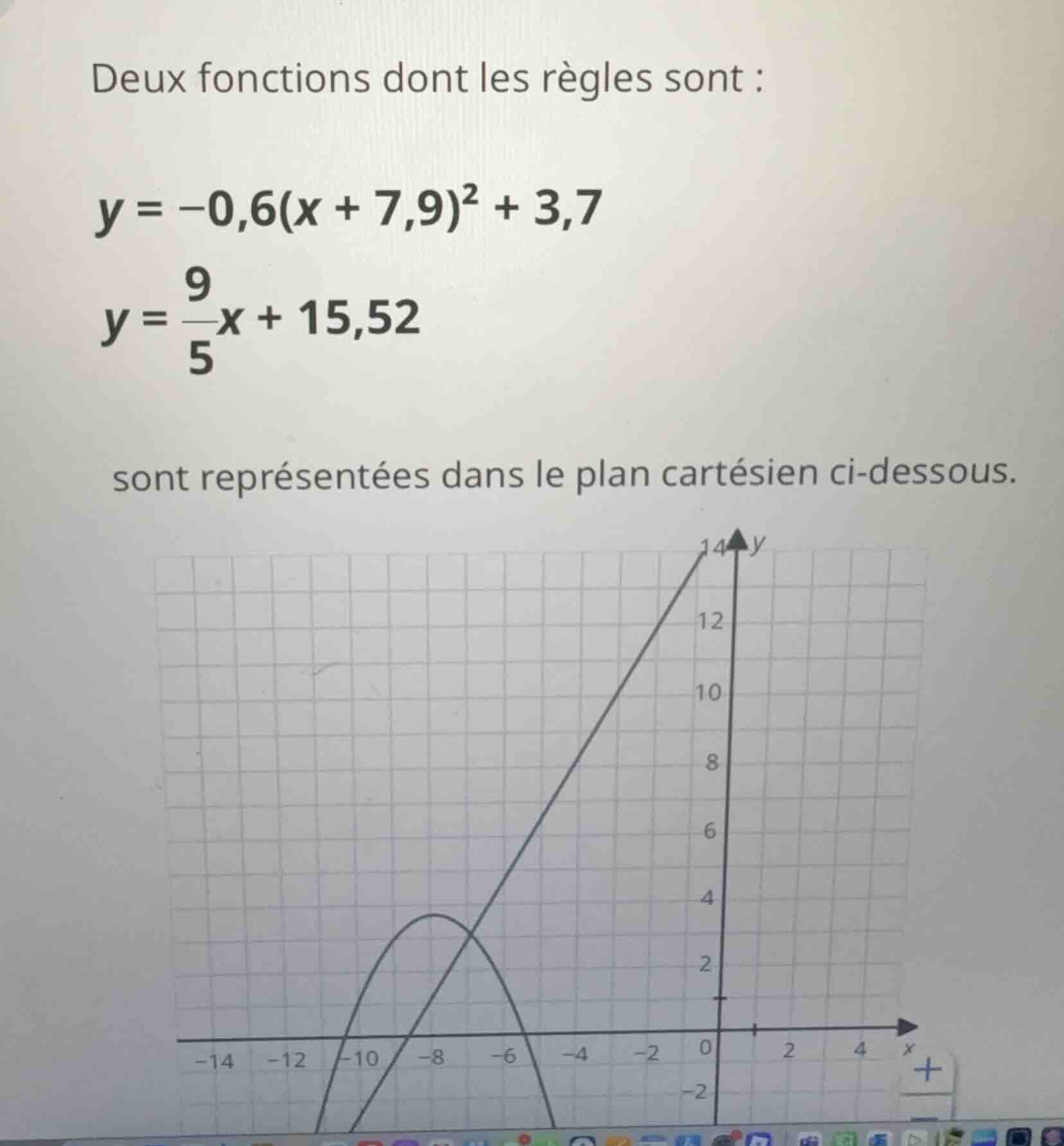
sont représentées dans le plan cartésien ci - dessous.
To find the intersection point of the two functions \( y = -0.6(x + 7.9)^2 + 3.7 \) and \( y=\frac{9}{5}x + 15.52 \), we set them equal to each other:
\[
-0.6(x + 7.9)^2 + 3.7=\frac{9}{5}x + 15.52
\]
First, expand \( (x + 7.9)^2 \):
\[
(x + 7.9)^2=x^{2}+15.8x + 62.41
\]
Substitute this into the equation:
\[
-0.6(x^{2}+15.8x + 62.41)+3.7 = 1.8x+15.52
\]
Distribute the \(- 0.6\):
\[
-0.6x^{2}-9.48x-37.446 + 3.7=1.8x + 15.52
\]
Simplify the left - hand side:
\[
-0.6x^{2}-9.48x-33.746=1.8x + 15.52
\]
Move all terms to the left - hand side:
\[
-0.6x^{2}-9.48x-33.746-1.8x - 15.52 = 0
\]
Combine like terms:
\[
-0.6x^{2}-11.28x-49.266 = 0
\]
Multiply through by \(-1\) to make the coefficient of \(x^{2}\) positive:
\[
0.6x^{2}+11.28x + 49.266=0
\]
We can use the quadratic formula \(x=\frac{-b\pm\sqrt{b^{2}-4ac}}{2a}\) for a quadratic equation \(ax^{2}+bx + c = 0\). Here, \(a = 0.6\), \(b = 11.28\), and \(c = 49.266\)
First, calculate the discriminant \(\Delta=b^{2}-4ac\):
\[
\Delta=(11.28)^{2}-4\times0.6\times49.266
\]
\[
\Delta = 127.2384-118.2384
\]
\[
\Delta=9
\]
Then, find \(x\):
\[
x=\frac{-11.28\pm\sqrt{9}}{2\times0.6}=\frac{-11.28\pm3}{1.2}
\]
We have two solutions for \(x\):
- When we take the plus sign:
\[
x=\frac{-11.28 + 3}{1.2}=\frac{-8.28}{1.2}=-6.9
\]
- When we take the minus sign:
\[
x=\frac{-11.28-3}{1.2}=\frac{-14.28}{1.2}=-11.9
\]
Now, we need to check which solution is valid by looking at the graph. The linear function \(y = \frac{9}{5}x+15.52\) and the quadratic function \(y=-0.6(x + 7.9)^{2}+3.7\) intersect at a point in the region where \(x\) is between \(-8\) and \(-6\) (from the graph). So we take \(x=-6.9\)
Now, substitute \(x = - 6.9\) into the linear function \(y=\frac{9}{5}x + 15.52\)
\[
y=\frac{9}{5}\times(-6.9)+15.52
\]
\[
y=-12.42 + 15.52
\]
\[
y = 3.1
\]
So the intersection point is \((-6.9,3.1)\)

Snap & solve any problem in the app
Get step-by-step solutions on Sovi AI
Photo-based solutions with guided steps
Explore more problems and detailed explanations
To find the intersection point of the two functions \( y = -0.6(x + 7.9)^2 + 3.7 \) and \( y=\frac{9}{5}x + 15.52 \), we set them equal to each other:
\[
-0.6(x + 7.9)^2 + 3.7=\frac{9}{5}x + 15.52
\]
First, expand \( (x + 7.9)^2 \):
\[
(x + 7.9)^2=x^{2}+15.8x + 62.41
\]
Substitute this into the equation:
\[
-0.6(x^{2}+15.8x + 62.41)+3.7 = 1.8x+15.52
\]
Distribute the \(- 0.6\):
\[
-0.6x^{2}-9.48x-37.446 + 3.7=1.8x + 15.52
\]
Simplify the left - hand side:
\[
-0.6x^{2}-9.48x-33.746=1.8x + 15.52
\]
Move all terms to the left - hand side:
\[
-0.6x^{2}-9.48x-33.746-1.8x - 15.52 = 0
\]
Combine like terms:
\[
-0.6x^{2}-11.28x-49.266 = 0
\]
Multiply through by \(-1\) to make the coefficient of \(x^{2}\) positive:
\[
0.6x^{2}+11.28x + 49.266=0
\]
We can use the quadratic formula \(x=\frac{-b\pm\sqrt{b^{2}-4ac}}{2a}\) for a quadratic equation \(ax^{2}+bx + c = 0\). Here, \(a = 0.6\), \(b = 11.28\), and \(c = 49.266\)
First, calculate the discriminant \(\Delta=b^{2}-4ac\):
\[
\Delta=(11.28)^{2}-4\times0.6\times49.266
\]
\[
\Delta = 127.2384-118.2384
\]
\[
\Delta=9
\]
Then, find \(x\):
\[
x=\frac{-11.28\pm\sqrt{9}}{2\times0.6}=\frac{-11.28\pm3}{1.2}
\]
We have two solutions for \(x\):
- When we take the plus sign:
\[
x=\frac{-11.28 + 3}{1.2}=\frac{-8.28}{1.2}=-6.9
\]
- When we take the minus sign:
\[
x=\frac{-11.28-3}{1.2}=\frac{-14.28}{1.2}=-11.9
\]
Now, we need to check which solution is valid by looking at the graph. The linear function \(y = \frac{9}{5}x+15.52\) and the quadratic function \(y=-0.6(x + 7.9)^{2}+3.7\) intersect at a point in the region where \(x\) is between \(-8\) and \(-6\) (from the graph). So we take \(x=-6.9\)
Now, substitute \(x = - 6.9\) into the linear function \(y=\frac{9}{5}x + 15.52\)
\[
y=\frac{9}{5}\times(-6.9)+15.52
\]
\[
y=-12.42 + 15.52
\]
\[
y = 3.1
\]
So the intersection point is \((-6.9,3.1)\)