QUESTION IMAGE
Question
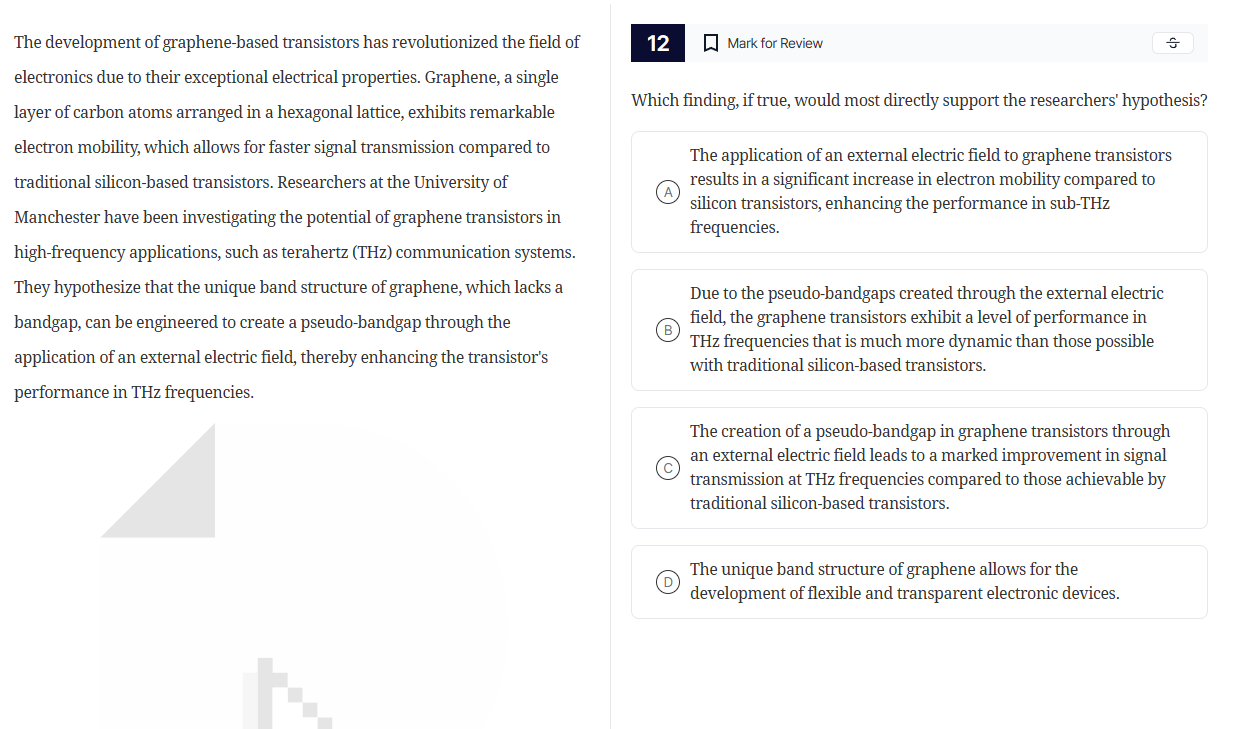
the development of graphene - based transistors has revolutionized the field of electronics due to their exceptional electrical properties. graphene, a single layer of carbon atoms arranged in a hexagonal lattice, exhibits remarkable electron mobility, which allows for faster signal transmission compared to traditional silicon - based transistors. researchers at the university of manchester have been investigating the potential of graphene transistors in high - frequency applications, such as terahertz (thz) communication systems. they hypothesize that the unique band structure of graphene, which lacks a bandgap, can be engineered to create a pseudo - bandgap through the application of an external electric field, thereby enhancing the transistor’s performance in thz frequencies.
12 which finding, if true, would most directly support the researchers hypothesis?
a the application of an external electric field to graphene transistors results in a significant increase in electron mobility compared to silicon transistors, enhancing the performance in sub - thz frequencies.
b due to the pseudo - bandgaps created through the external electric field, the graphene transistors exhibit a level of performance in thz frequencies that is much more dynamic than those possible with traditional silicon - based transistors.
c the creation of a pseudo - bandgap in graphene transistors through an external electric field leads to a marked improvement in signal transmission at thz frequencies compared to those achievable by traditional silicon - based transistors.
d the unique band structure of graphene allows for the development of flexible and transparent electronic devices.
The researchers' hypothesis is that engineering a pseudo - bandgap in graphene (via external electric field) enhances transistor performance at THz frequencies.
- Option A: Focuses on electron mobility increase vs silicon, not directly on pseudo - bandgap - performance at THz link.
- Option B: Talks about "dynamic" performance, not the direct link of pseudo - bandgap to enhanced performance at THz.
- Option C: Shows that creating pseudo - bandgap (via external field) improves signal transmission at THz vs silicon, directly supporting the hypothesis.
- Option D: Discusses flexible/transparent devices, irrelevant to THz performance.

Snap & solve any problem in the app
Get step-by-step solutions on Sovi AI
Photo-based solutions with guided steps
Explore more problems and detailed explanations
C. The creation of a pseudo - bandgap in graphene transistors through an external electric field leads to a marked improvement in signal transmission at THz frequencies compared to those achievable by traditional silicon - based transistors.