QUESTION IMAGE
Question
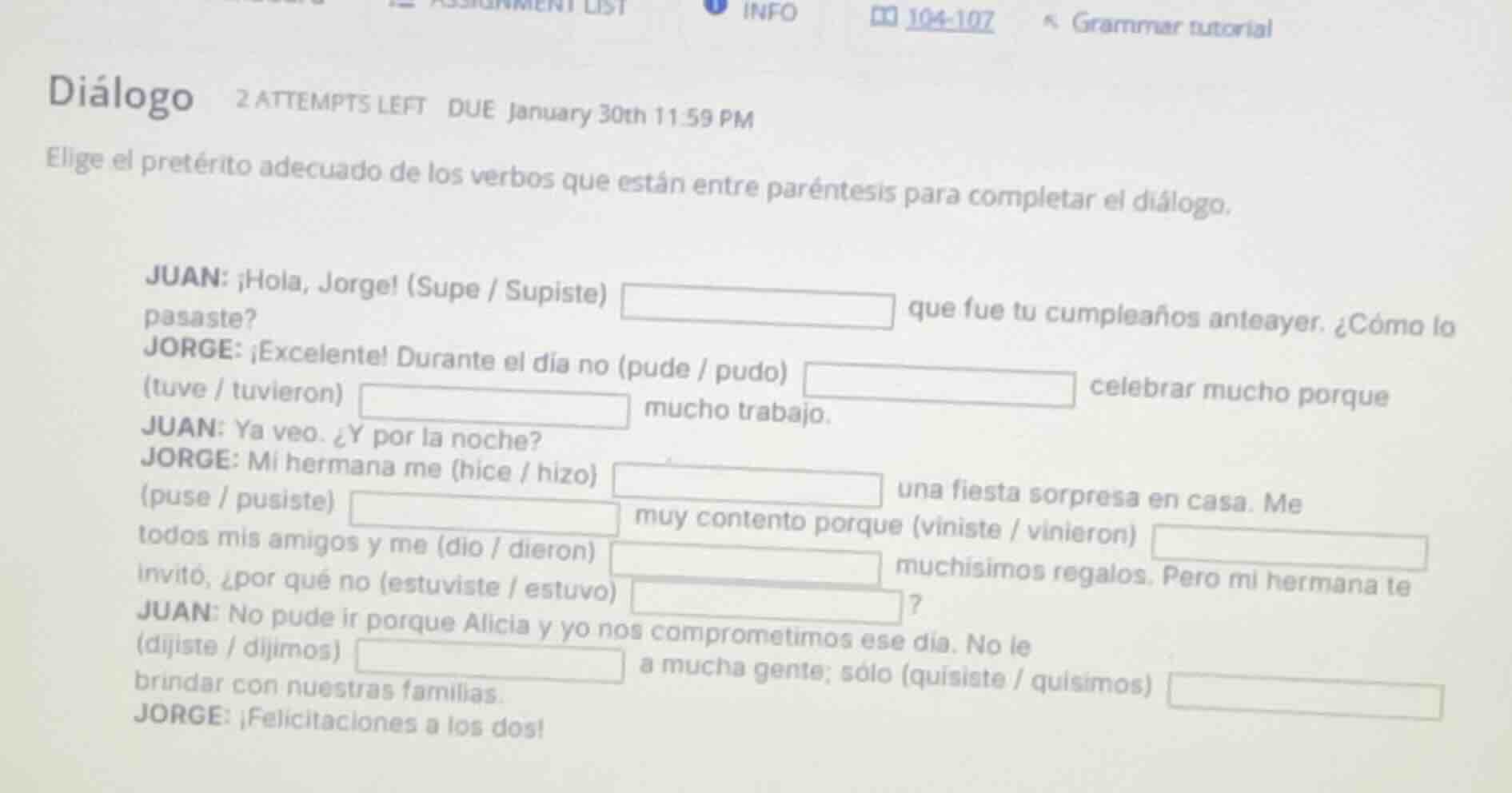
diálogo
2 attempts left due january 30th 11:59 pm
elige el pretérito adecuado de los verbos que están entre paréntesis para completar el diálogo.
juan: ¡hola, jorge! (supe / supiste) que fue tu cumpleaños anteayer. ¿cómo lo pasaste?
jorge: ¡excelente! durante el día no (pude / pudo) celebrar mucho porque (tuve / tuvieron) mucho trabajo.
juan: ya veo. ¿y por la noche?
jorge: mi hermana me (hice / hizo) una fiesta sorpresa en casa. me (puse / pusiste) muy contento porque (viniste / vinieron) todos mis amigos y me (dio / dieron) muchísimos regalos. pero mi hermana te invitó, ¿por qué no (estuviste / estuvo) ?
juan: no pude ir porque alicia y yo nos comprometimos ese día. no le (dijiste / dijimos) a mucha gente; sólo (quisiste / quisimos) brindar con nuestras familias.
jorge: ¡felicitaciones a los dos!
To solve this, we analyze each verb based on subject - verb agreement in the preterite tense (Spanish past tense) and context:
1. First blank (JUAN's first sentence)
The subject is "yo" (implied, as Juan is speaking about what he knew). The verb "saber" (to know) has the preterite form "supe" for the first - person singular (yo). "Supiste" is the second - person singular (tú) form. So we choose "Supe".
2. Second blank (JORGE's first sentence)
The subject is "yo" (Jorge is speaking about himself). The verb "poder" (to be able to) has the preterite form "pude" for the first - person singular (yo). "Pudo" is the third - person singular (él/ella/usted) form. So we choose "pude".
3. Third blank (JORGE's first sentence)
The subject is "yo" (Jorge). The verb "tener" (to have) has the preterite form "tuve" for the first - person singular (yo). "Tuvieron" is the third - person plural (ellos/ellas/ustedes) form. So we choose "tuve".
4. Fourth blank (JORGE's second sentence)
The subject is "mi hermana" (third - person singular, feminine). The verb "hacer" (to do/make) has the preterite form "hizo" for the third - person singular (él/ella/usted). "Hice" is the first - person singular (yo) form. So we choose "hizo".
5. Fifth blank (JORGE's second sentence)
The subject is "yo" (Jorge, implied as he is talking about himself). The verb "poner" (to put) has the preterite form "puse" for the first - person singular (yo). "Pusiste" is the second - person singular (tú) form. So we choose "puse".
6. Sixth blank (JORGE's second sentence)
The subject is "todos mis amigos" (third - person plural). The verb "venir" (to come) has the preterite form "vinieron" for the third - person plural (ellos/ellas/ustedes). "Viniste" is the second - person singular (tú) form. So we choose "vinieron".
7. Seventh blank (JORGE's second sentence)
The subject is "todos mis amigos" (third - person plural). The verb "dar" (to give) has the preterite form "dieron" for the third - person plural (ellos/ellas/ustedes). "Dio" is the third - person singular (él/ella/usted) form. So we choose "dieron".
8. Eighth blank (JORGE's second sentence)
The subject is "tú" (Juan, as Jorge is addressing him). The verb "estar" (to be) has the preterite form "estuviste" for the second - person singular (tú). "Estuvo" is the third - person singular (él/ella/usted) form. So we choose "estuviste".
9. Ninth blank (JUAN's second sentence)
The subject is "Alicia y yo" (first - person plural, nosotros). The verb "decir" (to say) has the preterite form "dijimos" for the first - person plural (nosotros). "Dijiste" is the second - person singular (tú) form. So we choose "dijimos".
10. Tenth blank (JUAN's second sentence)
The subject is "Alicia y yo" (first - person plural, nosotros). The verb "querer" (to want) has the preterite form "quisimos" for the first - person plural (nosotros). "Quisiste" is the second - person singular (tú) form. So we choose "quisimos".
The completed dialogue with the correct preterite verbs is:
JUAN: ¡Hola, Jorge! Supe que fue tu cumpleaños anteayer. ¿Cómo lo pasaste?
JORGE: ¡Excelente! Durante el día no pude celebrar mucho porque tuve mucho trabajo.
JUAN: Ya veo. ¿Y por la noche?
JORGE: Mi hermana me hizo una fiesta sorpresa en casa. Me puse muy contento porque vinieron todos mis amigos y me dieron muchísimos regalos. Pero mi hermana te invitó, ¿por qué no estuviste?
JUAN: No pude ir porque Alicia y yo nos comprometimos ese día. No le dijimos a mucha gente; sólo quisimos brindar con nu…

Snap & solve any problem in the app
Get step-by-step solutions on Sovi AI
Photo-based solutions with guided steps
Explore more problems and detailed explanations
To solve this, we analyze each verb based on subject - verb agreement in the preterite tense (Spanish past tense) and context:
1. First blank (JUAN's first sentence)
The subject is "yo" (implied, as Juan is speaking about what he knew). The verb "saber" (to know) has the preterite form "supe" for the first - person singular (yo). "Supiste" is the second - person singular (tú) form. So we choose "Supe".
2. Second blank (JORGE's first sentence)
The subject is "yo" (Jorge is speaking about himself). The verb "poder" (to be able to) has the preterite form "pude" for the first - person singular (yo). "Pudo" is the third - person singular (él/ella/usted) form. So we choose "pude".
3. Third blank (JORGE's first sentence)
The subject is "yo" (Jorge). The verb "tener" (to have) has the preterite form "tuve" for the first - person singular (yo). "Tuvieron" is the third - person plural (ellos/ellas/ustedes) form. So we choose "tuve".
4. Fourth blank (JORGE's second sentence)
The subject is "mi hermana" (third - person singular, feminine). The verb "hacer" (to do/make) has the preterite form "hizo" for the third - person singular (él/ella/usted). "Hice" is the first - person singular (yo) form. So we choose "hizo".
5. Fifth blank (JORGE's second sentence)
The subject is "yo" (Jorge, implied as he is talking about himself). The verb "poner" (to put) has the preterite form "puse" for the first - person singular (yo). "Pusiste" is the second - person singular (tú) form. So we choose "puse".
6. Sixth blank (JORGE's second sentence)
The subject is "todos mis amigos" (third - person plural). The verb "venir" (to come) has the preterite form "vinieron" for the third - person plural (ellos/ellas/ustedes). "Viniste" is the second - person singular (tú) form. So we choose "vinieron".
7. Seventh blank (JORGE's second sentence)
The subject is "todos mis amigos" (third - person plural). The verb "dar" (to give) has the preterite form "dieron" for the third - person plural (ellos/ellas/ustedes). "Dio" is the third - person singular (él/ella/usted) form. So we choose "dieron".
8. Eighth blank (JORGE's second sentence)
The subject is "tú" (Juan, as Jorge is addressing him). The verb "estar" (to be) has the preterite form "estuviste" for the second - person singular (tú). "Estuvo" is the third - person singular (él/ella/usted) form. So we choose "estuviste".
9. Ninth blank (JUAN's second sentence)
The subject is "Alicia y yo" (first - person plural, nosotros). The verb "decir" (to say) has the preterite form "dijimos" for the first - person plural (nosotros). "Dijiste" is the second - person singular (tú) form. So we choose "dijimos".
10. Tenth blank (JUAN's second sentence)
The subject is "Alicia y yo" (first - person plural, nosotros). The verb "querer" (to want) has the preterite form "quisimos" for the first - person plural (nosotros). "Quisiste" is the second - person singular (tú) form. So we choose "quisimos".
The completed dialogue with the correct preterite verbs is:
JUAN: ¡Hola, Jorge! Supe que fue tu cumpleaños anteayer. ¿Cómo lo pasaste?
JORGE: ¡Excelente! Durante el día no pude celebrar mucho porque tuve mucho trabajo.
JUAN: Ya veo. ¿Y por la noche?
JORGE: Mi hermana me hizo una fiesta sorpresa en casa. Me puse muy contento porque vinieron todos mis amigos y me dieron muchísimos regalos. Pero mi hermana te invitó, ¿por qué no estuviste?
JUAN: No pude ir porque Alicia y yo nos comprometimos ese día. No le dijimos a mucha gente; sólo quisimos brindar con nuestras familias.
JORGE: ¡Felicitaciones a los dos!
So the answers in order are: Supe, pude, tuve, hizo, puse, vinieron, dieron, estuviste, dijimos, quisimos.