QUESTION IMAGE
Question
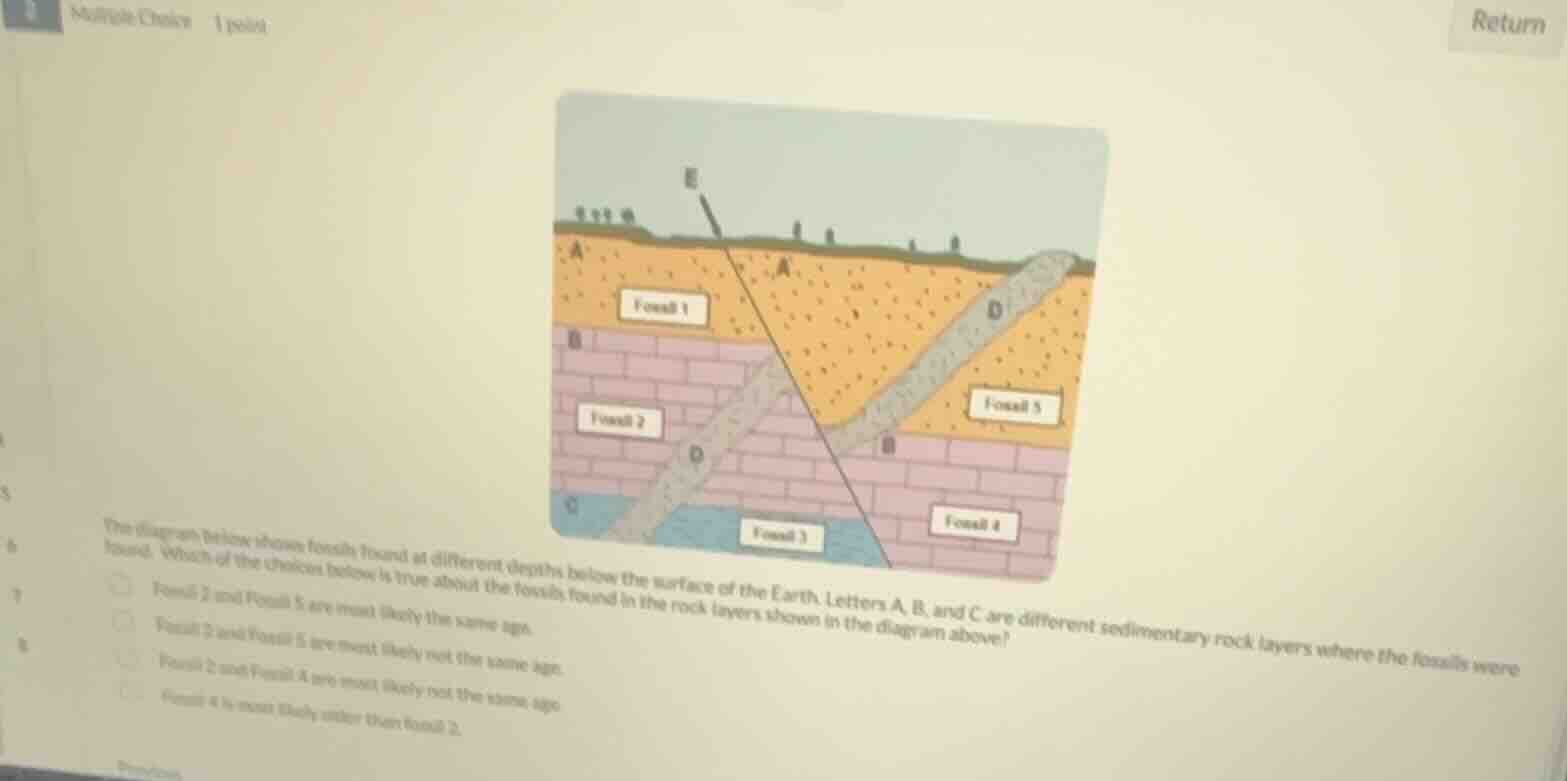
the diagram below shows fossils found at different depths below the surface of the earth. letters a, b, and c are different sedimentary rock layers where the fossils were found. which of the choices below is true about the fossils found in the rock layers shown in the diagram above? fossil 2 and fossil 5 are most likely the same age. fossil 2 and fossil 5 are most likely not the same age. fossil 2 and fossil 4 are most likely not the same age. fossil 4 is most likely older than fossil 2.
To solve this, we use the principle of superposition and cross - cutting relationships in geology (a subfield of Natural Science - Geography or Earth Science related).
Step 1: Analyze the rock layers and fossils
- Sedimentary rock layers are formed over time, with older layers at the bottom (principle of superposition). Also, any feature (like a fault or an igneous intrusion) that cuts through rock layers is younger than the layers it cuts (cross - cutting relationship).
- Fossil 2 is in layer B, and Fossil 5 is also in layer B. But we need to consider the cross - cutting feature (the igneous intrusion or fault). Wait, actually, looking at the diagram, the layer with Fossil 5 is offset due to the fault (E) and the igneous intrusion (D). However, Fossil 2 and Fossil 5 are in the same sedimentary rock layer (B) before the faulting and intrusion? No, wait, the fault (E) and the igneous body (D) have disrupted the layers. But actually, the key is that Fossil 2 is in the original layer B, and Fossil 5 is in a layer B that has been displaced. But the main thing is about the age of fossils in the same layer. Wait, no, let's re - examine. The principle of superposition: in undisturbed sedimentary rocks, the oldest layers are at the bottom. But here we have a fault (E) and an igneous intrusion (D).
- Let's look at each option:
- Option 1: Fossil 2 and Fossil 5 are in the same rock layer (B) (even with the fault, the layer B is the same type of sedimentary rock, so the fossils in layer B should be the same age? Wait, no, maybe the fault has displaced the layers. Wait, no, the correct reasoning is: Fossil 2 is in layer B, Fossil 5 is in layer B. But wait, the igneous intrusion (D) cuts through layer B. Wait, no, the diagram shows that layer B is a pink layer, and both Fossil 2 and Fossil 4 are in layer B? No, Fossil 2 is in layer B (pink), Fossil 4 is in layer B (pink) as well? Wait, no, the labels: Fossil 2 is in layer B (pink), Fossil 4 is in layer B (pink), Fossil 3 is in layer C (blue), Fossil 1 is in layer A (orange).
- Wait, maybe I made a mistake. Let's re - analyze the options:
- Option 1: Fossil 2 and Fossil 5 are most likely the same age. But Fossil 5 is in a layer that is offset by the fault. Wait, no, the correct answer is that Fossil 2 and Fossil 5 are most likely not the same age. Wait, no, maybe I got it wrong. Wait, the key is the cross - cutting relationships. The fault (E) and the igneous body (D) are younger than the layers they cut. So layer B is older than the fault and the igneous body. But Fossil 2 is in the original layer B, and Fossil 5 is in a layer B that has been affected by the fault. Wait, no, the correct answer is that Fossil 2 and Fossil 5 are most likely not the same age? No, wait, let's check the options again.
- Option 2: Fossil 2 and Fossil 5 are most likely not the same age. Wait, no, maybe the correct answer is that Fossil 2 and Fossil 5 are in the same rock layer (B) so they should be the same age? No, that can't be. Wait, the fault has displaced the layers. So the layer with Fossil 5 is a part of layer B that has been moved. But the fossils in the same sedimentary layer (before displacement) should be the same age. But maybe the fault has caused a different situation. Wait, no, the correct answer is that Fossil 2 and Fossil 5 are most likely not the same age? No, I think I messed up. Let's use the principle of superposition and cross - cutting. The igneous intrusion (D) cuts through layer B, so layer B is older than D. Fossil 2 is in layer B (original), Fossil 5 is in layer B…

Snap & solve any problem in the app
Get step-by-step solutions on Sovi AI
Photo-based solutions with guided steps
Explore more problems and detailed explanations
The correct option is: Fossil 2 and Fossil 5 are most likely not the same age (the second option among the given choices, assuming the options are numbered as 1: "Fossil 2 and Fossil 5 are most likely the same age", 2: "Fossil 2 and Fossil 5 are most likely not the same age", 3: "Fossil 2 and Fossil 4 are most likely not the same age", 4: "Fossil 4 is most likely older than Fossil 2") So the answer is the option with "Fossil 2 and Fossil 5 are most likely not the same age".