QUESTION IMAGE
Question
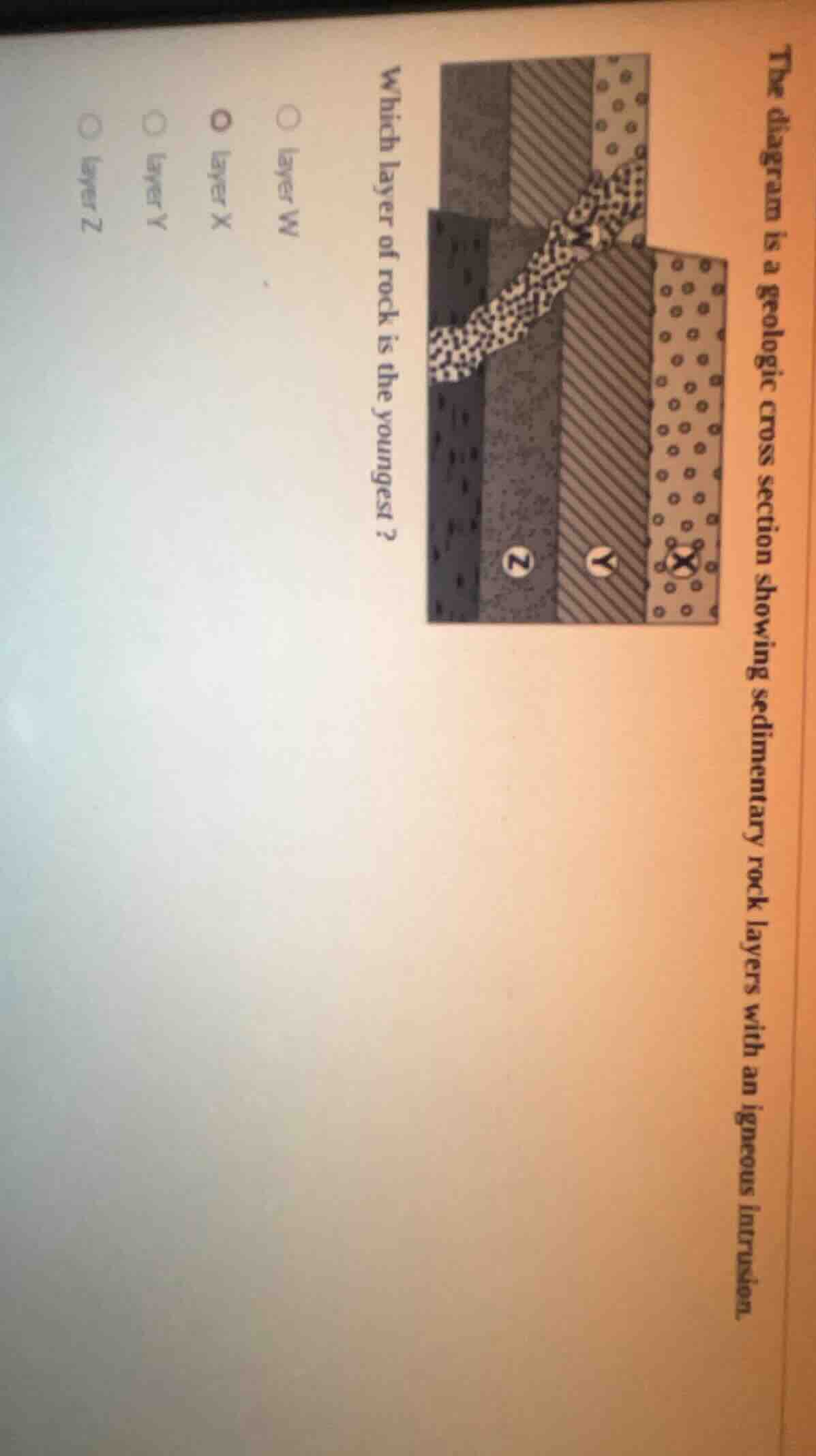
the diagram is a geologic cross section showing sedimentary rock layers with an igneous intrusion. which layer of rock is the youngest?
options:
layer w
layer x
layer y
layer z
To determine the youngest rock layer, we use the principle of superposition (for sedimentary layers) and cross - cutting relationships (for intrusions). Sedimentary rock layers are typically deposited in horizontal layers, and the younger layers are on top of older ones. However, when there is an igneous intrusion (like the patterned layer here), the intrusion is younger than the layers it cuts through. Looking at the layers: Layer W is the intrusion? No, wait, among the sedimentary - like layers (X, Y, Z) and the intrusion. Wait, actually, in the diagram, the layers X, Y, Z are sedimentary? Wait, no, the key is that for the sedimentary layers (assuming X, Y, Z are sedimentary with the intrusion cutting through). Wait, no, the principle is that the youngest layer is the one that is on top or the intrusion that cuts through others. Wait, looking at the options: Layer W is the intrusion? Wait, no, the options are Layer W, X, Y, Z. Wait, actually, in geological cross - sections, the youngest sedimentary layer is the one that is the topmost among the undisturbed sedimentary layers, but if there is an intrusion, the intrusion is younger than the layers it cuts. But in this case, among the layers X, Y, Z (assuming X is the bottom - most, Y above X, Z above Y) and the intrusion (W? No, the options are W, X, Y, Z). Wait, maybe I got it wrong. Wait, the correct approach: The principle of superposition states that in undisturbed sedimentary rock layers, the oldest layer is at the bottom and the youngest is at the top. But if there is an igneous intrusion (the patterned layer), it is younger than the layers it intrudes. Now, looking at the layers: Layer Z is the topmost among the sedimentary - looking layers? Wait, no, let's re - examine. Wait, the diagram shows that the intrusion cuts through some layers. But the options are Layer W, X, Y, Z. Wait, maybe Layer W is the intrusion, but no, the question is which layer of rock is the youngest. Wait, actually, the youngest layer is the one that was deposited last. So if we consider the sedimentary layers, the topmost sedimentary layer (before the intrusion) would be younger, but the intrusion is younger than the layers it cuts. Wait, but in the options, Layer W is the intrusion? Wait, no, the options are Layer W, X, Y, Z. Wait, maybe I made a mistake. Wait, the correct answer is Layer W? No, wait, no. Wait, the principle of cross - cutting relationships: the intrusion (the patterned layer) is younger than the layers it cuts. But the layers X, Y, Z: if X is the bottom, Y above X, Z above Y, then Z is younger than Y and X. But then there is the intrusion (W) which cuts through Z, Y, X? No, maybe the layers are arranged such that Layer W is the intrusion, but the question is which layer is the youngest. Wait, no, maybe the answer is Layer W? No, that can't be. Wait, no, let's think again. Wait, the options are Layer W, X, Y, Z. Wait, maybe the correct answer is Layer W? No, I think I messed up. Wait, actually, in the diagram, the youngest layer is Layer W? No, no. Wait, the correct answer is Layer W? No, wait, no. Wait, the key is that the intrusion (Layer W) is younger than the layers it cuts (X, Y, Z), so Layer W is the youngest? But that contradicts. Wait, no, maybe the layers X, Y, Z are sedimentary, with X at the bottom, Y in the middle, Z on top, and the intrusion (W) cutting through all of them. So the intrusion (W) is younger than X, Y, Z. So among the options, Layer W is the youngest. But wait, the options are Layer W, X, Y, Z. So the answer is Layer W? But that seems wrong. Wait, no, maybe I…

Snap & solve any problem in the app
Get step-by-step solutions on Sovi AI
Photo-based solutions with guided steps
Explore more problems and detailed explanations
Layer W