QUESTION IMAGE
Question
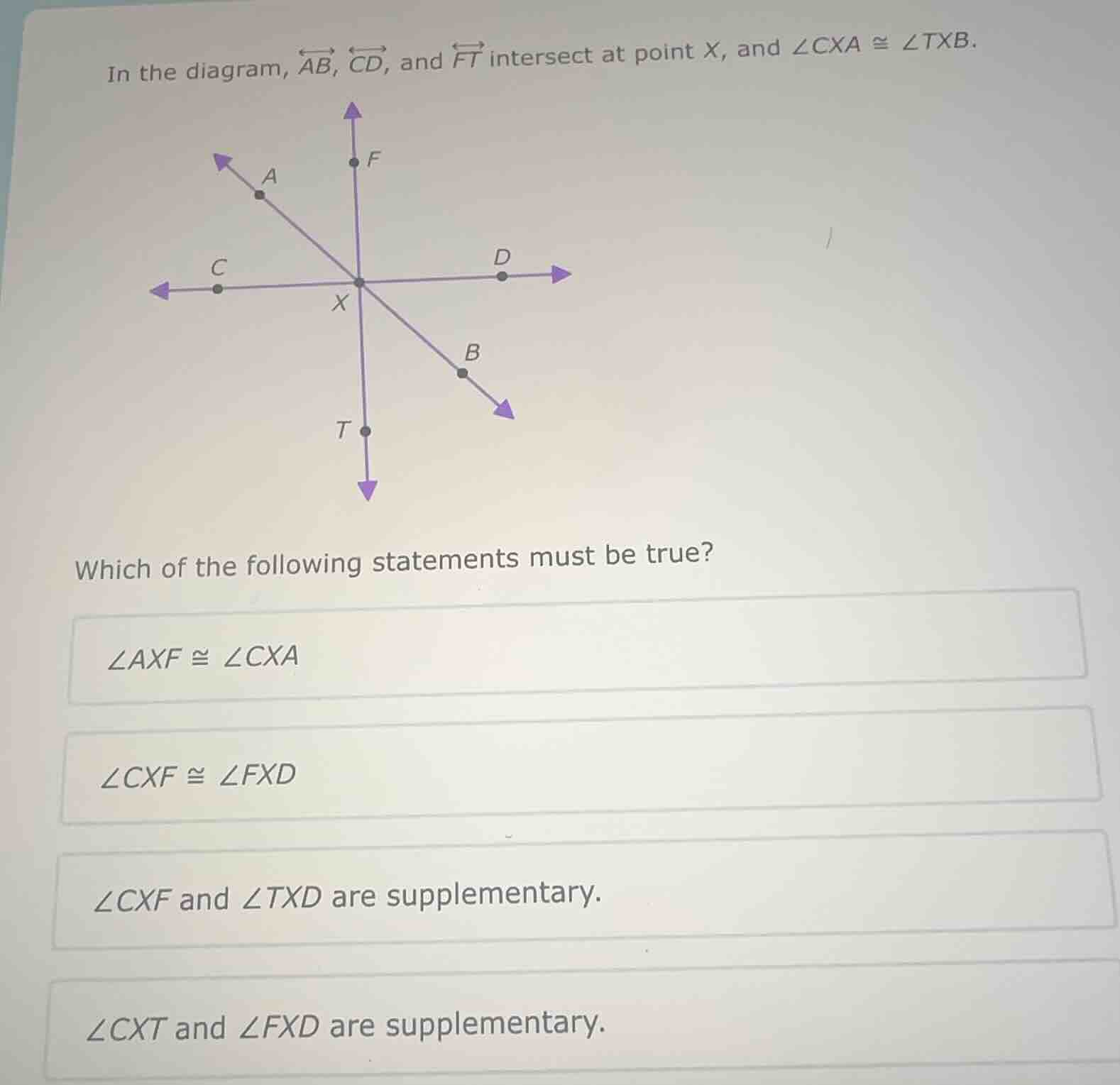
in the diagram, \\(\overleftrightarrow{ab}\\), \\(\overleftrightarrow{cd}\\), and \\(\overleftrightarrow{ft}\\) intersect at point x, and \\(\angle cxa \cong \angle txb\\).
which of the following statements must be true?
\\(\angle axf \cong \angle cxa\\)
\\(\angle cxf \cong \angle fxd\\)
\\(\angle cxf\\) and \\(\angle txd\\) are supplementary.
\\(\angle cxt\\) and \\(\angle fxd\\) are supplementary.
Step1: Analyze Vertical Angles and Supplementary Angles
First, recall that vertical angles are equal, and supplementary angles add up to \(180^\circ\). Also, given \(\angle CXA\cong\angle TXB\), which are vertical angles? Wait, no, let's look at the lines. \(CD\) is a straight line, \(FT\) is a straight line, and \(AB\) intersects them at \(X\).
Step2: Check Each Option
- Option 1: \(\angle AXF\cong\angle CXA\) – There's no reason these should be congruent. \(\angle CXA\) and \(\angle TXB\) are given congruent, but \(\angle AXF\) is related to \(FT\) and \(AB\), no info to say it's equal to \(\angle CXA\).
- Option 2: \(\angle CXF\cong\angle FXD\) – \(CD\) is a straight line, but \(FT\) is another line. \(\angle CXF\) and \(\angle FXD\) would be supplementary (since \(CD\) is straight), but not necessarily congruent unless \(FT\) is perpendicular to \(CD\), which we don't know.
- Option 3: \(\angle CXF\) and \(\angle TXD\) – Let's see, \(\angle CXF + \angle FXT + \angle TXD = 180^\circ\) (since \(CD\) is straight), but \(\angle FXT\) is a right angle? No, wait, \(FT\) is a straight line, so \(\angle CXF + \angle FXD = 180^\circ\), but \(\angle TXD\) – wait, maybe better to look at \(\angle CXT\) and \(\angle FXD\). Wait, no, let's re-examine.
Wait, \(FT\) is a straight line, so \(\angle CXF + \angle FXT = 180^\circ\)? No, \(CD\) is horizontal, \(FT\) is vertical? Wait, in the diagram, \(CD\) is horizontal (left-right), \(FT\) is vertical (up-down), so they are perpendicular? Wait, the diagram shows \(CD\) as horizontal, \(FT\) as vertical, intersecting at \(X\), so \(\angle CXF = 90^\circ\), \(\angle FXD = 90^\circ\), \(\angle CXT = 90^\circ\), \(\angle TXD = 90^\circ\)? Wait, maybe the diagram has \(FT\) perpendicular to \(CD\). But even if not, let's use the given \(\angle CXA\cong\angle TXB\).
Wait, another approach: \(\angle CXT\) is a straight angle? No, \(FT\) is a straight line, so \(\angle CXT + \angle TXD = 180^\circ\)? No, \(CD\) is straight, so \(\angle CXT + \angle TXD = 180^\circ\)? Wait, no, \(CD\) is a straight line, so any angle on one side of \(CD\) at \(X\) adds to \(180^\circ\). Wait, \(\angle CXF\) and \(\angle FXD\) are supplementary (since \(CD\) is straight). But let's check the last option: \(\angle CXT\) and \(\angle FXD\) are supplementary.
Wait, \(FT\) is a straight line, so \(\angle CXT + \angle TXB + \angle BXD = 180^\circ\)? No, maybe I made a mistake. Let's recall that if two lines are perpendicular, then angles are 90 degrees, but the key is that \(\angle CXA\cong\angle TXB\) (given), and \(FT\) and \(CD\) intersect at \(X\), so \(\angle CXF + \angle FXD = 180^\circ\) (linear pair). But the correct option is the last one: \(\angle CXT\) and \(\angle FXD\) are supplementary. Wait, no, let's think again.
Wait, \(FT\) is a straight line, so \(\angle CXT + \angle TXD = 180^\circ\)? No, \(CD\) is straight, so \(\angle CXT + \angle TXD = 180^\circ\)? Wait, no, \(CD\) is horizontal, \(FT\) is vertical, so they are perpendicular, so \(\angle CXF = 90^\circ\), \(\angle FXD = 90^\circ\), \(\angle CXT = 90^\circ\), \(\angle TXD = 90^\circ\). But given \(\angle CXA\cong\angle TXB\), which are the angles between \(AB\) and \(CD\), and \(AB\) and \(FT\)? Wait, maybe the diagram has \(FT\) perpendicular to \(CD\), so \(FT\perp CD\), making \(\angle CXF = \angle FXD = \angle CXT = \angle TXD = 90^\circ\). But then, \(\angle CXT\) (90°) and \(\angle FXD\) (90°) would add to 180°? No, 90+90=180, so they are supplementary. Wait, but let's check the options again.
Wait, the last option: \(\angle CXT\) and \(\a…

Snap & solve any problem in the app
Get step-by-step solutions on Sovi AI
Photo-based solutions with guided steps
Explore more problems and detailed explanations
\(\boldsymbol{\angle CXT}\) and \(\boldsymbol{\angle FXD}\) are supplementary. (The last option: \(\angle CXT\) and \(\angle FXD\) are supplementary.)