QUESTION IMAGE
Question
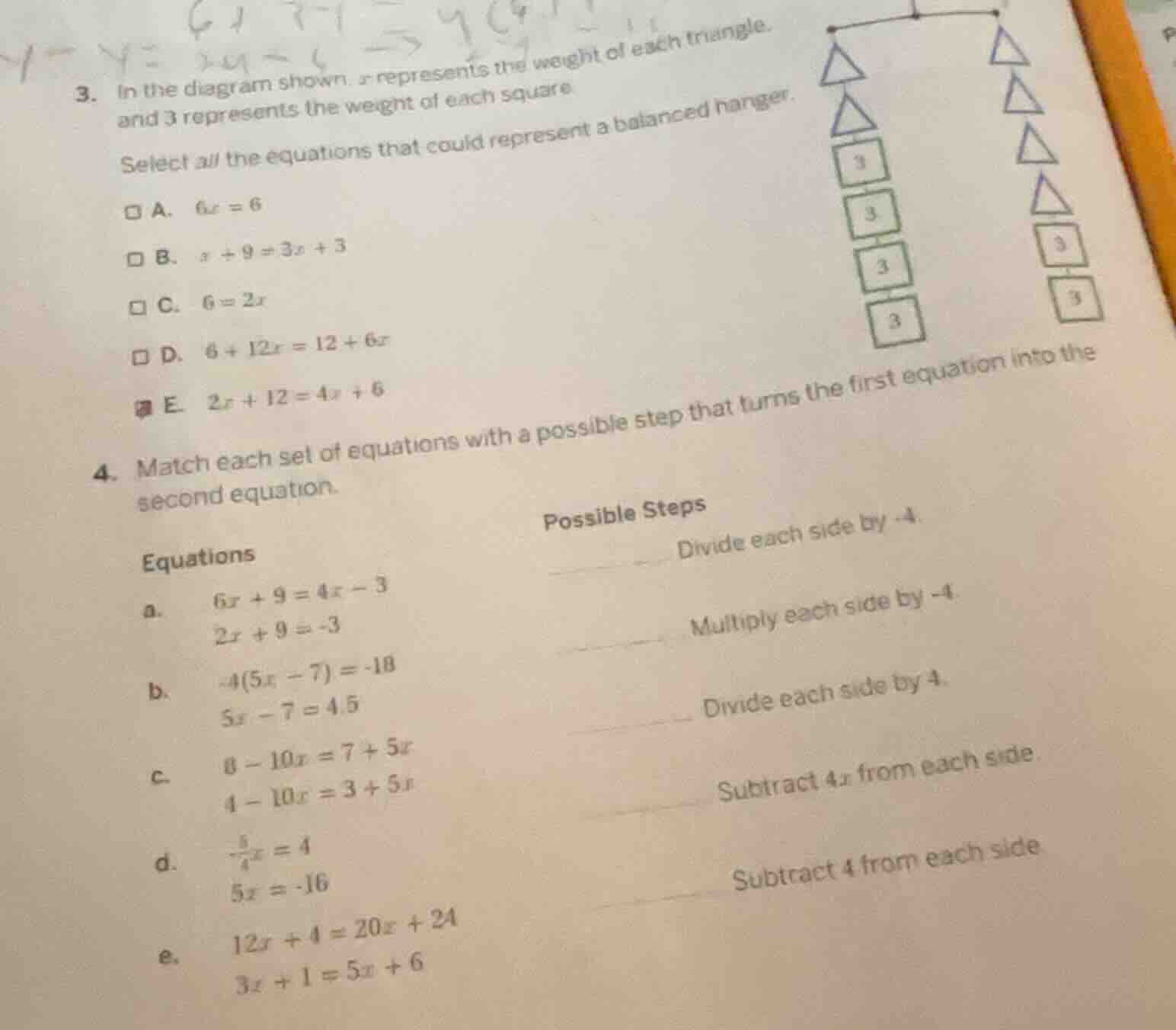
- in the diagram shown, ( x ) represents the weight of each triangle, and 3 represents the weight of each square. select all the equations that could represent a balanced hanger.
a. ( 6x = 6 )
b. ( x + 9 = 3x + 3 )
c. ( 6 = 2x )
d. ( 6 + 12x = 12 + 6x )
e. ( 2x + 12 = 4x + 6 )
- match each set of equations with a possible step that turns the first equation into the second equation.
equations
a. ( 6x + 9 = 4x - 3 ) ( 2x + 9 = -3 )
b. ( -4(5x - 7) = -18 ) ( 5x - 7 = 4.5 )
c. ( 8 - 10x = 7 + 5x ) ( 4 - 10x = 3 + 5x )
d. ( -\frac{5}{4}x = 4 ) ( 5x = -16 )
e. ( 12x + 4 = 20x + 24 ) ( 3x + 1 = 5x + 6 )
possible steps
divide each side by -4.
multiply each side by -4.
divide each side by 4.
subtract ( 4x ) from each side.
subtract 4 from each side
Question 3
First, let's analyze the diagram. On the left side, we have 2 triangles and 4 squares. Wait, no, looking at the diagram: left side has 2 triangles (wait, no, the left column: top two are triangles, then four squares? Wait, no, the user's diagram: left side: two triangles, then four squares (each 3). Right side: four triangles, then two squares. Wait, no, let's count:
Left side: number of triangles: 2, number of squares: 4 (each square is 3, so 43=12). Wait, no, the left column: first two are triangles (x each), then four squares (3 each). Right column: first four are triangles (x each), then two squares (3 each). So total weight left: 2x + 43 = 2x + 12. Total weight right: 4x + 2*3 = 4x + 6. So balanced means 2x + 12 = 4x + 6 (option E). Also, let's check other options.
Option A: 6x = 6. If we simplify 2x + 12 = 4x + 6, subtract 2x: 12 = 2x + 6, subtract 6: 6 = 2x, which is option C. Wait, maybe I miscounted. Wait, maybe the left has 2 triangles and 4 squares? No, looking at the options, let's re-express.
Wait, maybe the left side has 2 triangles and 4 squares (each square 3, so 43=12), right side has 4 triangles and 2 squares (23=6). So 2x + 12 = 4x + 6 (E). Also, if we subtract 2x from both sides: 12 = 2x + 6, then subtract 6: 6 = 2x (C). Also, from 2x + 12 = 4x + 6, we can also manipulate. Wait, let's check each option:
Option A: 6x = 6 → x=1. Let's see if that works. If x=1, left: 21 + 12=14, right:41 +6=10. No, that's not balanced. Wait, maybe my initial count is wrong.
Wait, maybe the left has 3 triangles and 3 squares? No, the options:
Wait, let's look at the options again. Option E: 2x + 12 = 4x + 6. Let's solve that: 12 - 6 = 4x - 2x → 6 = 2x → x=3. Then check option C: 6=2x → x=3. So if x=3, let's check the weights.
Left side: 2 triangles (23=6) + 4 squares (43=12) → total 18. Right side: 4 triangles (43=12) + 2 squares (23=6) → total 18. Balanced. So 2x + 12 = 4x + 6 (E) is correct. Also, 6=2x (C) is correct (since 2x=6 → x=3). Wait, but option A: 6x=6 → x=1, which doesn't balance. Option B: x + 9 = 3x + 3 → 9 - 3 = 2x → 6=2x → x=3. Wait, where does x + 9 come from? Maybe another count. Wait, maybe left has 1 triangle and 3 squares (33=9), right has 3 triangles and 1 square (3). So 1x + 9 = 3x + 3. Then solving: 9 - 3 = 2x → 6=2x → x=3. Which also works. Wait, now I'm confused. Maybe the diagram has left: 1 triangle, 3 squares (33=9), right: 3 triangles, 1 square (3). So total left: x + 9, total right: 3x + 3. Then balanced: x + 9 = 3x + 3 (B). And 2x + 12 = 4x + 6 (E) would be if left has 2 triangles, 4 squares, right has 4 triangles, 2 squares. So both B and E? Wait, but let's check the options.
Wait, the user's diagram: left column: top two triangles, then four squares (each 3). Right column: top four triangles, then two squares. So 2x + 43 = 2x + 12; 4x + 23 = 4x + 6. So 2x + 12 = 4x + 6 (E). Then, if we subtract 2x: 12 = 2x + 6 → subtract 6: 6 = 2x (C). Also, if we consider another way: maybe the total number of triangles is 6? Wait, no. Let's check the options:
Option A: 6x = 6 → x=1. Not balanced.
Option B: x + 9 = 3x + 3 → 2x=6 → x=3. If x=3, left: 3 + 9=12, right: 9 + 3=12. Balanced. So maybe the diagram has left: 1 triangle, 3 squares (3*3=9), right: 3 triangles, 1 square (3). So 1x + 9 = 3x + 3. That works.
Option C: 6=2x → x=3. Which is the same as B's solution.
Option D: 6 + 12x = 12 + 6x → 6x=6 → x=1. No.
Option E: 2x + 12 = 4x + 6 → 2x=6 → x=3. Yes.
So which options are correct? Let's see:
From 2x + 12 = 4x + 6 (E), we can get 6=2x (C) by subtracting 2x and 6. Also, if the diagra…
We need to match each equation set with the possible step.
Part a:
First equation: 6x + 9 = 4x - 3
Second equation: 2x + 9 = -3
What step transforms 6x + 9 = 4x - 3 into 2x + 9 = -3?
Subtract 4x from both sides: (6x + 9) - 4x = (4x - 3) - 4x → 2x + 9 = -3. So step: Subtract 4x from each side.
Part b:
First equation: -4(5x - 7) = -18
Second equation: 5x - 7 = 4.5
What step? Divide each side by -4: [ -4(5x - 7) ] / (-4) = (-18)/(-4) → 5x - 7 = 4.5. So step: Divide each side by -4.
Part c:
First equation: 8 - 10x = 7 + 5x
Second equation: 4 - 10x = 3 + 5x
What step? Subtract 4 from each side? Wait, 8 - 4 = 4, 7 - 4 = 3. So subtract 4 from each side: (8 - 10x) - 4 = (7 + 5x) - 4 → 4 - 10x = 3 + 5x. So step: Subtract 4 from each side.
Part d:
First equation: -5/4 x = 4
Second equation: 5x = -16
What step? Multiply each side by -4: (-5/4 x)(-4) = 4(-4) → 5x = -16. So step: Multiply each side by -4.
Part e:
First equation: 12x + 4 = 20x + 24
Second equation: 3x + 1 = 5x + 6
What step? Divide each side by 4: (12x + 4)/4 = (20x + 24)/4 → 3x + 1 = 5x + 6. So step: Divide each side by 4.
Now, let's match:
a. 6x + 9 = 4x - 3 → 2x + 9 = -3: Subtract 4x from each side.
b. -4(5x - 7) = -18 → 5x - 7 = 4.5: Divide each side by -4.
c. 8 - 10x = 7 + 5x → 4 - 10x = 3 + 5x: Subtract 4 from each side.
d. -5/4 x = 4 → 5x = -16: Multiply each side by -4.
e. 12x + 4 = 20x + 24 → 3x + 1 = 5x + 6: Divide each side by 4.
Now, the possible steps are:
- Divide each side by -4.
- Multiply each side by -4.
- Divide each side by 4.
- Subtract 4x from each side.
- Subtract 4 from each side.
So matching:
a → Subtract 4x from each side.
b → Divide each side by -4.
c → Subtract 4 from each side.
d → Multiply each side by -4.
e → Divide each side by 4.

Snap & solve any problem in the app
Get step-by-step solutions on Sovi AI
Photo-based solutions with guided steps
Explore more problems and detailed explanations
(Question 3):
The correct options are B, C, E. Wait, but let's confirm again. If the diagram is left: 1 triangle, 3 squares (33=9), right: 3 triangles, 1 square (3), then B (x + 9 = 3x + 3) is correct. If left: 2 triangles, 4 squares (43=12), right: 4 triangles, 2 squares (2*3=6), then E (2x + 12 = 4x + 6) is correct, and C (6=2x) is derived from E. So the correct options are B, C, E.