QUESTION IMAGE
Question
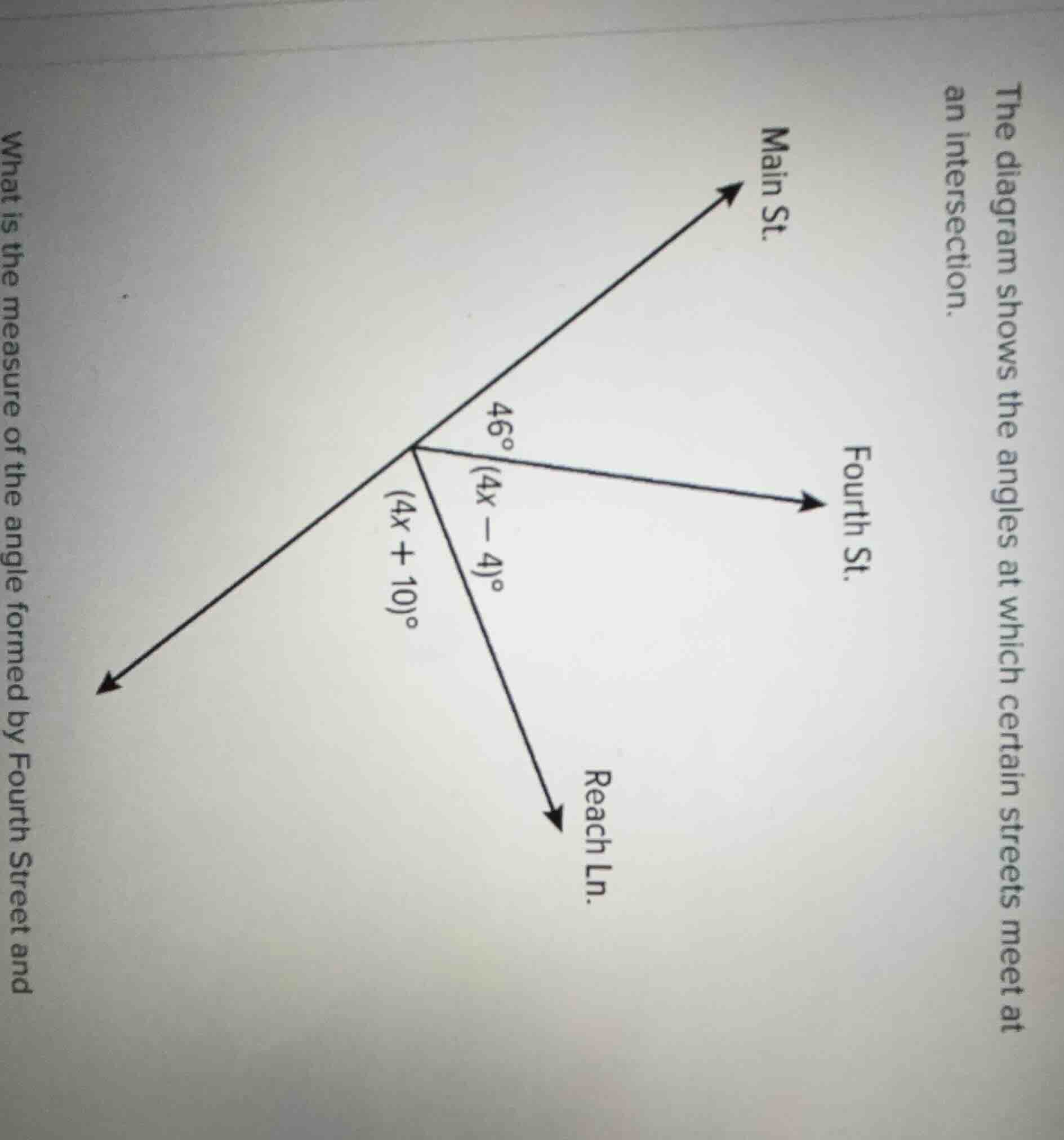
the diagram shows the angles at which certain streets meet at an intersection.
what is the measure of the angle formed by fourth street and the other street, likely reach ln or similar, based on the diagram with main st, fourth st, reach ln, and angle labels: 46°, (4x - 4)°, (4x + 10)°
Step1: Identify angle relationships
From the diagram, we can see that the angle between Main St. and Fourth St. is \(46^\circ\), the angle between Fourth St. and Reach Ln. is \((4x - 4)^\circ\), and the angle between Reach Ln. and the other line is \((4x + 10)^\circ\). Also, we can infer that the angle \(46^\circ\) and \((4x - 4)^\circ\) might be related to the angle \((4x + 10)^\circ\) through some angle - bisecting or vertical - angle - like relationships? Wait, actually, looking at the diagram, it seems that the angle between Main St. and Fourth St. (\(46^\circ\)) and the angle between Reach Ln. and the opposite line \((4x + 10)^\circ\) might be equal? Wait, no, maybe the angle between Fourth St. and Reach Ln. (\(4x - 4\)) and the angle \(46^\circ\) are related such that \(4x-4 = 46\)? Wait, no, let's re - examine.
Wait, maybe the two angles \((4x - 4)^\circ\) and \(46^\circ\) are equal? Wait, no, perhaps the angle \((4x + 10)^\circ\) is equal to \(46^\circ+(4x - 4)^\circ\)? No, that doesn't make sense. Wait, maybe the diagram is such that the angle between Main St. and Fourth St. is \(46^\circ\), the angle between Fourth St. and Reach Ln. is \((4x - 4)^\circ\), and the angle between Reach Ln. and the other line is \((4x + 10)^\circ\), and also, the angle between Main St. and the opposite line is equal to the sum of the other angles? Wait, no, maybe the key is that the angle \((4x - 4)^\circ\) is equal to \(46^\circ\)? Wait, let's assume that the angle between Fourth St. and Reach Ln. is equal to the angle between Main St. and Fourth St. (maybe due to some symmetry or angle - bisector). So we set up the equation \(4x-4 = 46\).
Step2: Solve for \(x\)
We have the equation \(4x-4 = 46\).
Add 4 to both sides of the equation: \(4x-4 + 4=46 + 4\), which simplifies to \(4x=50\).
Then divide both sides by 4: \(x=\frac{50}{4}=12.5\)? Wait, that can't be right. Wait, maybe the angle \((4x - 4)^\circ\) and \((4x + 10)^\circ\) are related to \(46^\circ\) in a way that \(46+(4x - 4)+(4x + 10)=180\)? Wait, no, the sum of angles around a point is \(360^\circ\), but if we are dealing with a straight line (a linear pair), the sum is \(180^\circ\). Wait, maybe the three angles \(46^\circ\), \((4x - 4)^\circ\), and \((4x + 10)^\circ\) are on a straight line? So their sum is \(180^\circ\).
So, \(46+(4x - 4)+(4x + 10)=180\).
First, simplify the left - hand side: \(46+4x-4 + 4x + 10=180\).
Combine like terms: \((4x+4x)+(46 - 4+10)=180\).
\(8x+(52)=180\).
Subtract 52 from both sides: \(8x=180 - 52=128\).
Divide both sides by 8: \(x = 16\).
Wait, now let's check. If \(x = 16\), then \(4x-4=4\times16 - 4=64 - 4 = 60\), and \(4x + 10=4\times16+10 = 64 + 10=74\). And \(46+60 + 74=180\), which works.
Now, the angle formed by Fourth Street and Reach Lane is \((4x - 4)^\circ\). Substitute \(x = 16\) into \(4x-4\): \(4\times16-4=64 - 4 = 60^\circ\)? Wait, no, the question is "What is the measure of the angle formed by Fourth Street and...", wait, maybe the angle between Fourth St. and Main St. is \(46^\circ\), and the angle between Fourth St. and Reach Ln. is \((4x - 4)^\circ\). Wait, if \(x = 16\), then \(4x-4=60\), and the angle between Fourth St. and Reach Ln. is \(60^\circ\)? Wait, but let's re - check the equation.
Wait, maybe the correct equation is that the angle \((4x - 4)^\circ\) is equal to \(46^\circ\)? But when we solved \(4x-4 = 46\), we got \(x=\frac{50}{4}=12.5\), and then \(4x + 10=4\times12.5+10=50 + 10 = 60\), and \(46+(4\times12.5-4)=46 + 46=92
eq60\). So that was wrong.
The correct approach: Looking at the diagram, it seems tha…

Snap & solve any problem in the app
Get step-by-step solutions on Sovi AI
Photo-based solutions with guided steps
Explore more problems and detailed explanations
If we assume that the angle formed by Fourth Street and Reach Lane is \((4x - 4)^\circ\), and after solving \(x = 16\), the measure of the angle is \(60^\circ\). (If the question was to find the angle formed by Fourth Street and the other line, \((4x + 10)^\circ=4\times16 + 10 = 74^\circ\), but based on the diagram's context, it's more likely the angle between Fourth St. and Reach Ln. is \((4x - 4)^\circ\), so the answer is \(60^\circ\))