QUESTION IMAGE
Question
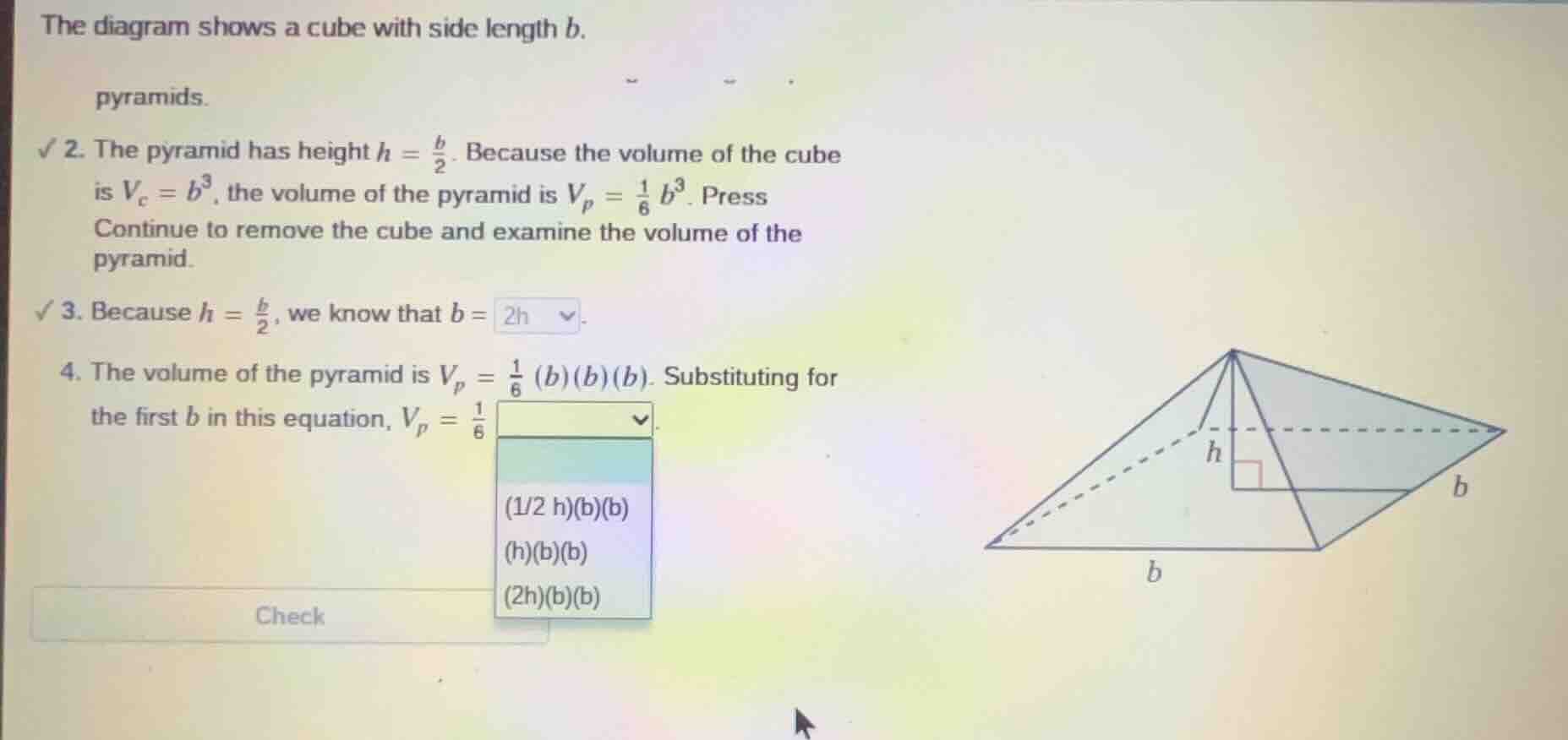
the diagram shows a cube with side length b. pyramids. 2. the pyramid has height ( h = \frac{b}{2} ). because the volume of the cube is ( v_c = b^3 ), the volume of the pyramid is ( v_p = \frac{1}{6}b^3 ). press continue to remove the cube and examine the volume of the pyramid. 3. because ( h = \frac{b}{2} ), we know that ( b = 2h ). 4. the volume of the pyramid is ( v_p = \frac{1}{6}(b)(b)(b) ). substituting for the first ( b ) in this equation, ( v_p = \frac{1}{6} ) (\boldsymbol{\text{dropdown options: } (1/2 h)(b)(b), (h)(b)(b), (2h)(b)(b)}). check
Step1: Recall the relationship between \( b \) and \( h \)
We know from step 3 that \( b = 2h \). So we need to substitute \( b \) with \( 2h \) in the first \( b \) of the expression \( \frac{1}{6}(b)(b)(b) \).
Step2: Substitute \( b = 2h \) into the formula
The original formula for the volume of the pyramid is \( V_p=\frac{1}{6}(b)(b)(b) \). Substituting the first \( b \) with \( 2h \), we get \( V_p = \frac{1}{6}(2h)(b)(b) \).

Snap & solve any problem in the app
Get step-by-step solutions on Sovi AI
Photo-based solutions with guided steps
Explore more problems and detailed explanations
\( (2h)(b)(b) \) (corresponding to the option \( (2h)(b)(b) \))