QUESTION IMAGE
Question
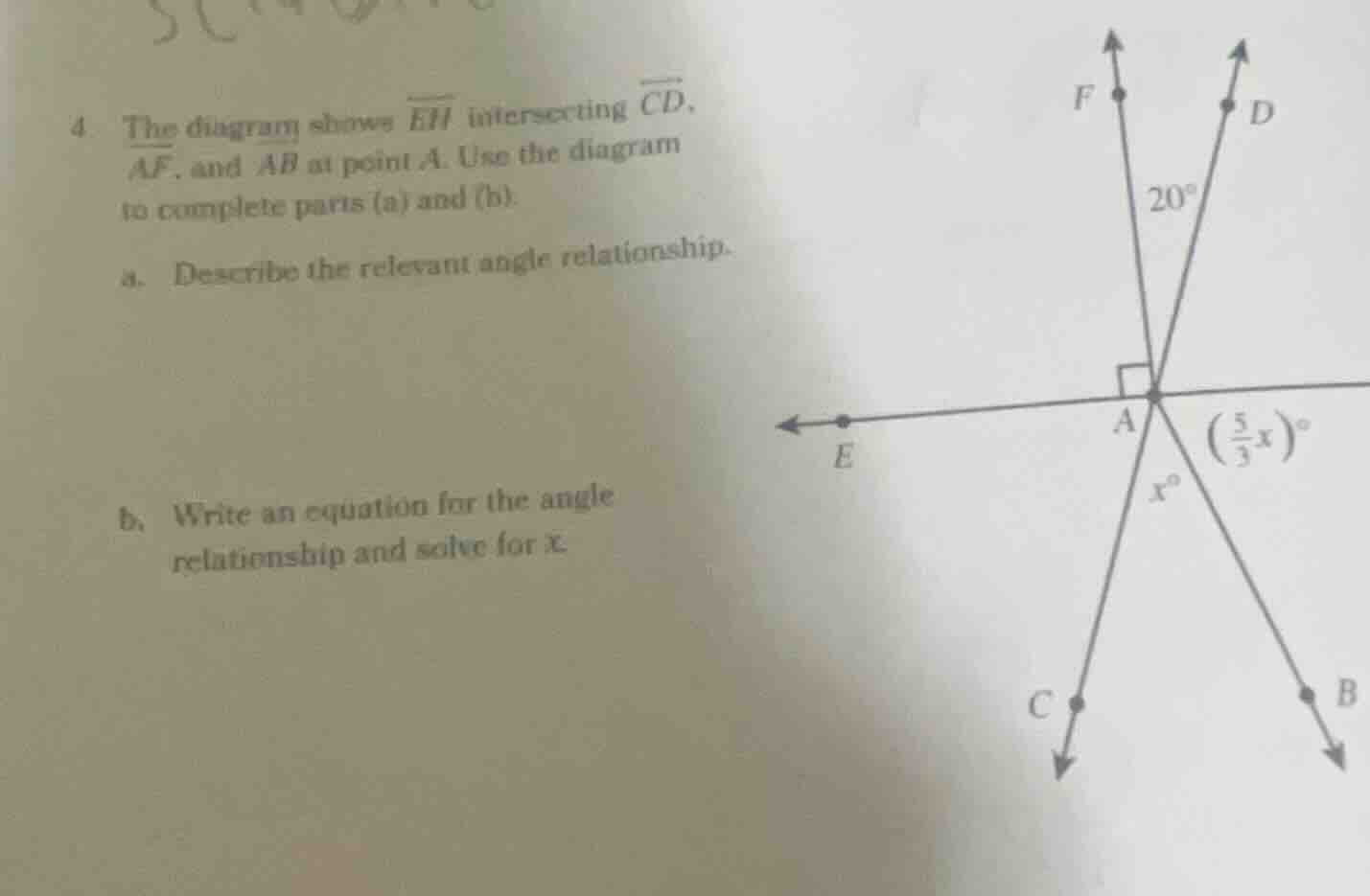
- the diagram shows $overline{eh}$ intersecting $overline{cd}$, $overline{af}$, and $overline{ab}$ at point $a$. use the diagram to complete parts (a) and (b).
a. describe the relevant angle relationship.
b. write an equation for the angle relationship and solve for $x$.
Part (a)
Looking at the diagram, we see that \( \angle FAD = 20^\circ \), \( \angle FAE \) is a right angle (\( 90^\circ \)), and the angles around point \( A \) on one side of the straight line \( EH \) (or the angles related to the right angle and the given angles) should sum up appropriately. Also, the angles \( x^\circ \), \( \frac{5}{3}x^\circ \), along with the right angle and the \( 20^\circ \) angle, might be related to supplementary or complementary angles, but more precisely, since \( EH \) is a straight line (so a straight angle is \( 180^\circ \)) and there's a right angle (\( 90^\circ \)) between \( E \) and \( F \) (or related rays), the relevant angle relationship is that the sum of the right angle (\( 90^\circ \)), the \( 20^\circ \) angle, \( x^\circ \), and \( \frac{5}{3}x^\circ \) should equal \( 180^\circ \) (since they are on a straight line, forming a linear pair or supplementary angles with the right angle considered). Alternatively, the angles \( x \) and \( \frac{5}{3}x \) along with the \( 20^\circ \) and the right angle make up a straight angle (180 degrees). So the relevant angle relationship is that the sum of \( 90^\circ \), \( 20^\circ \), \( x^\circ \), and \( \frac{5}{3}x^\circ \) is \( 180^\circ \) (they are supplementary as they lie on a straight line, forming a linear pair with the right angle - related angles).
Step 1: Set up the equation
From the angle relationship in part (a), we know that \( 90 + 20 + x + \frac{5}{3}x = 180 \). First, combine the constant terms: \( 90 + 20 = 110 \), so the equation becomes \( 110 + x + \frac{5}{3}x = 180 \).
Step 2: Combine like terms (the \( x \) terms)
To combine \( x \) and \( \frac{5}{3}x \), we can write \( x \) as \( \frac{3}{3}x \). So \( \frac{3}{3}x + \frac{5}{3}x = \frac{8}{3}x \). Now the equation is \( 110 + \frac{8}{3}x = 180 \).
Step 3: Solve for \( x \)
Subtract 110 from both sides: \( \frac{8}{3}x = 180 - 110 = 70 \). Then multiply both sides by \( \frac{3}{8} \) to isolate \( x \): \( x = 70\times\frac{3}{8} = \frac{210}{8} = \frac{105}{4} = 26.25 \). Wait, no, wait, maybe I made a mistake in the angle relationship. Wait, looking again: the right angle is between \( E \) and \( F \), so the angles on the right side of the right angle (towards \( D \), \( B \), \( C \)): the straight line is \( EH \), so from \( E \) to the right is 180 degrees. The right angle is \( 90^\circ \) (between \( E \) and \( F \)), then \( \angle FAD = 20^\circ \), then \( \angle DAB = \frac{5}{3}x \), and \( \angle BAC = x \). Wait, maybe the correct angle relationship is that the sum of \( 20^\circ \), \( \frac{5}{3}x^\circ \), \( x^\circ \), and the right angle's complement? No, wait, the right angle is \( 90^\circ \), so the angles from \( F \) to \( B \) to \( C \) to the right side of \( EH \): actually, the straight line is \( EH \), so the total angle on one side (from \( E \) to the right) is \( 180^\circ \). The right angle is \( 90^\circ \) (between \( E \) and \( F \)), so the angles from \( F \) to \( H \) (the right side) should sum to \( 90^\circ \)? Wait, no, the diagram shows a right angle symbol between \( E \) and \( F \), so \( \angle EAF = 90^\circ \). Then, the angles \( \angle FAD = 20^\circ \), \( \angle DAB = \frac{5}{3}x \), \( \angle BAC = x \), and these three angles plus \( \angle EAF \) should sum to \( 180^\circ \) (since \( EH \) is a straight line). So \( 90 + 20 + \frac{5}{3}x + x = 180 \). Let's recalculate:
Step 1: Correct equation setup
\( 90 + 20 + \frac{5}{3}x + x = 180 \)
Combine constants: \( 90 + 20 = 110 \)
Combine \( x \) terms: \( x + \frac{5}{3}x = \frac{3}{3}x + \frac{5}{3}x = \frac{8}{3}x \)
So equation: \( 110 + \frac{8}{3}x = 180 \)
Step 2: Subtract 110 from both sides
\( \frac{8}{3}x = 180 - 110 = 70 \)
Step 3: Multiply both sides by \( \frac{3}{8} \)
\( x = 70\times\frac{3}{8} = \frac{210}{8} = \frac{105}{4} = 26.25 \)? Wait, that seems odd. Wait, maybe the right angle is between \( F \) and the horizontal line? No, the diagram shows a right angle at \( A \) between the horizontal line ( \( E \) to the right) and \( F \). So the horizontal line is \( EH \), with \( E \) on the left and \( H \) on the right? Wait, no, the arrow for \( E \) is left, and the right side is the other direction. Wait, maybe the straight line is \( EH \), so from \( E \) (left) to \( H \) (right) is 180 degrees. The right angle is between \( E \) and \( F \), so \( \angle EAF = 90^\circ \), so the angles from \( F \) to \( H \) (right side) should sum to \( 90^\circ \). Wait, that's the mistake! The right angle is \( 90^\circ \), so \( \angle EAF = 90^\circ \), so the angles \( \angle FAD = 20^\circ \), \( \angle DAB = \frac{5}{3}x \), and \( \angle BAC = x \) should sum to \( 90^\circ \), because \( \angle EAF = 90^\circ \), and \( \angle FAD + \angle DAB + \angle BAC = \angle FAC \) (or related) which is complementary to \( \angle EAF \)? No, wait, the diagram:…

Snap & solve any problem in the app
Get step-by-step solutions on Sovi AI
Photo-based solutions with guided steps
Explore more problems and detailed explanations
The relevant angle relationship is that the sum of the right angle (\( 90^\circ \)), \( 20^\circ \), \( x^\circ \), and \( \frac{5}{3}x^\circ \) equals \( 180^\circ \) (these angles lie on a straight line, so they are supplementary).