QUESTION IMAGE
Question
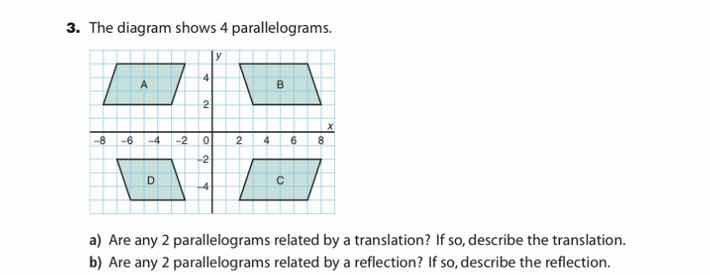
- the diagram shows 4 parallelograms.
a) are any 2 parallelograms related by a translation? if so, describe the translation.
b) are any 2 parallelograms related by a reflection? if so, describe the reflection.
Part (a)
Step 1: Analyze Translation Properties
Translation moves a figure without rotation/reflection. Check coordinates (assume grid units, e.g., A: left, B: right; D: left-bottom, C: right-bottom).
For A and B: A is at \( x \approx -8 \) to \( -2 \), B at \( x \approx 2 \) to \( 8 \). The horizontal distance: \( 2 - (-8) = 10 \)? Wait, better: A to B: shift right by 10 units? Wait, A's leftmost x: -8, B's leftmost x: 2. \( 2 - (-8) = 10 \)? Wait, no, let's check coordinates. Let's take a vertex of A: say top-left of A: (-8,4), top-left of B: (2,4). So from (-8,4) to (2,4): change in x is \( 2 - (-8) = 10 \), y same. Similarly, D and C: D's top-left: (-8,-2), C's top-left: (2,-2). So D to C: shift right by 10 units. So A to B: translation right 10 units (or B to A left 10). D to C: translation right 10 units.
Step 2: Confirm Translation
Translation preserves shape, direction. A and B: same shape, y-coordinate range (2-4 for A, 2-4 for B? Wait, A: y from 2 to 4, B: y from 2 to 4. D: y from -4 to -2, C: y from -4 to -2. So A to B: translate right 10 units (or D to C: right 10 units).
Reflection over y-axis (x=0) swaps left/right. Check A and D: A is top-left, D is bottom-left. Wait, A and D: A is above x-axis, D is below, same x-range (-8 to -2). Reflect A over x-axis: would go to D? Wait, A's y: 2-4, D's y: -4 to -2. So A to D: reflection over x-axis (since (x,y) → (x,-y)). Similarly, B and C: B's y: 2-4, C's y: -4 to -2. B to C: reflection over x-axis. Also, A and D: A (top) and D (bottom) same x, opposite y. B and C: same x, opposite y. Also, A and D: reflect over x-axis. B and C: reflect over x-axis. Also, check y-axis reflection: A (left) and B (right) same y, opposite x. Wait, A: x from -8 to -2, B: 2 to 8 (symmetric over x=0: -8 and 8, -2 and 2). So A and B: reflect over y-axis? Wait, A's right x: -2, B's left x: 2. \( -2 \) and \( 2 \) are symmetric over x=0. So A to B: reflect over y-axis? Wait no, earlier thought translation, but wait: A's coordinates: left x: -8, right x: -2; B's left x: 2, right x: 8. So -8 and 8, -2 and 2: symmetric over y-axis (x=0). So A and B: reflection over y-axis? Wait, no, translation was 10 units right, but also, (-8,4) reflected over y-axis is (8,4), but B's top-right is (8,4). Wait, A's top-right: (-2,4), reflected over y-axis is (2,4), which is B's top-left. Wait, maybe A and B: reflection over y-axis? Wait, let's take A: vertices (-8,4), (-2,4), (-2,2), (-8,2) (assuming a parallelogram with height 2, base 6). B: (2,4), (8,4), (8,2), (2,2). So A's vertices: (-8,4), (-2,4), (-2,2), (-8,2). B's vertices: (2,4), (8,4), (8,2), (2,2). So A to B: reflect over y-axis: (-8,4)→(8,4), (-2,4)→(2,4), (-2,2)→(2,2), (-8,2)→(8,2). Which matches B's vertices. Oh! So A and B: reflection over y-axis. Similarly, D: vertices (-8,-2), (-2,-2), (-2,-4), (-8,-4). C: (2,-2), (8,-2), (8,-4), (2,-4). So D to C: reflection over y-axis. Also, A and D: A (top) and D (bottom): A's vertices (-8,4), (-2,4), (-2,2), (-8,2); D's vertices (-8,-2), (-2,-2), (-2,-4), (-8,-4). So A to D: reflect over x-axis (y=0): (x,y)→(x,-y). So (-8,4)→(-8,-4)? Wait, no, D's top is y=-2? Wait, maybe my vertex assumption is wrong. Let's correct: A: top side y=4 to 2 (height 2), so A's vertices: (-8,4), (-2,4), (-2,2), (-8,2). D's vertices: (-8,-2), (-2,-2), (-2,-4), (-8,-4). So A to D: reflect over x-axis (since (x,4)→(x,-4)? No, D's y is -2 to -4. Wait, maybe A's bottom y is 2, D's top y is -2. So vertical distance: 2 - (-2) = 4, so midline y=0. So A to D: reflection over x-axis (y=0). Similarly, B to C: reflection over x-axis.
So two types of reflections: over y-axis (A↔B, D↔C) and over x-axis (A↔D, B↔C).

Snap & solve any problem in the app
Get step-by-step solutions on Sovi AI
Photo-based solutions with guided steps
Explore more problems and detailed explanations
(a): Yes, e.g., Parallelogram A to B: translation 10 units right (or D to C: 10 units right).