QUESTION IMAGE
Question
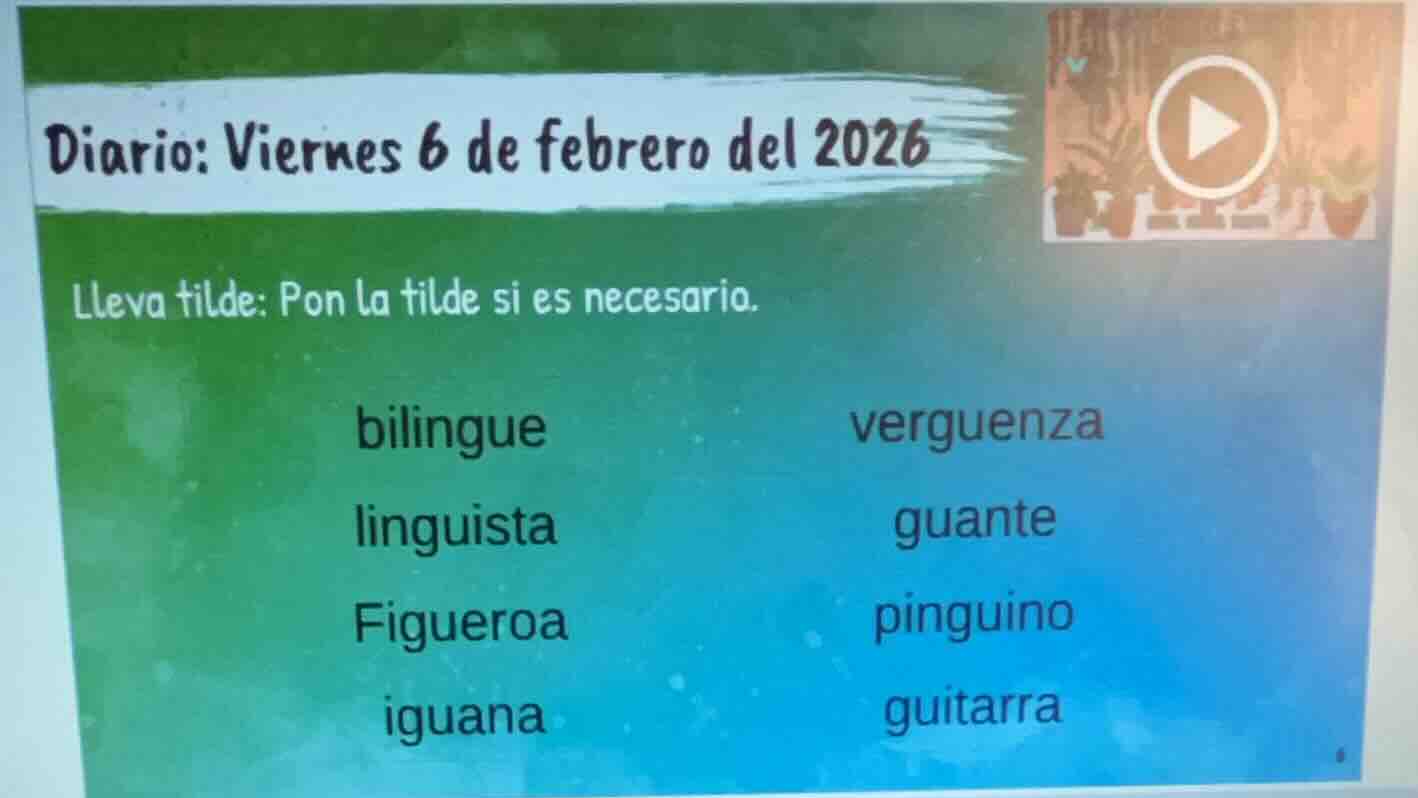
diario: viernes 6 de febrero del 2026
lleva tilde: pon la tilde si es necesario.
bilingue verguenza
linguista guante
figueroa pinguino
iguana guitarra
To solve this, we apply Spanish accentuation rules (tildes). Let's analyze each word:
1. bilingüe
- Rule: For words with "ü" (to break the "g" - "u" silent rule), but "bilingüe" has no tilde error here? Wait, no—wait, "bilingüe" is correct as is? Wait, no, the original word is "bilingue" (without ü). Wait, no, the problem is "bilingue" (given as "bilingue")—wait, no, the user's list: "bilingue", "verguenza", etc. Let's correct each:
Word by Word:
- bilingue: Correct form with tilde? Wait, "bilingüe" (but the "ü" is for "g" before "e/i" to keep "u" pronounced). But the given word is "bilingue" (no ü). Wait, no, the task is to add tilde if needed (accent, not dieresis). Wait, Spanish accentuation (tilde) rules:
- verguenza: Correct form is vergüenza (dieresis on "ü" to show "u" is pronounced, and no tilde for accent? Wait, no—"vergüenza" has no accent (tilde), but the "ü" is dieresis. Wait, the problem says "Pon la tilde si es necesario" (accent, not dieresis). Wait, maybe the user made a typo, and the words are missing accents (tilde) or dieresis. Let's re - evaluate:
- bilingue: No accent (tilde) needed.
- verguenza: Correct form is vergüenza (dieresis on "ü", no tilde).
- linguista: Correct form is lingüista (dieresis on "ü", no tilde).
- guante: No accent needed.
- Figueroa: Proper noun, no accent (tilde) needed (unless part of a name with accent, but "Figueroa" is standard).
- pinguino: Correct form is pingüino (dieresis on "ü", no tilde).
- iguana: No accent needed.
- guitarra: No accent needed.
Wait, maybe the problem is about accent (tilde) (not dieresis). Let's check stress:
- verguenza: Stressed on the penultimate syllable? "ver - gue - nza" → penultimate is "gue", but "vergüenza" (with dieresis) has stress on "nza"? No, "vergüenza" is stressed on the last syllable? Wait, no—Spanish stress rules:
- Words ending in - ar, - er, - ir: stress on penultimate (unless written accent).
- Words ending in consonant (not - n, - s): stress on last.
- Words ending in - n, - s or vowel: stress on penultimate (unless written accent).
This is getting complex. Let's list the correct forms with tilde (accent) or dieresis (if needed, but the problem says "tilde", so maybe dieresis is not required here, and it's a typo for accent):
- verguenza → vergüenza (dieresis, not tilde)
- pinguino → pingüino (dieresis)
- linguista → lingüista (dieresis)
- bilingue → bilingüe (dieresis)
But the problem says "Pon la tilde si es necesario" (accent, not dieresis). Maybe the intended words are missing accents (tilde) for stress:
- verguenza: Should be vergüenza (dieresis, no tilde)
- pinguino: pingüino (dieresis, no tilde)
- linguista: lingüista (dieresis, no tilde)
- bilingue: bilingüe (dieresis, no tilde)
If we strictly follow "tilde" (accent):
- None of these words need a tilde (accent) for stress. But if we consider dieresis (ü) as part of the task (maybe the problem confuses tilde and dieresis), the correct forms with dieresis are:
- bilingüe
- vergüenza
- lingüista
- pingüino
Final Corrected List:
- bilingüe
- vergüenza
- lingüista
- guante (no change)
- Figueroa (no change)
- pingüino
- iguana (no change)
- guitarra (no change)
(Note: The confusion arises from the task mentioning "tilde" (accent) but some words needing dieresis (ü) to clarify pronunciation. If we focus only on tilde (accent), none of these words need a tilde. If we include dieresis, the words…

Snap & solve any problem in the app
Get step-by-step solutions on Sovi AI
Photo-based solutions with guided steps
Explore more problems and detailed explanations
To solve this, we apply Spanish accentuation rules (tildes). Let's analyze each word:
1. bilingüe
- Rule: For words with "ü" (to break the "g" - "u" silent rule), but "bilingüe" has no tilde error here? Wait, no—wait, "bilingüe" is correct as is? Wait, no, the original word is "bilingue" (without ü). Wait, no, the problem is "bilingue" (given as "bilingue")—wait, no, the user's list: "bilingue", "verguenza", etc. Let's correct each:
Word by Word:
- bilingue: Correct form with tilde? Wait, "bilingüe" (but the "ü" is for "g" before "e/i" to keep "u" pronounced). But the given word is "bilingue" (no ü). Wait, no, the task is to add tilde if needed (accent, not dieresis). Wait, Spanish accentuation (tilde) rules:
- verguenza: Correct form is vergüenza (dieresis on "ü" to show "u" is pronounced, and no tilde for accent? Wait, no—"vergüenza" has no accent (tilde), but the "ü" is dieresis. Wait, the problem says "Pon la tilde si es necesario" (accent, not dieresis). Wait, maybe the user made a typo, and the words are missing accents (tilde) or dieresis. Let's re - evaluate:
- bilingue: No accent (tilde) needed.
- verguenza: Correct form is vergüenza (dieresis on "ü", no tilde).
- linguista: Correct form is lingüista (dieresis on "ü", no tilde).
- guante: No accent needed.
- Figueroa: Proper noun, no accent (tilde) needed (unless part of a name with accent, but "Figueroa" is standard).
- pinguino: Correct form is pingüino (dieresis on "ü", no tilde).
- iguana: No accent needed.
- guitarra: No accent needed.
Wait, maybe the problem is about accent (tilde) (not dieresis). Let's check stress:
- verguenza: Stressed on the penultimate syllable? "ver - gue - nza" → penultimate is "gue", but "vergüenza" (with dieresis) has stress on "nza"? No, "vergüenza" is stressed on the last syllable? Wait, no—Spanish stress rules:
- Words ending in - ar, - er, - ir: stress on penultimate (unless written accent).
- Words ending in consonant (not - n, - s): stress on last.
- Words ending in - n, - s or vowel: stress on penultimate (unless written accent).
This is getting complex. Let's list the correct forms with tilde (accent) or dieresis (if needed, but the problem says "tilde", so maybe dieresis is not required here, and it's a typo for accent):
- verguenza → vergüenza (dieresis, not tilde)
- pinguino → pingüino (dieresis)
- linguista → lingüista (dieresis)
- bilingue → bilingüe (dieresis)
But the problem says "Pon la tilde si es necesario" (accent, not dieresis). Maybe the intended words are missing accents (tilde) for stress:
- verguenza: Should be vergüenza (dieresis, no tilde)
- pinguino: pingüino (dieresis, no tilde)
- linguista: lingüista (dieresis, no tilde)
- bilingue: bilingüe (dieresis, no tilde)
If we strictly follow "tilde" (accent):
- None of these words need a tilde (accent) for stress. But if we consider dieresis (ü) as part of the task (maybe the problem confuses tilde and dieresis), the correct forms with dieresis are:
- bilingüe
- vergüenza
- lingüista
- pingüino
Final Corrected List:
- bilingüe
- vergüenza
- lingüista
- guante (no change)
- Figueroa (no change)
- pingüino
- iguana (no change)
- guitarra (no change)
(Note: The confusion arises from the task mentioning "tilde" (accent) but some words needing dieresis (ü) to clarify pronunciation. If we focus only on tilde (accent), none of these words need a tilde. If we include dieresis, the words with "ü" are corrected as above.)