QUESTION IMAGE
Question
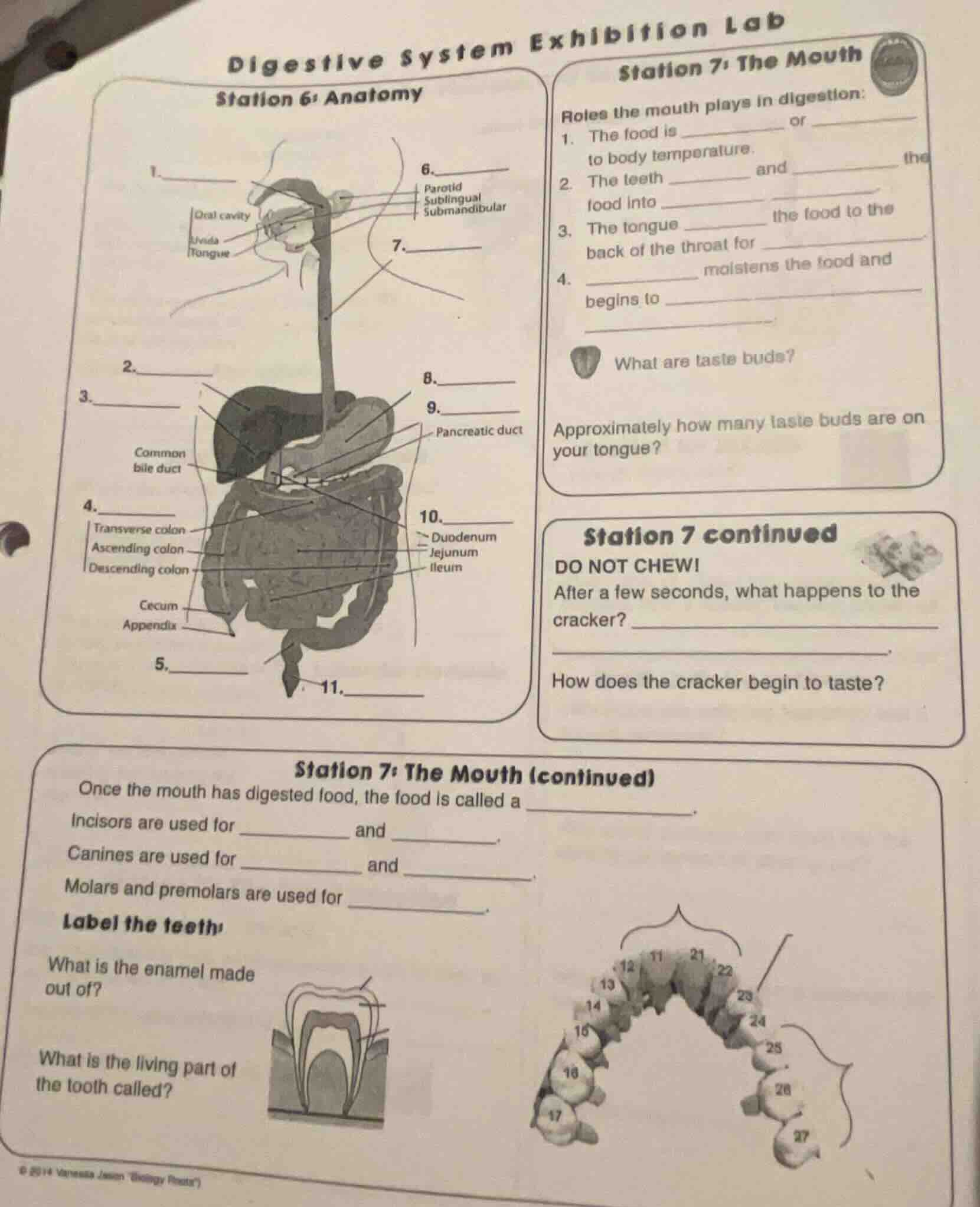
digestive system exhibition lab
station 6: anatomy
- ______
- ______
- ______
- ______
- ______
- ______
- ______
- ______
- ______
- ______
- ______
(diagram of digestive system with labels: oral cavity, uvula, tongue, common bile duct, transverse colon, ascending colon, descending colon, cecum, appendix, parotid, sublingual, submandibular, duodenum, jejunum, ileum, pancreatic duct)
station 7: the mouth
roles the mouth plays in digestion:
- the food is ____ or ____ to body temperature.
- the teeth ____ and __ the food into ____
- the tongue ____ the food to the back of the throat for ____
- ____ moistens the food and begins to ____
what are taste buds?
approximately how many taste buds are on your tongue?
station 7 continued
do not chew!
after a few seconds, what happens to the cracker? ______
how does the cracker begin to taste?
station 7: the mouth (continued)
once the mouth has digested food, the food is called a ______.
incisors are used for ____ and ____.
canines are used for ____ and ____.
molars and premolars are used for ______.
label the teeth
what is the enamel made out of?
what is the living part of the tooth called?
(diagrams of a tooth and a dental arch with numbered teeth)
Step1: Label Digestive Anatomy
- Oral cavity
- Liver
- Gallbladder
- Large intestine (colon)
- Rectum
- Salivary glands (Parotid, Sublingual, Submandibular)
- Esophagus
- Stomach
- Pancreas
- Small intestine (Duodenum, Jejunum, Ileum)
- Anus
Step2: Station 7 (Mouth Roles)
- The food is warmed or cooled to body temperature.
- The teeth grind and break the food into small pieces/bolus.
- The tongue moves the food to the back of the throat for swallowing.
- Saliva moistens the food and begins to break down carbohydrates (starches).
- What are taste buds? Sensory organs on the tongue that detect taste (sweet, sour, salty, bitter, umami).
- Approximately how many taste buds are on your tongue? ~10,000
Step3: Station 7 Continued
- After a few seconds, what happens to the cracker? It softens and begins to dissolve.
- How does the cracker begin to taste? It starts to taste sweet (from saliva breaking down starch into sugar).
Step4: Station 7 (Mouth, Continued)
- Once the mouth has digested food, the food is called a bolus.
- Incisors are used for biting and cutting.
- Canines are used for tearing and piercing.
- Molars and premolars are used for grinding and crushing.
- What is the enamel made out of? Hard calcium phosphate mineral.
- What is the living part of the tooth called? Pulp (contains nerves and blood vessels).

Snap & solve any problem in the app
Get step-by-step solutions on Sovi AI
Photo-based solutions with guided steps
Explore more problems and detailed explanations
Station 6: Anatomy Labels
- Oral cavity
- Liver
- Gallbladder
- Large intestine (colon)
- Rectum
- Salivary glands (Parotid, Sublingual, Submandibular)
- Esophagus
- Stomach
- Pancreas
- Small intestine (Duodenum, Jejunum, Ileum)
- Anus
Station 7: The Mouth
- warmed; cooled
- grind; break; small pieces/bolus
- moves; swallowing
- Saliva; break down carbohydrates (starches)
- What are taste buds? Sensory organs on the tongue that detect the five basic tastes (sweet, sour, salty, bitter, umami).
- Approximately how many taste buds are on your tongue? ~10,000
Station 7 Continued
- After a few seconds, what happens to the cracker? It softens and starts to dissolve.
- How does the cracker begin to taste? It takes on a sweet flavor (as saliva breaks starch into sugar).
Station 7: The Mouth (Continued)
- Once the mouth has digested food, the food is called a bolus.
- Incisors are used for biting and cutting.
- Canines are used for tearing and piercing.
- Molars and premolars are used for grinding and crushing.
- What is the enamel made out of? Calcium phosphate (hard mineral)
- What is the living part of the tooth called? Pulp