QUESTION IMAGE
Question
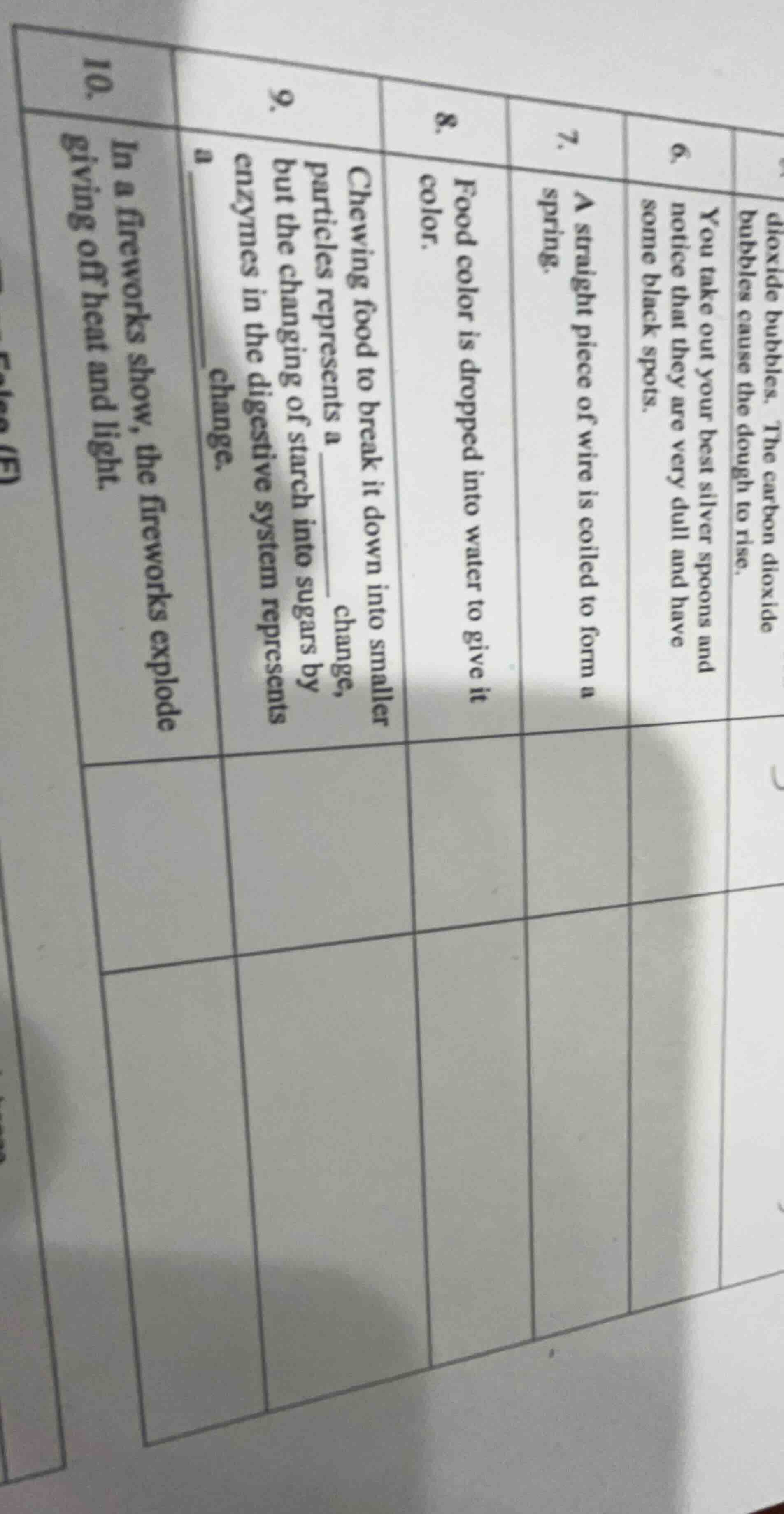
- dioxide bubbles. the carbon dioxide bubbles cause the dough to rise. you take out your best silver spoons and notice that they are very dull and have some black spots. 7. a straight piece of wire is coiled to form a spring. 8. food color is dropped into water to give it color. 9. chewing food to break it down into smaller particles represents a ____ change, but the changing of starch into sugars by enzymes in the digestive system represents a ____ change. 10. in a fireworks show, the fireworks explode giving off heat and light.
To solve these fill - in - the - blank questions about physical and chemical changes, we analyze each situation:
Question 6
When silver spoons become dull and have black spots, silver reacts with substances in the air (like sulfur compounds) to form silver sulfide. Since a new substance is formed, this is a chemical change.
Question 7
Coiling a straight wire into a spring only changes the shape of the wire. There is no new substance formed. So, this is a physical change.
Question 8
When food color is dropped into water to give it color, the food color just dissolves in the water. The chemical composition of both the food color and water remains essentially the same (no new substance is formed). Thus, this is a physical change.
Question 9
- Chewing food to break it down into smaller particles only changes the physical state (size) of the food. No new substance is created in this process. So, this is a physical change.
- The changing of starch into sugars by enzymes in the digestive system involves a chemical reaction where starch (a complex carbohydrate) is converted into simpler sugars (like glucose). A new substance is formed, so this is a chemical change.
Question 10
In a fireworks show, when fireworks explode, they undergo a series of chemical reactions. These reactions produce heat, light, and new substances (like various gases and metal oxides). So, this is a chemical change.
Final Answers (filling in the blanks):
- chemical
- physical
- physical
- physical; chemical
- chemical

Snap & solve any problem in the app
Get step-by-step solutions on Sovi AI
Photo-based solutions with guided steps
Explore more problems and detailed explanations
To solve these fill - in - the - blank questions about physical and chemical changes, we analyze each situation:
Question 6
When silver spoons become dull and have black spots, silver reacts with substances in the air (like sulfur compounds) to form silver sulfide. Since a new substance is formed, this is a chemical change.
Question 7
Coiling a straight wire into a spring only changes the shape of the wire. There is no new substance formed. So, this is a physical change.
Question 8
When food color is dropped into water to give it color, the food color just dissolves in the water. The chemical composition of both the food color and water remains essentially the same (no new substance is formed). Thus, this is a physical change.
Question 9
- Chewing food to break it down into smaller particles only changes the physical state (size) of the food. No new substance is created in this process. So, this is a physical change.
- The changing of starch into sugars by enzymes in the digestive system involves a chemical reaction where starch (a complex carbohydrate) is converted into simpler sugars (like glucose). A new substance is formed, so this is a chemical change.
Question 10
In a fireworks show, when fireworks explode, they undergo a series of chemical reactions. These reactions produce heat, light, and new substances (like various gases and metal oxides). So, this is a chemical change.
Final Answers (filling in the blanks):
- chemical
- physical
- physical
- physical; chemical
- chemical