QUESTION IMAGE
Question
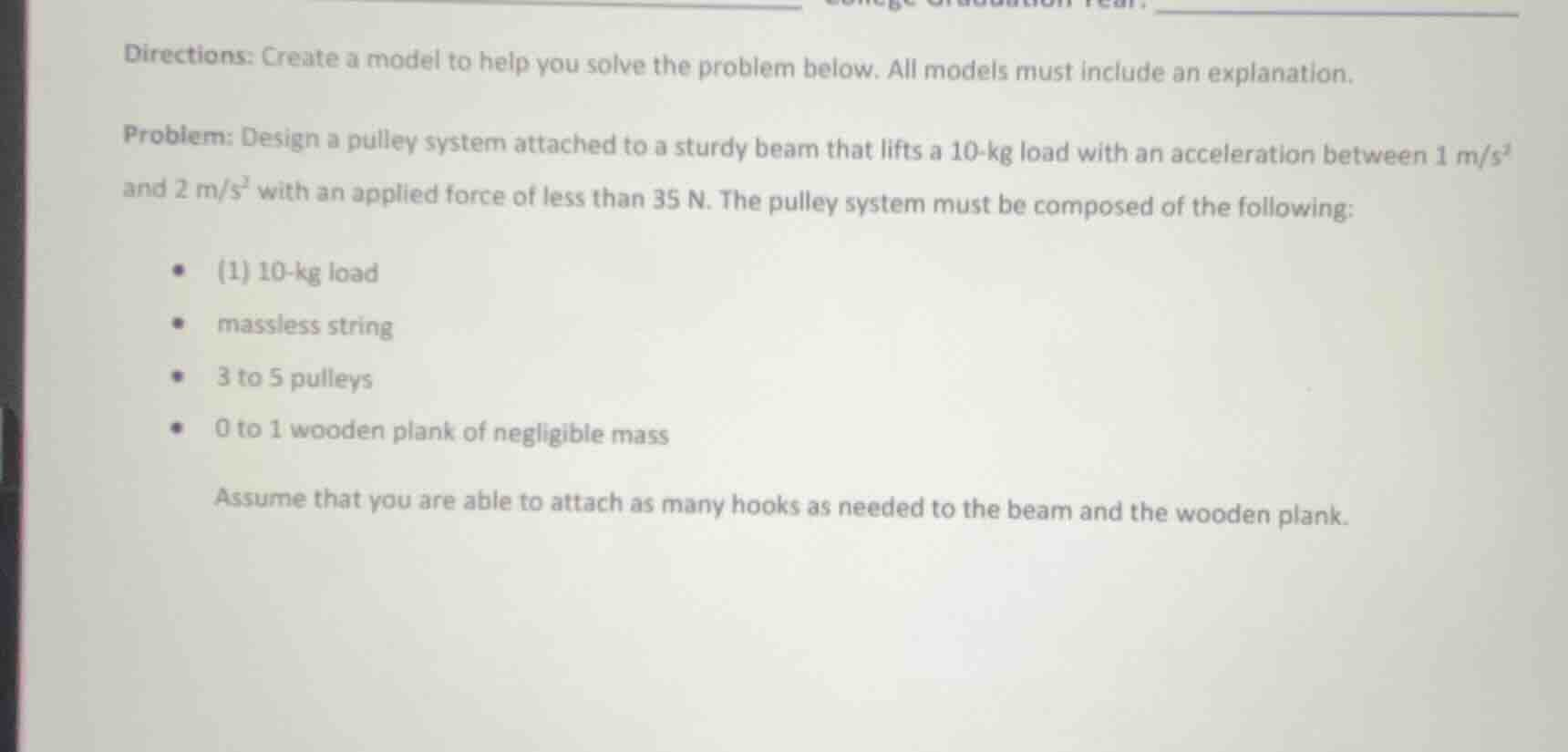
directions: create a model to help you solve the problem below. all models must include an explanation. problem: design a pulley system attached to a sturdy beam that lifts a 10-kg load with an acceleration between 1 m/s² and 2 m/s² with an applied force of less than 35 n. the pulley system must be composed of the following: (1) 10-kg load, massless string, 3 to 5 pulleys, 0 to 1 wooden plank of negligible mass. assume that you are able to attach as many hooks as needed to the beam and the wooden plank.
Step1: Analyze the forces on the load
The load has a mass \( m = 10\space kg \). Let the acceleration be \( a \) (between \( 1\space m/s^2 \) and \( 2\space m/s^2 \)) and the tension in the string supporting the load be \( T \). Using Newton's second law \( F_{net}=ma \), for the load, the net force is \( T - mg=ma \) (taking upward as positive). So \( T=m(g + a) \).
For \( a = 1\space m/s^2 \), \( T_1=10\times(9.8 + 1)=10\times10.8 = 108\space N \)
For \( a = 2\space m/s^2 \), \( T_2=10\times(9.8+ 2)=10\times11.8 = 118\space N \)
Step2: Relate tension to applied force in pulley system
In a pulley system with \( n \) supporting ropes (ideal pulleys, massless string), the applied force \( F=\frac{T}{n} \) (since the tension is distributed among \( n \) ropes). We need \( F<35\space N \).
Let's find the number of supporting ropes \( n \) required.
For \( T = 108\space N \), \( n_1=\frac{T_1}{F}=\frac{108}{35}\approx3.09 \)
For \( T = 118\space N \), \( n_2=\frac{T_2}{F}=\frac{118}{35}\approx3.37 \)
Since \( n \) must be an integer (number of pulleys and ropes), we need at least 4 supporting ropes (so \( n = 4 \)).
Step3: Design the pulley system
We can use a combination of fixed and movable pulleys. Let's use 2 fixed pulleys and 2 movable pulleys (total of 4 pulleys, which is within 3 - 5 range).
- Attach 2 fixed pulleys to the beam.
- Attach 2 movable pulleys to the load and the wooden plank (if using the plank, we can attach the movable pulleys to it).
- Thread the massless string through the pulleys: start from the beam, go through a movable pulley, then a fixed pulley, then the other movable pulley, then the other fixed pulley, and the applied force is at the end.
In this system, the number of supporting ropes \( n = 4 \). Let's check the applied force for \( a = 2\space m/s^2 \) (worst - case, highest tension). \( T = 118\space N \), \( F=\frac{T}{4}=\frac{118}{4} = 29.5\space N<35\space N \), which satisfies the condition. For \( a = 1\space m/s^2 \), \( T = 108\space N \), \( F=\frac{108}{4}=27\space N<35\space N \)

Snap & solve any problem in the app
Get step-by-step solutions on Sovi AI
Photo-based solutions with guided steps
Explore more problems and detailed explanations
A pulley system with 2 fixed pulleys and 2 movable pulleys (total 4 pulleys) attached as follows: Attach 2 fixed pulleys to the beam. Attach 2 movable pulleys (either to the load or a wooden plank of negligible mass attached to the load). Thread a massless string through the pulleys: starting from the beam, pass through a movable pulley, then a fixed pulley, then the second movable pulley, then the second fixed pulley. The applied force is applied at the free end of the string. This system has 4 supporting ropes, so the applied force \( F=\frac{T}{4} \), and for the given acceleration range (\( 1\space m/s^2\) to \( 2\space m/s^2\)) and load mass (\( 10\space kg\)), the applied force is less than \( 35\space N \).