QUESTION IMAGE
Question
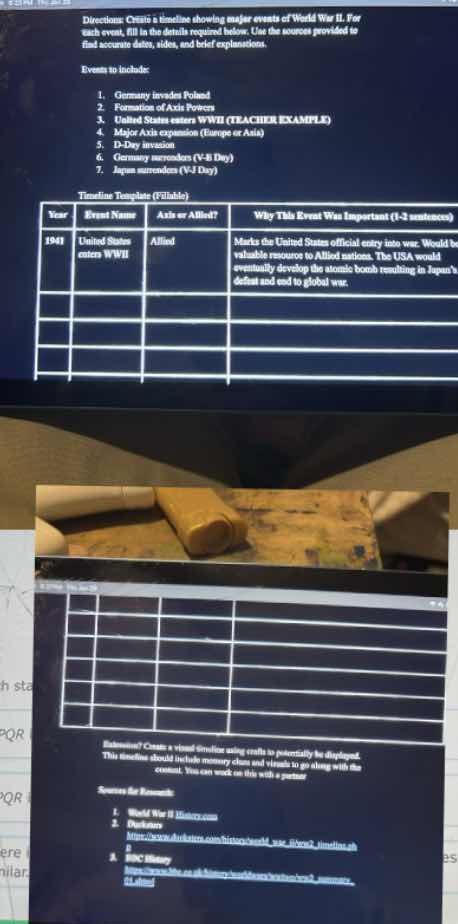
directions: create a timeline showing major events of world war ii. for each event, fill in the details required below. use the sources provided to find accurate dates, sides, and brief explanations.
events to include:
- germany invades poland
- formation of axis powers
- united states enters wwii (teacher example)
- major axis expansion (europe or asia)
- d - day invasion
- germany surrenders (v - e day)
- japan surrenders (v - j day)
timeline template (fillable)
| year | event name | axis or allied? | why this event was important (1 - 2 sentences) |
|---|---|---|---|
extension? create a visual timeline using crafts or poster - board. the timeline should include memory clues or visuals to go along with the content. you can work on this with a partner
sources for research:
- ducksters history
- https://www.ducksters.com/history/world_war_ii/world_war_ii_timeline.php
- bbc history
https://www.bbc.co.uk/history/worldwars/wwtwo/
Each entry follows the timeline template requirements, with accurate historical dates, clear alignment of each power to Axis or Allied forces, and concise 1-2 sentence explanations of the event's significance to World War II. Dates are based on standard historical records of each key event.

Snap & solve any problem in the app
Get step-by-step solutions on Sovi AI
Photo-based solutions with guided steps
Explore more problems and detailed explanations
- 1939 | Germany invades Poland | Axis | Marks the official start of World War II in Europe, as Britain and France declared war on Germany in response, igniting the global conflict.
- 1940 | Formation of Axis Powers | Axis | Formalized the military alliance between Germany, Italy, and Japan, unifying their expansionist goals and coordinating their wartime strategies across Europe and Asia.
- 1941 | United States enters WWII | Allied | Marks the United States' official entry into the war. The U.S. provided massive industrial, military, and financial resources to the Allies, turning the tide of the conflict and eventually leading to the development of the atomic bomb that forced Japan's surrender.
- 1942-1943 | Major Axis expansion (Europe or Asia) | Axis | Axis forces reached their territorial peak, controlling most of Western Europe, large parts of Eastern Europe, and much of Southeast Asia and the Pacific, putting the Allies on the defensive globally.
- 1944 | D-Day invasion | Allied | The largest amphibious invasion in history opened a second front in Western Europe, pushing German forces back toward Germany and accelerating the end of the war in Europe.
- 1945 | Germany surrenders (V-E Day) | Allied | Marked the formal end of Nazi Germany's resistance in Europe, bringing an end to the war in the European theater and allowing the Allies to focus fully on the final push against Japan.
- 1945 | Japan surrenders (V-J Day) | Allied | Brought the entire global conflict of World War II to a close, following the U.S. atomic bombings of Hiroshima and Nagasaki and the Soviet Union's declaration of war on Japan.