QUESTION IMAGE
Question
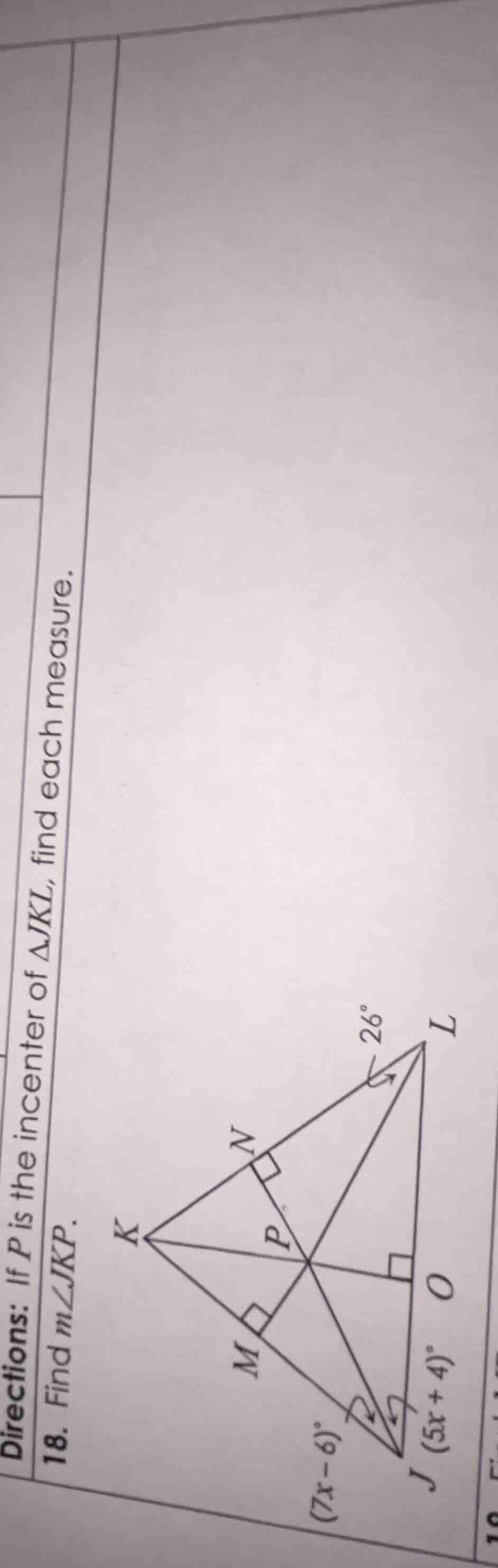
directions: if p is the incenter of δjkl, find each measure. 18. find m∠jkp.
Step1: Identify angle bisector property
Since \( P \) is the incenter, \( JM \) and \( JO \) are angle bisectors? Wait, no, the segments from \( J \) to \( M \) and \( J \) to \( O \) – wait, the lengths: \( JM = 7x - 6 \) and \( JO = 5x + 4 \)? Wait, no, actually, since \( P \) is the incenter, the perpendicular distances from \( P \) to the sides are equal, but also, the angle bisectors: Wait, the segments \( JM \) and \( JO \) – wait, maybe \( JM \) and \( JO \) are equal? Wait, no, \( JM \) and \( JO \) are perpendicular to \( KL \) and \( KJ \)? Wait, looking at the diagram, \( JM \perp KJ \)? No, \( M \) is on \( KJ \)? Wait, maybe \( JM \) and \( JO \) are the lengths of the angle bisectors? Wait, no, the problem has \( \angle J \) with angle bisector? Wait, the expressions \( 7x - 6 \) and \( 5x + 4 \) – maybe \( JM = JO \) because they are both from \( J \) to the incenter's perpendiculars? Wait, no, \( JM \) and \( JO \) are perpendicular to \( KJ \) and \( KL \)? Wait, \( M \) is on \( KJ \), \( O \) is on \( KL \), and \( JM \perp KJ \), \( JO \perp KL \)? No, \( JM \) is perpendicular to \( KL \)? Wait, the right angles: \( \angle JMK \) and \( \angle JOK \) are right angles? Wait, maybe \( JM \) and \( JO \) are the lengths of the angle bisectors? Wait, no, the incenter is the intersection of angle bisectors, and the distances from the incenter to the sides are equal. But here, \( JM \) and \( JO \) – maybe \( JM = JO \) because they are both the distance from \( J \) to the incenter along the angle bisector? Wait, no, let's re-express: Since \( P \) is the incenter, the angle bisectors of \( \angle J \) would make \( JM = JO \)? Wait, \( JM = 7x - 6 \) and \( JO = 5x + 4 \). So set them equal: \( 7x - 6 = 5x + 4 \).
Step2: Solve for \( x \)
\( 7x - 6 = 5x + 4 \)
Subtract \( 5x \) from both sides: \( 2x - 6 = 4 \)
Add 6 to both sides: \( 2x = 10 \)
Divide by 2: \( x = 5 \)
Step3: Find \( \angle J \) measure? Wait, no, we need \( m\angle JKP \). Wait, first, find the measure of \( \angle KJL \). Wait, \( JM = 7x - 6 = 7(5) - 6 = 35 - 6 = 29 \), \( JO = 5x + 4 = 25 + 4 = 29 \). Now, \( \angle KJL \): Wait, the other angle at \( L \): \( \angle KLJ = 26^\circ \), and its bisector? Wait, no, the problem is to find \( m\angle JKP \). Wait, \( P \) is the incenter, so \( KP \) bisects \( \angle JKL \). First, we need to find \( \angle JKL \). Wait, triangle \( JKL \): we know \( \angle KLJ = 26^\circ \), and we can find \( \angle KJL \). Wait, \( JM \) and \( JO \) are the angle bisectors? No, \( JM \) and \( JO \) are the lengths of the perpendiculars? Wait, no, \( JM \perp KJ \), \( JO \perp KL \), so \( JM = JO \) (since incenter is equidistant from all sides, but \( JM \) and \( JO \) are from \( J \) to the sides? Wait, no, \( JM \) is from \( J \) to \( M \) on \( KJ \), \( JO \) is from \( J \) to \( O \) on \( KL \). Wait, maybe \( \angle KJL \) is being bisected? Wait, the two segments \( 7x - 6 \) and \( 5x + 4 \) are the lengths of the angle bisectors? No, maybe \( \angle KJL \) is split into two equal angles, but the lengths \( JM \) and \( JO \) are equal. Wait, we found \( x = 5 \), so \( JM = 29 \), \( JO = 29 \). Now, in triangle \( JKL \), we have \( \angle KLJ = 26^\circ \), let's find \( \angle KJL \). Wait, but we need to find \( \angle JKP \), which is half of \( \angle JKL \). Wait, maybe first find \( \angle KJL \). Wait, no, let's re-express: The incenter \( P \) means \( KP \) bisects \( \angle JKL \), \( LP \) bisects \( \angle KLJ \), and \( JP \) bisects \( \angle KJL \). We know \( \ang…

Snap & solve any problem in the app
Get step-by-step solutions on Sovi AI
Photo-based solutions with guided steps
Explore more problems and detailed explanations
\( 64^\circ \)