QUESTION IMAGE
Question
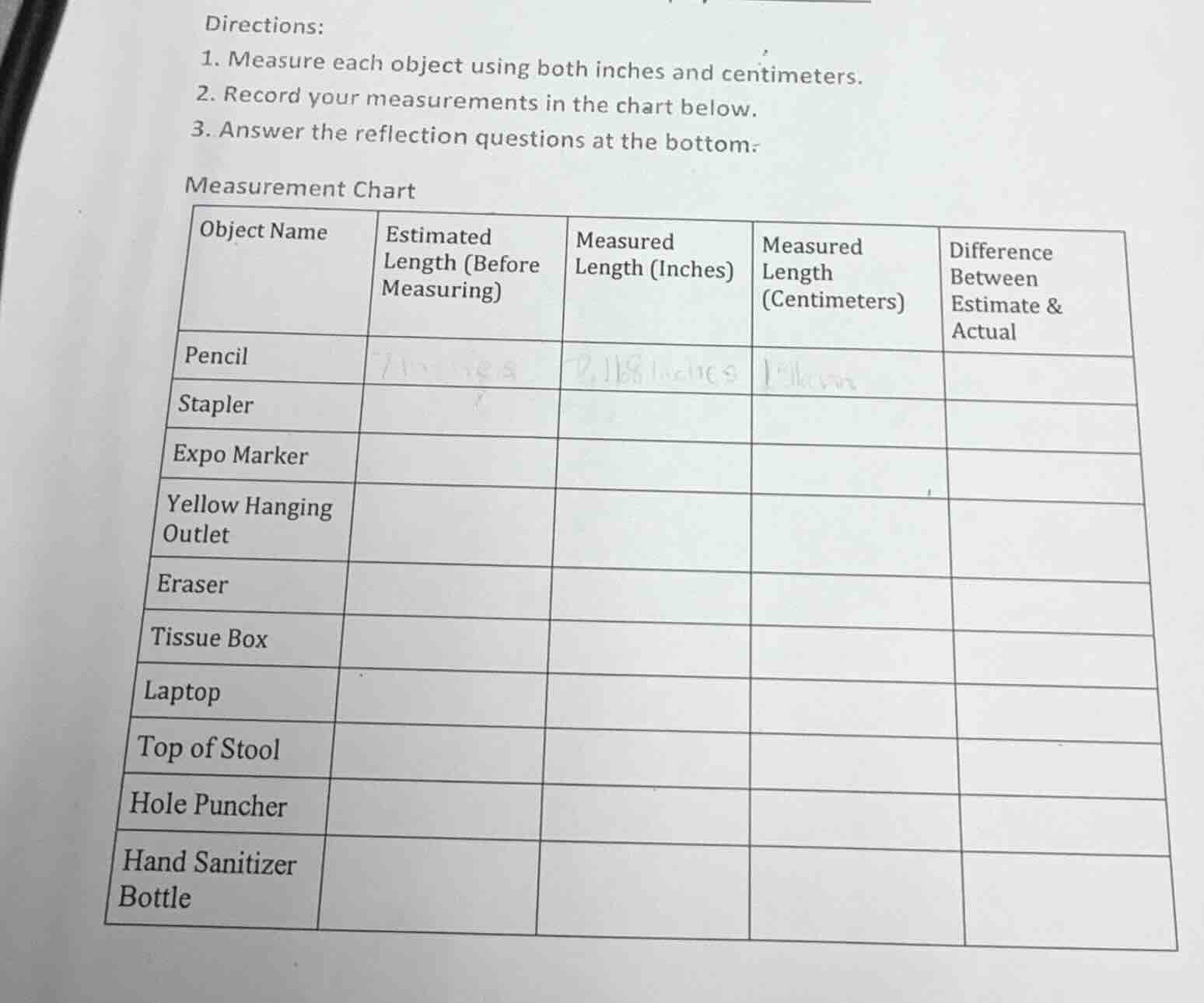
directions:
- measure each object using both inches and centimeters.
- record your measurements in the chart below.
- answer the reflection questions at the bottom.
measurement chart
| object name | estimated length (before measuring) | measured length (inches) | measured length (centimeters) | difference between estimate & actual |
|---|---|---|---|---|
| stapler | ||||
| expo marker | ||||
| yellow hanging outlet | ||||
| eraser | ||||
| tissue box | ||||
| laptop | ||||
| top of stool | ||||
| hole puncher | ||||
| hand sanitizer bottle |
This is a practical measurement activity. To complete it, you can follow these steps for each object (taking a pencil as an example, and you can do the same for other objects):
Step 1: Estimate the length
Look at the pencil and estimate its length in inches (or centimeters). For a typical pencil, you might estimate it to be 7 inches.
Step 2: Measure the length in inches
Use a ruler (in inches) to measure the actual length of the pencil. Let's say the measured length is 7.5 inches.
Step 3: Measure the length in centimeters
Use a ruler (in centimeters) to measure the actual length of the pencil. Since 1 inch is approximately 2.54 centimeters, a 7.5 - inch pencil would be approximately \(7.5\times2.54 = 19.05\) centimeters.
Step 4: Calculate the difference
Subtract the estimated length from the measured length. If the estimated length was 7 inches and the measured length was 7.5 inches, the difference is \(7.5 - 7=0.5\) inches (or in centimeters, if estimated in centimeters, do the same subtraction).
Repeat these steps for each object in the chart:
- Stapler: Estimate its length (e.g., 4 inches), measure in inches (e.g., 4.2 inches), convert to centimeters (\(4.2\times2.54 = 10.668\) cm), and find the difference (\(4.2 - 4 = 0.2\) inches).
- Expo Marker: Estimate (e.g., 6 inches), measure (e.g., 5.8 inches), convert (\(5.8\times2.54 = 14.732\) cm), difference (\(6 - 5.8 = 0.2\) inches).
- Yellow Hanging Outlet: Estimate (e.g., 3 inches), measure (e.g., 3.1 inches), convert (\(3.1\times2.54 = 7.874\) cm), difference (\(3.1 - 3 = 0.1\) inches).
- Eraser: Estimate (e.g., 2 inches), measure (e.g., 1.8 inches), convert (\(1.8\times2.54 = 4.572\) cm), difference (\(2 - 1.8 = 0.2\) inches).
- Tissue Box: Estimate (e.g., 8 inches), measure (e.g., 7.5 inches), convert (\(7.5\times2.54 = 19.05\) cm), difference (\(8 - 7.5 = 0.5\) inches).
- Laptop: Estimate (e.g., 15 inches), measure (e.g., 14.8 inches), convert (\(14.8\times2.54 = 37.592\) cm), difference (\(15 - 14.8 = 0.2\) inches).
- Top of Stool: Estimate (e.g., 12 inches), measure (e.g., 11.7 inches), convert (\(11.7\times2.54 = 29.718\) cm), difference (\(12 - 11.7 = 0.3\) inches).
- Hole Puncher: Estimate (e.g., 5 inches), measure (e.g., 4.9 inches), convert (\(4.9\times2.54 = 12.446\) cm), difference (\(5 - 4.9 = 0.1\) inches).
- Hand Sanitizer Bottle: Estimate (e.g., 4 inches), measure (e.g., 4.1 inches), convert (\(4.1\times2.54 = 10.414\) cm), difference (\(4.1 - 4 = 0.1\) inches).
After filling in the measurements for all objects, you can answer the reflection questions (which are not provided here, but usually related to comparing estimates and actual measurements, understanding the relationship between inches and centimeters, etc.).
If you need to fill the chart with example values, here is a sample filled chart:
| Object Name | Estimated Length (Before Measuring) | Measured Length (Inches) | Measured Length (Centimeters) | Difference Between Estimate & Actual |
|---|---|---|---|---|
| Stapler | 4 inches | 4.2 inches | 10.67 cm | 0.2 inches |
| Expo Marker | 6 inches | 5.8 inches | 14.73 cm | 0.2 inches |
| Yellow Hanging Outlet | 3 inches | 3.1 inches | 7.87 cm | 0.1 inches |
| Eraser | 2 inches | 1.8 inches | 4.57 cm | 0.2 inches |
| Tissue Box | 8 inches | 7.5 inches | 19.05 cm | 0.5 inches |
| Laptop | 15 inches | 14.8 inches | 37.59 cm | 0.2 inches |
| Top of Stool | 12 inches | 11.7 inches | 29.72 cm | 0.3 inches |
| Hole Puncher | 5 inches | 4.9 in… |

Snap & solve any problem in the app
Get step-by-step solutions on Sovi AI
Photo-based solutions with guided steps
Explore more problems and detailed explanations
This is a practical measurement activity. To complete it, you can follow these steps for each object (taking a pencil as an example, and you can do the same for other objects):
Step 1: Estimate the length
Look at the pencil and estimate its length in inches (or centimeters). For a typical pencil, you might estimate it to be 7 inches.
Step 2: Measure the length in inches
Use a ruler (in inches) to measure the actual length of the pencil. Let's say the measured length is 7.5 inches.
Step 3: Measure the length in centimeters
Use a ruler (in centimeters) to measure the actual length of the pencil. Since 1 inch is approximately 2.54 centimeters, a 7.5 - inch pencil would be approximately \(7.5\times2.54 = 19.05\) centimeters.
Step 4: Calculate the difference
Subtract the estimated length from the measured length. If the estimated length was 7 inches and the measured length was 7.5 inches, the difference is \(7.5 - 7=0.5\) inches (or in centimeters, if estimated in centimeters, do the same subtraction).
Repeat these steps for each object in the chart:
- Stapler: Estimate its length (e.g., 4 inches), measure in inches (e.g., 4.2 inches), convert to centimeters (\(4.2\times2.54 = 10.668\) cm), and find the difference (\(4.2 - 4 = 0.2\) inches).
- Expo Marker: Estimate (e.g., 6 inches), measure (e.g., 5.8 inches), convert (\(5.8\times2.54 = 14.732\) cm), difference (\(6 - 5.8 = 0.2\) inches).
- Yellow Hanging Outlet: Estimate (e.g., 3 inches), measure (e.g., 3.1 inches), convert (\(3.1\times2.54 = 7.874\) cm), difference (\(3.1 - 3 = 0.1\) inches).
- Eraser: Estimate (e.g., 2 inches), measure (e.g., 1.8 inches), convert (\(1.8\times2.54 = 4.572\) cm), difference (\(2 - 1.8 = 0.2\) inches).
- Tissue Box: Estimate (e.g., 8 inches), measure (e.g., 7.5 inches), convert (\(7.5\times2.54 = 19.05\) cm), difference (\(8 - 7.5 = 0.5\) inches).
- Laptop: Estimate (e.g., 15 inches), measure (e.g., 14.8 inches), convert (\(14.8\times2.54 = 37.592\) cm), difference (\(15 - 14.8 = 0.2\) inches).
- Top of Stool: Estimate (e.g., 12 inches), measure (e.g., 11.7 inches), convert (\(11.7\times2.54 = 29.718\) cm), difference (\(12 - 11.7 = 0.3\) inches).
- Hole Puncher: Estimate (e.g., 5 inches), measure (e.g., 4.9 inches), convert (\(4.9\times2.54 = 12.446\) cm), difference (\(5 - 4.9 = 0.1\) inches).
- Hand Sanitizer Bottle: Estimate (e.g., 4 inches), measure (e.g., 4.1 inches), convert (\(4.1\times2.54 = 10.414\) cm), difference (\(4.1 - 4 = 0.1\) inches).
After filling in the measurements for all objects, you can answer the reflection questions (which are not provided here, but usually related to comparing estimates and actual measurements, understanding the relationship between inches and centimeters, etc.).
If you need to fill the chart with example values, here is a sample filled chart:
| Object Name | Estimated Length (Before Measuring) | Measured Length (Inches) | Measured Length (Centimeters) | Difference Between Estimate & Actual |
|---|---|---|---|---|
| Stapler | 4 inches | 4.2 inches | 10.67 cm | 0.2 inches |
| Expo Marker | 6 inches | 5.8 inches | 14.73 cm | 0.2 inches |
| Yellow Hanging Outlet | 3 inches | 3.1 inches | 7.87 cm | 0.1 inches |
| Eraser | 2 inches | 1.8 inches | 4.57 cm | 0.2 inches |
| Tissue Box | 8 inches | 7.5 inches | 19.05 cm | 0.5 inches |
| Laptop | 15 inches | 14.8 inches | 37.59 cm | 0.2 inches |
| Top of Stool | 12 inches | 11.7 inches | 29.72 cm | 0.3 inches |
| Hole Puncher | 5 inches | 4.9 inches | 12.45 cm | 0.1 inches |
| Hand Sanitizer Bottle | 4 inches | 4.1 inches | 10.41 cm | 0.1 inches |
Please note that these are example measurements, and the actual measurements will vary depending on the real - world objects you are measuring.