QUESTION IMAGE
Question
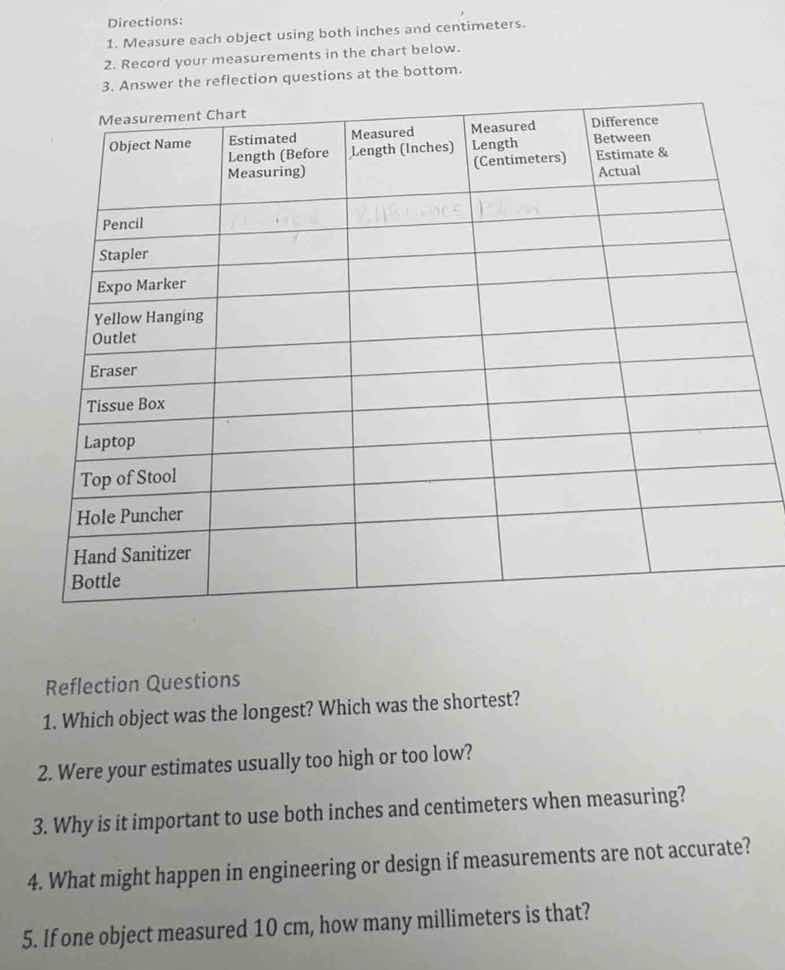
directions: 1. measure each object using both inches and centimeters. 2. record your measurements in the chart below. 3. answer the reflection questions at the bottom. measurement chart object name estimated length (before measuring) measured length (inches) measured length (centimeters) difference between estimate & actual pencil stapler expo marker yellow hanging outlet eraser tissue box laptop top of stool hole puncher hand sanitizer bottle reflection questions 1. which object was the longest? which was the shortest? 2. were your estimates usually too high or too low? 3. why is it important to use both inches and centimeters when measuring? 4. what might happen in engineering or design if measurements are not accurate? 5. if one object measured 10 cm, how many millimeters is that?
Reflection Question 5 Solution:
Step1: Recall unit conversion factor
We know that \( 1 \text{ centimeter (cm)} = 10 \text{ millimeters (mm)} \).
Step2: Apply conversion to 10 cm
To find the number of millimeters in 10 cm, we multiply the length in centimeters by the conversion factor. So, \( 10 \text{ cm} \times 10 \frac{\text{mm}}{\text{cm}} = 100 \text{ mm} \).

Snap & solve any problem in the app
Get step-by-step solutions on Sovi AI
Photo-based solutions with guided steps
Explore more problems and detailed explanations
100 millimeters