QUESTION IMAGE
Question
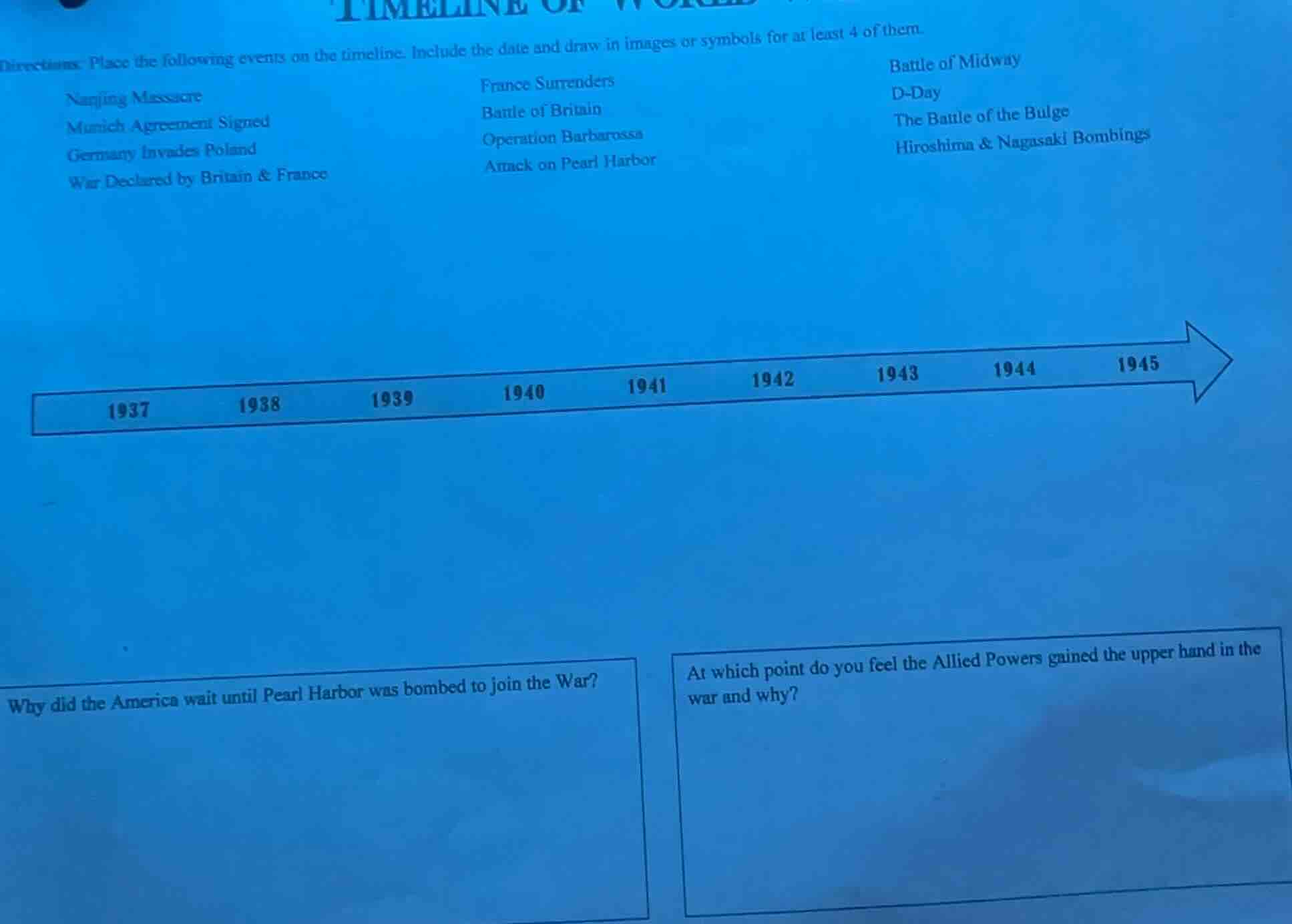
directions: place the following events on the timeline. include the date and draw in images or symbols for at least 4 of them.
nanjing massacre
munich agreement signed
germany invades poland
war declared by britain & france
france surrenders
battle of britain
operation barbarossa
attack on pearl harbor
battle of midway
d - day
the battle of the bulge
hiroshima & nagasaki bombings
timeline from 1937 to 1945 with years 1937, 1938, 1939, 1940, 1941, 1942, 1943, 1944, 1945
why did the america wait until pearl harbor was bombed to join the war?
at which point do you feel the allied powers gained the upper hand in the war and why?
Timeline Placement:
Each event is ordered by its historical date, aligned to the corresponding year on the timeline. Symbols are suggested for 4+ events to meet the requirement.
- 1937: Nanjing Massacre (Symbol: A broken Chinese temple icon)
- 1938: Munich Agreement Signed (Symbol: A signed document icon)
- 1939: Germany Invades Poland; War Declared by Britain & France (Symbol: A tank icon for the invasion)
- 1940: France Surrenders; Battle of Britain (Symbol: A British Spitfire plane icon)
- 1941: Operation Barbarossa; Attack on Pearl Harbor (Symbol: A battleship explosion icon for Pearl Harbor)
- 1942: Battle of Midway
- 1944: D-Day; The Battle of the Bulge
- 1945: Hiroshima & Nagasaki Bombings
"Why did America wait until Pearl Harbor to join the war?":
Before Pearl Harbor, the U.S. had strong isolationist sentiment from its population and government, rooted in avoiding the entanglements of European conflicts after World War I. Additionally, the U.S. was profiting from trade with both Allied and Axis powers, and there was no direct attack on U.S. territory or interests to galvanize public support for entering the war. The surprise attack on Pearl Harbor eliminated isolationist opposition and gave the government a clear, justifiable reason to declare war.
"At which point did the Allied Powers gain the upper hand, and why?":
The Allies gained the upper hand in 1942, with the combined outcomes of the Battle of Stalingrad (Soviet Union repelling Germany's eastern advance, inflicting massive Axis casualties), the Battle of Midway (U.S. destroyed Japan's core carrier fleet, ending Japanese naval dominance in the Pacific), and the Allied invasion of North Africa. These events halted Axis expansion, put Axis forces on the defensive, and allowed the Allies to begin coordinated counteroffensives across all major theaters of war.

Snap & solve any problem in the app
Get step-by-step solutions on Sovi AI
Photo-based solutions with guided steps
Explore more problems and detailed explanations
Timeline (Ordered by Year):
- 1937: Nanjing Massacre
- 1938: Munich Agreement Signed
- 1939: Germany Invades Poland; War Declared by Britain & France
- 1940: France Surrenders; Battle of Britain
- 1941: Operation Barbarossa; Attack on Pearl Harbor
- 1942: Battle of Midway
- 1944: D-Day; The Battle of the Bulge
- 1945: Hiroshima & Nagasaki Bombings
(Recommended symbols: Broken temple for Nanjing Massacre, signed document for Munich Agreement, tank for Poland invasion, Spitfire plane for Battle of Britain, battleship explosion for Pearl Harbor)
Why did America wait until Pearl Harbor to join the war?
The U.S. had widespread isolationist sentiment, seeking to avoid repeating World War I's European entanglements. It also profited from neutral trade with both sides, and there was no direct attack on U.S. interests to unify public support for war. The Pearl Harbor attack ended isolationist opposition and provided a clear, justifiable cause to declare war.
At which point did the Allied Powers gain the upper hand, and why?
The Allies gained the upper hand in 1942. Key victories at the Battle of Stalingrad (halted Germany's eastern advance, caused massive Axis losses), the Battle of Midway (destroyed Japan's critical carrier fleet, ended its Pacific naval dominance), and the North African invasion halted all Axis expansion, forced Axis forces into retreat, and allowed the Allies to launch coordinated counteroffensives across all war theaters.