QUESTION IMAGE
Question
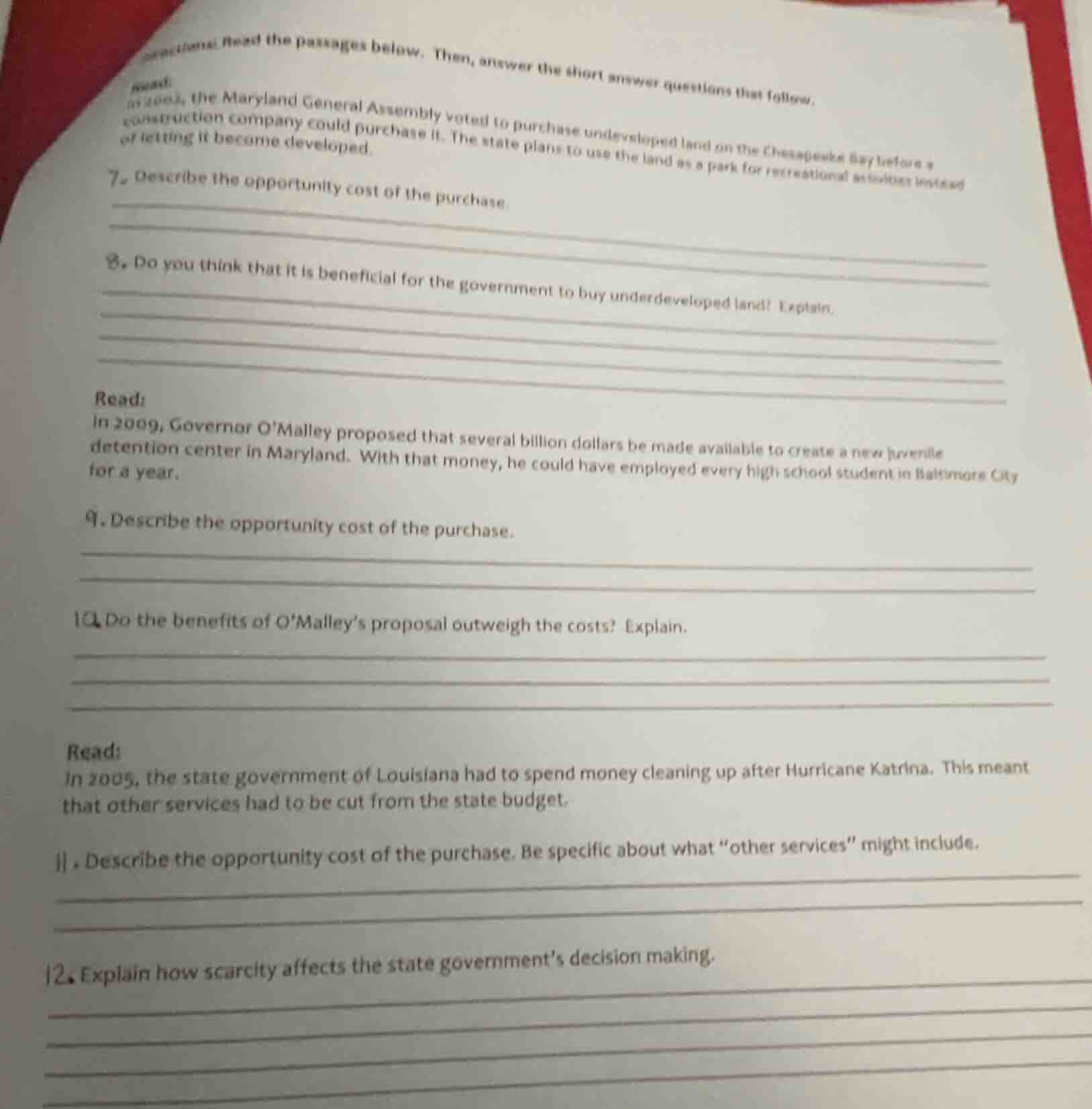
directions: read the passages below. then, answer the short answer questions that follow.read:in 2002, the maryland general assembly voted to purchase undeveloped land on the chesapeake bay before a construction company could purchase it. the state plans to use the land as a park for recreational activities instead of letting it become developed.7. describe the opportunity cost of the purchase.8. do you think that it is beneficial for the government to buy underdeveloped land? explain.read:in 2009, governor omalley proposed that several billion dollars be made available to create a new juvenile detention center in maryland. with that money, he could have employed every high school student in baltimore city for a year.9. describe the opportunity cost of the purchase.10. do the benefits of omalleys proposal outweigh the costs? explain.read:in 2005, the state government of louisiana had to spend money cleaning up after hurricane katrina. this meant that other services had to be cut from the state budget.11. describe the opportunity cost of the purchase. be specific about what \other services\ might include.12. explain how scarcity affects the state governments decision making.
For Question 7:
Opportunity cost is the value of the next best alternative forgone. Here, the state chose to turn the land into a park instead of letting a construction company develop it.
For Question 8:
This depends on weighing trade-offs: the park provides public recreation and environmental protection, but developing the land could bring tax revenue, jobs, and housing. A case can be made for either side based on priorities.
For Question 9:
The opportunity cost is the alternative use of the billions: employing every high school student in Baltimore City for a year, which would have provided income and work experience to those students.
For Question 10:
This depends on priorities: the juvenile detention center could reduce youth crime, but employing students could reduce poverty and unemployment long-term. There is no universal right answer, just a weighing of trade-offs.
For Question 11:
The opportunity cost is the state services that were cut to fund Katrina cleanup. These could include public education funding, road infrastructure repairs, public health services, or affordable housing programs.
For Question 12:
Scarcity means the government has limited funds. When it spent money on Katrina cleanup, it had less for other services, forcing it to choose between competing needs and prioritize the most urgent (cleanup) over other public goods.

Snap & solve any problem in the app
Get step-by-step solutions on Sovi AI
Photo-based solutions with guided steps
Explore more problems and detailed explanations
- The opportunity cost is the potential economic benefits (such as tax revenue, jobs, and developed housing/commercial space) that would have come from letting the construction company purchase and develop the land.
- Example 1 (Beneficial): Yes, it is beneficial. The park provides public recreational space, protects the Chesapeake Bay ecosystem, and offers long-term environmental and quality-of-life benefits that development cannot match.
Example 2 (Not Beneficial): No, it is not beneficial. Developing the land would generate local jobs, property tax revenue for the state, and new housing or businesses that could boost the local economy more directly than a park.
- The opportunity cost is the ability to employ every high school student in Baltimore City for a year, including the income, work experience, and reduced youth unemployment that would have resulted from that alternative use of the funds.
- Example 1 (Benefits Outweigh Costs): Yes, the benefits outweigh the costs. A new juvenile detention center could provide structured rehabilitation, reduce youth recidivism, and improve public safety, which are long-term social benefits that exceed the short-term benefits of employing students.
Example 2 (Costs Outweigh Benefits): No, the costs outweigh the benefits. Employing high school students would reduce poverty, build workforce skills, and decrease youth crime risks proactively, which has more sustainable positive impacts than building a detention center.
- The opportunity cost is the lost access to the state services that were cut, which could include things like K-12 education funding, public road maintenance, state-run healthcare clinics, affordable housing subsidies, or public library operations. These are the alternative goods and services the state could have provided with the funds used for cleanup.
- Scarcity means the Louisiana government had a limited budget. When Hurricane Katrina created an urgent need for cleanup funds, the government had to make trade-offs: it could not fund both cleanup and all its regular services, so it was forced to cut some programs to allocate resources to the most immediate critical need, demonstrating that scarcity requires prioritizing competing public needs.