QUESTION IMAGE
Question
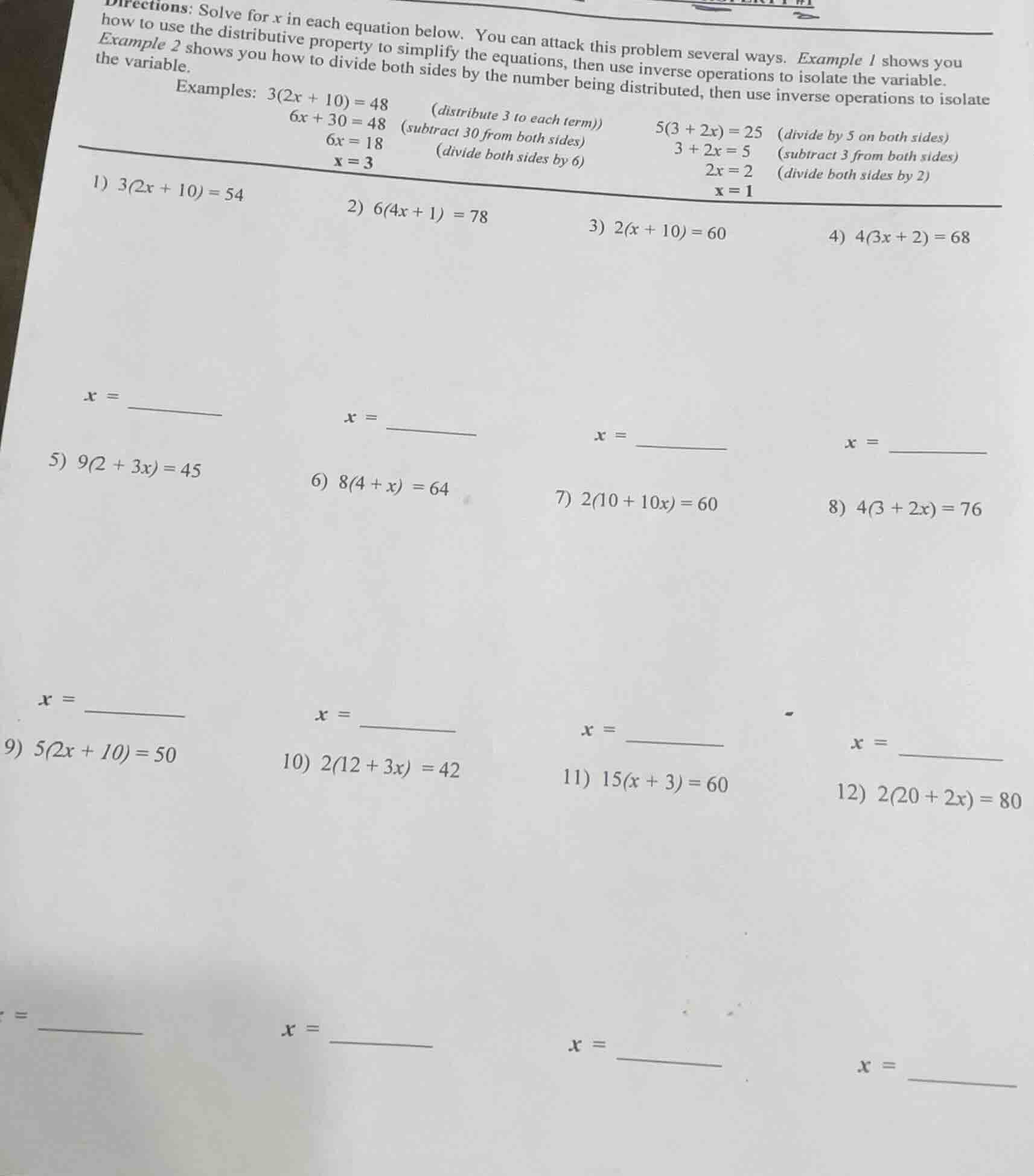
directions: solve for x in each equation below. you can attack this problem several ways. example 1 shows you how to use the distributive property to simplify the equations, then use inverse operations to isolate the variable. example 2 shows you how to divide both sides by the number being distributed, then use inverse operations to isolate the variable. examples: 3(2x + 10) = 48 (distribute 3 to each term)) 6x + 30 = 48 (subtract 30 from both sides) 6x = 18 (divide both sides by 6) x = 3 5(3 + 2x) = 25 (divide by 5 on both sides) 3 + 2x = 5 (subtract 3 from both sides) 2x = 2 (divide both sides by 2) x = 1 1) 3(2x + 10) = 54 x = ____ 2) 6(4x + 1) = 78 x = __ 3) 2(x + 10) = 60 x = __ 4) 4(3x + 2) = 68 x = __ 5) 9(2 + 3x) = 45 x = __ 6) 8(4 + x) = 64 x = __ 7) 2(10 + 10x) = 60 x = __ 8) 4(3 + 2x) = 76 x = __ 9) 5(2x + 10) = 50 x = __ 10) 2(12 + 3x) = 42 x = __ 11) 15(x + 3) = 60 x = __ 12) 2(20 + 2x) = 80 x = ____
Problem 1: \( 3(2x + 10) = 54 \)
Step 1: Divide both sides by 3
\( \frac{3(2x + 10)}{3} = \frac{54}{3} \)
\( 2x + 10 = 18 \)
Step 2: Subtract 10 from both sides
\( 2x + 10 - 10 = 18 - 10 \)
\( 2x = 8 \)
Step 3: Divide both sides by 2
\( \frac{2x}{2} = \frac{8}{2} \)
\( x = 4 \)
Step 1: Divide both sides by 6
\( \frac{6(4x + 1)}{6} = \frac{78}{6} \)
\( 4x + 1 = 13 \)
Step 2: Subtract 1 from both sides
\( 4x + 1 - 1 = 13 - 1 \)
\( 4x = 12 \)
Step 3: Divide both sides by 4
\( \frac{4x}{4} = \frac{12}{4} \)
\( x = 3 \)
Step 1: Divide both sides by 2
\( \frac{2(x + 10)}{2} = \frac{60}{2} \)
\( x + 10 = 30 \)
Step 2: Subtract 10 from both sides
\( x + 10 - 10 = 30 - 10 \)
\( x = 20 \)

Snap & solve any problem in the app
Get step-by-step solutions on Sovi AI
Photo-based solutions with guided steps
Explore more problems and detailed explanations
\( 4 \)