QUESTION IMAGE
Question
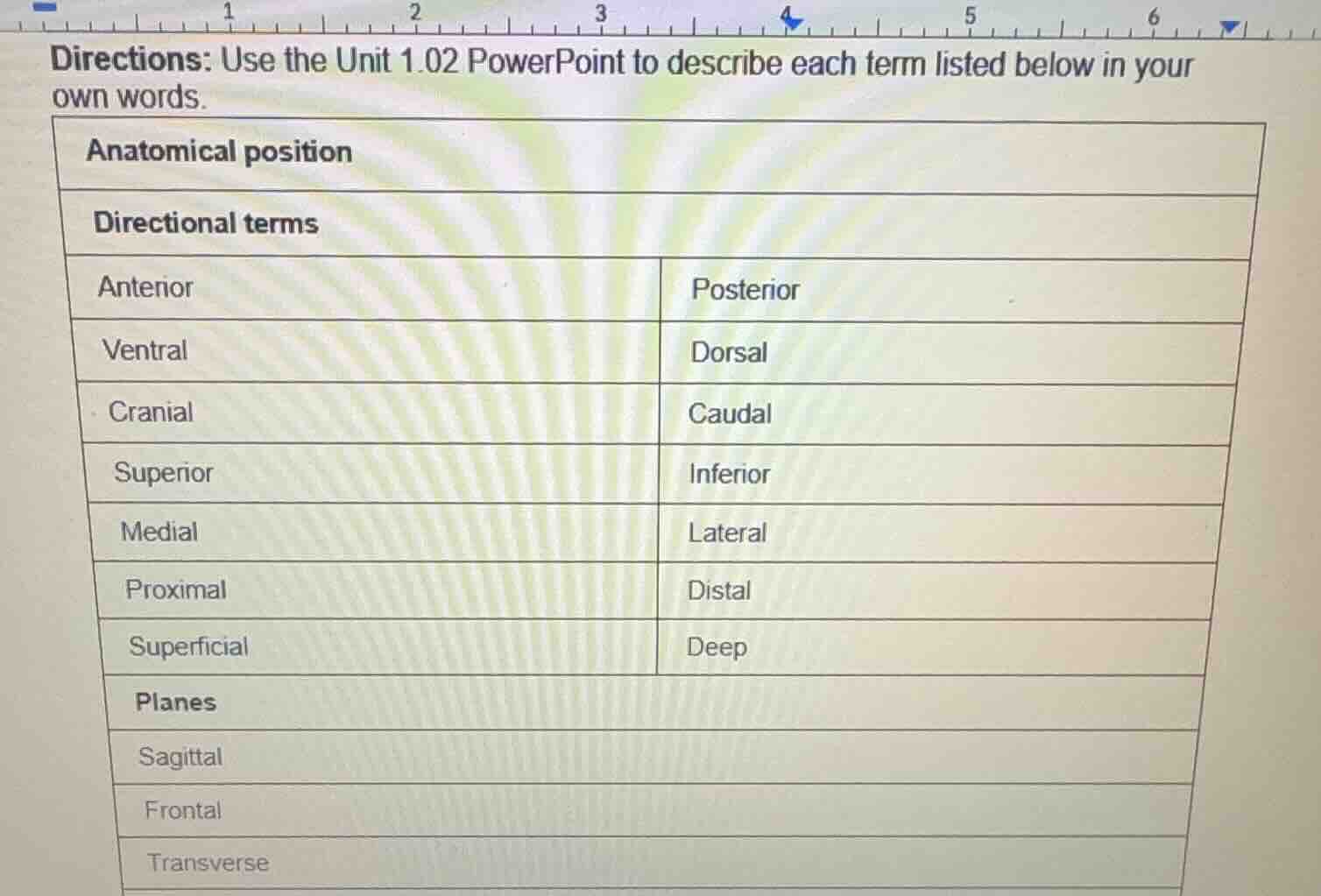
directions: use the unit 1.02 powerpoint to describe each term listed below in your own words. anatomical position directional terms anterior posterior ventral dorsal cranial caudal superior inferior medial lateral proximal distal superficial deep planes sagittal frontal transverse
Brief Explanations
- Anatomical position: The standard body stance used as a reference for anatomical descriptions: standing upright, feet flat, arms at sides, palms facing forward, head and eyes looking straight ahead.
- Directional terms: Standardized words used to describe the location of body parts relative to one another or the anatomical position.
- Anterior: Toward the front of the body.
- Posterior: Toward the back of the body.
- Ventral: Toward the belly side (equivalent to anterior in humans).
- Dorsal: Toward the back/spine side (equivalent to posterior in humans).
- Cranial: Toward the head/skull.
- Caudal: Toward the lower end of the body (tail area in animals, pelvis in humans).
- Superior: Toward the upper part of the body (closer to the head).
- Inferior: Toward the lower part of the body (farther from the head).
- Medial: Toward the midline of the body.
- Lateral: Away from the midline of the body, toward the sides.
- Proximal: Closer to the point where a limb attaches to the torso.
- Distal: Farther from the point where a limb attaches to the torso.
- Superficial: Closer to the surface of the body.
- Deep: Farther from the surface of the body, toward the interior.
- Planes: Flat surfaces that divide the body or organs into sections for anatomical study.
- Sagittal: A vertical plane that divides the body into left and right sections. The midsagittal plane splits the body into equal left/right halves.
- Frontal: A vertical plane that divides the body into anterior (front) and posterior (back) sections.
- Transverse: A horizontal plane that divides the body into superior (upper) and inferior (lower) sections.

Snap & solve any problem in the app
Get step-by-step solutions on Sovi AI
Photo-based solutions with guided steps
Explore more problems and detailed explanations
- Anatomical position: The standard reference body stance: upright, feet flat, arms at sides, palms forward, head/eyes forward.
- Directional terms: Standard words for describing body part locations relative to each other or anatomical position.
- Anterior: Toward the body's front
- Posterior: Toward the body's back
- Ventral: Toward the belly side (human anterior)
- Dorsal: Toward the back/spine side (human posterior)
- Cranial: Toward the head/skull
- Caudal: Toward the body's lower end
- Superior: Toward the body's upper part
- Inferior: Toward the body's lower part
- Medial: Toward the body's midline
- Lateral: Away from the body's midline
- Proximal: Closer to a limb's torso attachment
- Distal: Farther from a limb's torso attachment
- Superficial: Closer to the body's surface
- Deep: Farther from the body's surface
- Planes: Flat surfaces dividing the body/organs for study.
- Sagittal: Vertical plane splitting body into left/right sections
- Frontal: Vertical plane splitting body into front/back sections
- Transverse: Horizontal plane splitting body into upper/lower sections