QUESTION IMAGE
Question
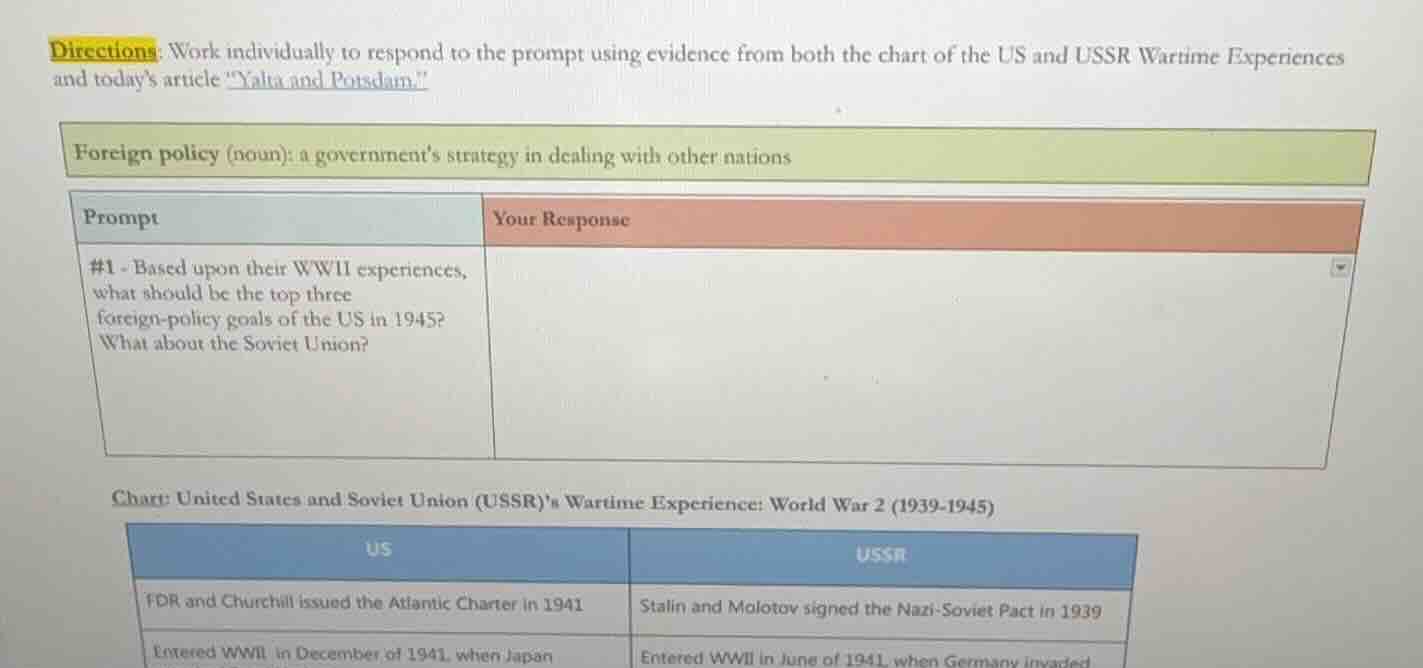
directions: work individually to respond to the prompt using evidence from both the chart of the us and ussr wartime experiences and today’s article “yalta and potsdam.”
foreign policy (noun): a government’s strategy in dealing with other nations
prompt
#1 - based upon their wwii experiences, what should be the top three foreign - policy goals of the us in 1945? what about the soviet union?
your response
chart: united states and soviet union (ussr)’s wartime experience: world war 2 (1939 - 1945)
us
fdr and churchill issued the atlantic charter in 1941
entered wwii in december of 1941, when japan
ussr
stalin and molotov signed the nazi - soviet pact in 1939
entered wwii in june of 1941, when germany invaded
For the US (1945 Foreign Policy Goals):
- Economic Recovery of Allies: The US, post - WWII, had a strong industrial base. To ensure global economic stability (and also to create markets for its goods), helping allies like Western Europe recover economically was crucial. The Marshall Plan later reflected this, but in 1945, the goal of fostering economic recovery in war - torn regions aligned with its interests in preventing economic collapse that could lead to political instability (and potential communist influence).
- Containment of Soviet Influence: The US was increasingly wary of Soviet expansion. The experiences of seeing Soviet influence grow in Eastern Europe (and the ideological differences) led to the goal of containing communism. The US wanted to prevent the spread of Soviet - style communism to other countries, especially in Western Europe and Asia.
- Maintaining Global Naval and Air Superiority: The US had a powerful navy and air force. To protect its interests, trade routes, and to project power globally, maintaining and enhancing its naval and air superiority was a key goal. This would also serve as a deterrent to potential adversaries.
For the Soviet Union (1945 Foreign Policy Goals):
- Securing Western Borders (Buffer Zones): The Soviet Union had suffered massive losses (20 + million people) due to the German invasion. To prevent future invasions from the West, it sought to establish buffer zones in Eastern Europe. Countries like Poland, Czechoslovakia, etc., under Soviet influence, would act as a shield against potential Western aggression.
- Spreading Communist Ideology: The Soviet Union, with a communist ideology, aimed to spread it to other countries. The idea of a socialist bloc was appealing to many war - torn nations, and the Soviets wanted to expand their ideological influence, especially in regions where there was discontent with capitalist systems.
- Economic Reconstruction of the USSR: The Soviet Union's infrastructure was devastated by the war. Rebuilding its economy, including industries, agriculture, and infrastructure, was a top priority. This would also help in projecting power and supporting its ideological goals by showing the success of the communist economic model.

Snap & solve any problem in the app
Get step-by-step solutions on Sovi AI
Photo-based solutions with guided steps
Explore more problems and detailed explanations
US Foreign Policy Goals (1945, top 3):
- Foster economic recovery of war - torn allied and European nations.
- Contain the spread of Soviet - style communism globally.
- Maintain and enhance global naval and air superiority.
Soviet Union Foreign Policy Goals (1945, top 3):
- Establish buffer zones (friendly governments) in Eastern Europe to secure western borders.
- Spread communist ideology to other nations, especially in war - torn regions.
- Reconstruct the Soviet economy (industry, agriculture, infrastructure) devastated by WWII.