QUESTION IMAGE
Question
discussion topic
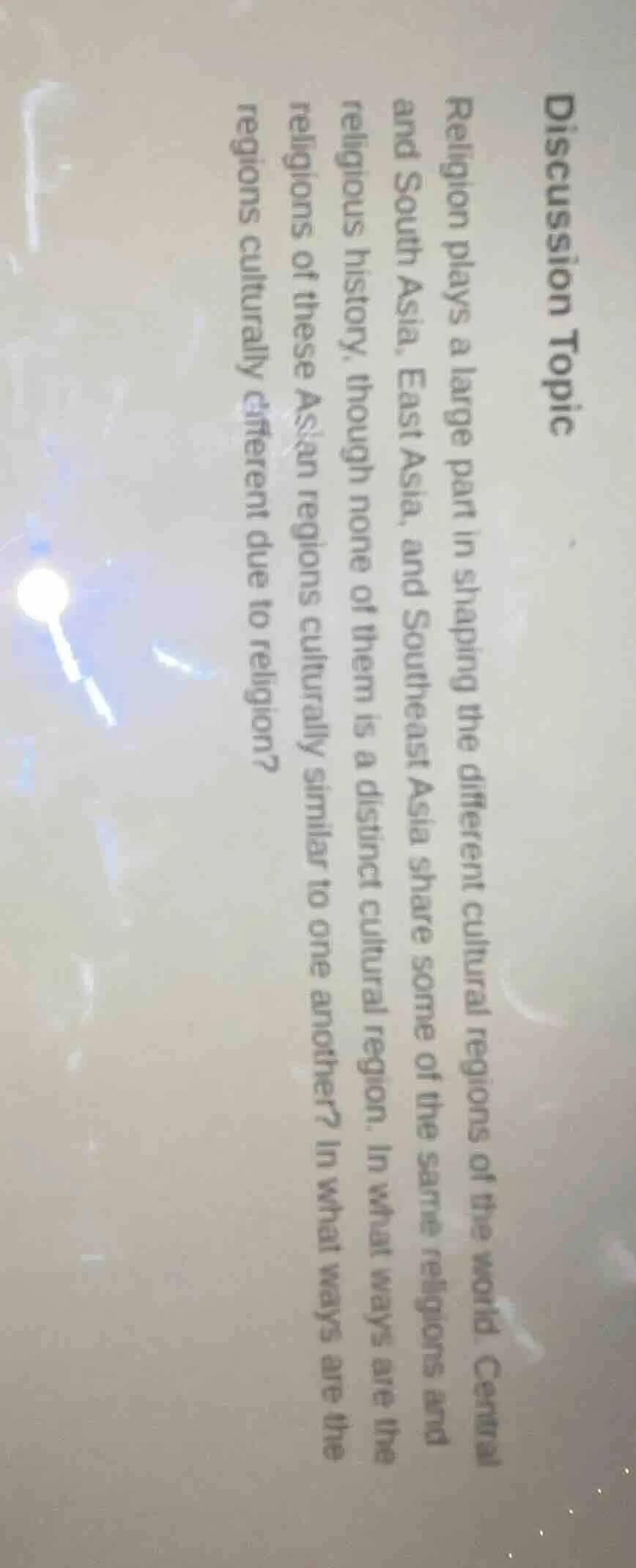
religion plays a large part in shaping the different cultural regions of the world. central and south asia, east asia, and southeast asia share some of the same religions and religious history, though none of them is a distinct cultural region. in what ways are the religions of these asian regions culturally similar to one another? in what ways are the regions culturally different due to religion?
To answer this, we analyze the religious and cultural dynamics of Central, South, East, and Southeast Asia:
Similarities (Shared Religious Influences):
- Hinduism & Buddhism Spread: Hinduism (from South Asia) and Buddhism (originating in South Asia) spread to Southeast and East Asia, shaping art (e.g., temple architecture), ethics (dharma, karma), and social structures (e.g., caste-influenced hierarchies in Southeast Asia, though less rigid than South Asia).
- Confucianism & Its Reach: East Asia (China, Korea, Japan) shares Confucian values (filial piety, social harmony), while Southeast Asia (e.g., Vietnam) also adopted Confucian ethics via Chinese cultural diffusion.
- Islamic Influence: South Asia (India, Pakistan) and Southeast Asia (Malaysia, Indonesia) have significant Muslim populations, with shared Islamic practices (e.g., Ramadan, mosque architecture) and cultural norms (e.g., family values, business ethics).
Differences (Cultural Distinctiveness):
- Religious Syncretism vs. Orthodoxy:
- South Asia: Hinduism’s caste system is deeply ingrained, with a mix of Hindu, Muslim, Sikh, and Buddhist traditions (e.g., India’s multireligious festivals like Diwali, Holi).
- East Asia: Dominated by Confucianism, Taoism, and Shinto (Japan), with less emphasis on caste and more on secular governance (e.g., China’s post-Mao secularization, Japan’s Shinto-Buddhist syncretism).
- Southeast Asia: A “melting pot” of Hindu-Buddhist-Islamic-Christian influences (e.g., Bali’s Hindu traditions, Philippines’ Christianity, Thailand’s Theravada Buddhism), creating unique syncretic practices (e.g., Vietnamese ancestor worship blending Buddhism and Taoism).
- Language & Ethnicity:
- South Asia: Diverse language families (Indo-European, Dravidian) and ethnic groups (Indians, Pakistanis, Sri Lankans) with distinct cultural identities.
- East Asia: Sinicized cultures (Chinese, Korean, Japanese) with shared writing systems (Chinese characters in Japan/Korea historically) and ethnic homogeneity (e.g., Japan’s Yamato people).
- Southeast Asia: Austronesian (Malays, Filipinos) and Austroasiatic (Vietnamese) ethnic groups, with languages like Malay (Indonesia, Malaysia) and Tagalog (Philippines) differing from South/East Asian language families.
- Colonial Legacies:
- South Asia: British colonialism shaped legal systems, education, and class structures (e.g., English as a lingua franca, parliamentary democracy).
- East Asia: Japanese modernization (Meiji era) and Chinese resistance to Western imperialism created unique national identities (e.g., Japan’s “modern traditionalism,” China’s Communist-led cultural revival).
- Southeast Asia: Dutch (Indonesia), French (Vietnam), and Spanish (Philippines) colonialisms introduced Catholicism, French civil law, and plantation economies, differing from South/East Asia’s colonial experiences.
Religious Drivers of Cultural Difference:
- Caste in South Asia: Hinduism’s caste system dictates social roles, limiting mobility (e.g., India’s reservation systems to address caste inequality).
- Confucian Hierarchy in East Asia: Emphasizes vertical social bonds (ruler-subject, parent-child) over horizontal (caste-like) divisions, fostering meritocracy in governance (e.g., China’s imperial exams, modern civil service).
- Animism & Local Beliefs in Southeast Asia: Blended with major religions (e.g., Thai Buddhism incorporating spirit worship, Indonesian Islam with animist rituals), creating region-specific practice…

Snap & solve any problem in the app
Get step-by-step solutions on Sovi AI
Photo-based solutions with guided steps
Explore more problems and detailed explanations
Similarities:
- Shared religious influences (Hinduism, Buddhism, Islam, Confucianism) shape ethics, art, and social norms across regions.
- Cross-regional diffusion of cultural practices (e.g., temple architecture, family values).
Differences:
- Religious expression: South Asia’s caste-based Hinduism vs. East Asia’s Confucian secularism vs. Southeast Asia’s syncretic “mix” of faiths.
- Ethnic-linguistic identity: South Asia’s diversity, East Asia’s Sinicized homogeneity, Southeast Asia’s Austronesian/Austroasiatic roots.
- Colonial and historical paths: British (South Asia), Sinicization (East Asia), and European colonialism (Southeast Asia) created distinct cultural trajectories.
(Note: For a more detailed answer, specific examples (e.g., comparing Indian caste to Vietnamese ancestor worship) can be expanded.)