QUESTION IMAGE
Question
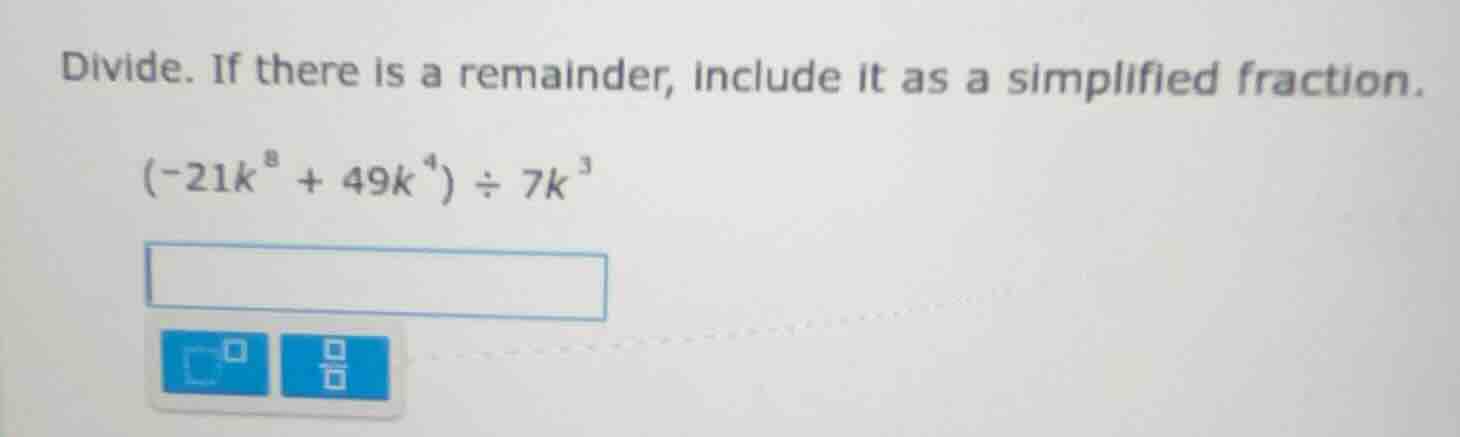
divide. if there is a remainder, include it as a simplified fraction.
$(-21k^{8} + 49k^{4}) \div 7k^{3}$
Step1: Divide each term by \(7k^3\)
We can use the distributive property of division over addition, which states that \((a + b) \div c = a \div c + b \div c\). So we divide \(-21k^8\) and \(49k^4\) by \(7k^3\) separately.
For the first term: \(\frac{-21k^8}{7k^3}\)
We divide the coefficients and use the quotient rule for exponents \(a^m\div a^n=a^{m - n}\). The coefficient \(\frac{-21}{7}=- 3\) and for the exponents of \(k\), \(k^{8-3}=k^5\). So \(\frac{-21k^8}{7k^3}=-3k^5\)
For the second term: \(\frac{49k^4}{7k^3}\)
Divide the coefficients: \(\frac{49}{7} = 7\) and for the exponents of \(k\), \(k^{4-3}=k^1=k\). So \(\frac{49k^4}{7k^3}=7k\)
Step2: Combine the results
Combining the two terms we got from the division, we have \(-3k^5+7k\)

Snap & solve any problem in the app
Get step-by-step solutions on Sovi AI
Photo-based solutions with guided steps
Explore more problems and detailed explanations
\(-3k^5 + 7k\)